Best Property Development Courses in 2026 (Online, UK, Australia, US)
Search "property development courses" and the results split into two piles that don't talk to each other. One pile is the American master's degrees, $60,000 and two years of your life. The other is a marketplace page listing 906 "property development" courses, most of them £15 e-learning modules with a CPD badge and no teacher. Neither is what a working surveyor in Leeds, a site manager in Brisbane, or an agent in Austin who wants to start developing is actually looking for, which is the middle: a course that teaches the development process properly, fits around a job, and means something when it's done.
This guide covers that middle for three markets plus the online options that serve all of them. Every fee, duration, and accreditation below was read from the official course page on August 22, 2026, in the currency the provider quotes, and the "status unclear" notes are real: two well-known UK names changed or vanished this year and most course lists haven't noticed. If what you want is an executive program at a named US school, our separate guide to executive real estate development programs goes deeper on Harvard, MIT, Wharton, and Cornell; if you want a full degree, see our top 10 developer classes. One disclosure: we're a property data company, nobody on this page pays us, and we wrote it because our readers kept asking.
The 2026 comparison table
Fees are as quoted for an individual; "member / non-member" where the provider has two prices. Level is the provider's own label. Where a page didn't state something, the cell says so rather than guessing.
| Course | Region | Level | Format | Duration | Fee (as quoted) | Accreditation | Best for |
|---|---|---|---|---|---|---|---|
| Property Council Academy, Property Development Core | Australia | Short course | Self-paced online (6-week window) or one-day classroom | 1 day | AUD 1,020 member / 1,530 non-member | Academy digital badge | First serious step for anyone in the Australian industry |
| Property Council Academy, Property Development Advanced | Australia | Short course | Three-day classroom, Sydney or Melbourne | 3 days | AUD 2,440 / 3,655 | Academy badge | Risk across the whole development lifecycle, with a board-style case presentation |
| Property Council Academy, Development Feasibility and Project Financing | Australia | Short course | Half day, virtual or in person | Half day | AUD 590 / 860 | Academy badge | The capital stack, fast |
| Property Council Academy, Property Development Industry Diploma | Australia | Industry diploma | Core + Advanced + Expert + written assessment | 7 days of classes plus a 3-month assessment; up to a few years | AUD 5,900 / 8,840 total | Articulates to RMIT Master of Property (credit for one elective) | Practitioners who want the industry credential without a degree |
| UTS Online, Graduate Certificate in Property Development | Australia | Graduate certificate | 100% online, part-time | 8 months minimum | AUD 4,559 per subject × 4 = 18,236 (FEE-HELP eligible) | Not stated on page | Working professionals who want university credit without campus |
| UNSW, Graduate Certificate in Property and Development | Australia | Graduate certificate | Part-time, blended | About 1 year | AUD 19,500 (domestic; not open to international students) | Pathway into the UNSW master's | A taster of the UNSW MPD with a credit-average exit into it |
| UNSW, Master of Property and Development | Australia | Master's | Face-to-face, blended, or online | 1.7 years standard; 1 year accelerated for related honours/master's holders | AUD 59,500 domestic / 76,500 international (2026 indicative totals) | AIB, API, RICS | The flagship Australian development degree |
| RMIT, Master of Property | Australia | Master's | On campus, Melbourne | 2 years full-time / 4 part-time | AUD 35,520 per year domestic / 48,000 international (2027 figures shown) | API, RICS | Valuation-heavy route; accepts 8+ years' experience in lieu of a degree |
| Bond University, Master of Valuation and Property Development | Australia | Master's | On campus, Gold Coast; part-time available | 1 year 4 months (trimesters) | AUD 20,358 per semester; 81,430 total | RICS, API, VRBQ | Fastest full master's; valuation registration pathway in Queensland |
| University of the Built Environment (formerly UCEM), MSc Real Estate | UK | MSc (conversion) | Fully online, part-time | 2 years, 8 modules | £12,000 total (2026/27; £1,500 per module) | RICS | The online RICS-accredited route; Planning and Development is a Year 2 module |
| University of the Built Environment, BSc (Hons) Real Estate Management | UK | Undergraduate | Fully online; part-time, full-time, or apprenticeship | 4.5 years part-time | £28,566 total (2026/27) | RICS; mapped to four APC pathways including planning and development | Career changers without a degree; levy-funded if your employer sponsors an apprenticeship |
| Henley Business School (University of Reading), MSc Spatial Planning and Development | UK | MSc | On campus, full- or part-time | 12 months / 24 months | £10,750 UK full-time; £5,375 part-time; £19,450 international | RTPI and RICS | The most development-focused Reading degree: two core "Development" modules on site planning and process and viability |
| Henley Business School, MSc Real Estate (Flexible) | UK | MSc | Part-time block release, 4 days per module | 24 to 72 months | £2,300 per 20-credit module | RICS | Employed professionals; Real Estate Development is a core module |
| UWE Bristol, Real Estate Investment and Development (distance learning) | UK | University short course / credit-bearing module | Self-study plus live webinars | 12 weekly sessions | £1,876 | RICS | A single accredited module on development economics and appraisal, no degree commitment |
| Distance Learning Centre, Property Development QLS Level 3 | UK | Endorsed certificate (not a regulated qualification) | Paper-based distance learning (online +£36) | About 120 study hours | £318 | QLS endorsed; no RICS | Self-funded beginners who want structure for under £350 |
| uAcademy, Property Development Course | UK | Non-accredited | Online, self-paced | 11 lessons, a few weeks | £99 | None | A weekend's orientation before you spend real money |
| Cornell eCornell, Real Estate Development Certificate | US / online | Professional certificate | 100% online | 4 months, 3 to 7 hours a week | USD 3,900 (or 7 × 608) | 90 professional development hours; 90 BOMI CPD credits | The best-value structured development course for anyone, anywhere |
| Harvard GSD Executive Education, Real Estate Development 101 | US / online | Short course | Live online, 4 × 2 hours | 4 sessions (October 29 to November 4, 2026) | USD 1,990 | Certificate of completion; 1 AMDP elective unit | The name, in eight hours |
| ULI Learning, Introduction to the Real Estate Development Process | US / online | Short course | On-demand video, 180 days' access | 7 hours | USD 395 member / 525 non-member | Counts toward ULI's Real Estate 101 certificate | A practitioner-taught overview from Georgia Tech faculty and a working developer |
| University of Michigan on Coursera, Real Estate Development: Building Value in Your Community | Online | MOOC | Self-paced | About 20 hours | Included in Coursera Plus (USD 24 a month or 160 a year as displayed; promo 14.40 a month until September 23, 2026) | Coursera certificate | Free-ish first course with a real university behind it; 4.9 stars from 55 reviews |
| Columbia University on Coursera, Construction Management Specialization | Online | MOOC specialization | Self-paced | 5 courses, about 110 hours | Included in Coursera Plus | Coursera certificate | The construction side of development; 4.7 stars from 9,804 reviews |
| Oxford Saïd on edX, Fundamentals of Real Estate Investment | Online | MOOC | Self-paced | 4 weeks, 2 to 4 hours a week | Free to audit; USD 189 for the certificate | edX verified certificate | Evaluating development and investment opportunities, with a world brand, for under $200 |
| Rice Business via GetSmarter (also on edX), Real Estate Investment and Development | Online | Executive short course | Instructor-paced online | 8 weeks, 7 to 10 hours a week; starts September 9, 2026 | USD 3,234 on the Rice site (edX page doesn't display a price) | Not stated on page | Development feasibility and equity partners taught together |
| Udemy, The Advanced Real Estate Development Modeling Master Class (Justin Kivel) | Online | Self-paced video | 15 hours of video, 107 lectures | Self-paced | USD 39.99 as displayed; Udemy prices vary by region and sale | None | Excel development pro forma modeling; 4.8 stars from 570 ratings, updated August 2026 |
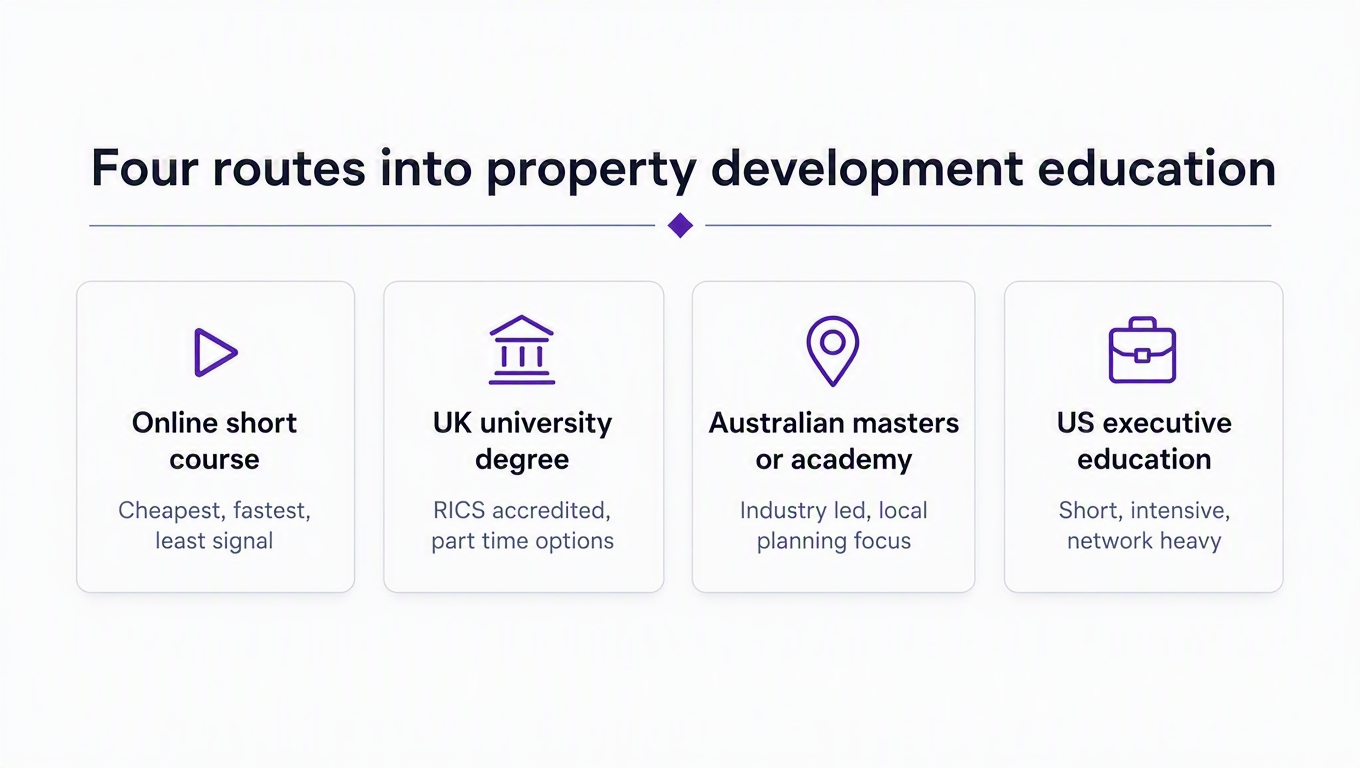
A pattern sits in that table that no list we found states out loud: the same development process is taught at £99, at AUD 1,020, at USD 3,900, and at AUD 76,500, and the syllabus barely changes. Site, planning, feasibility, finance, construction, disposal. What changes is who teaches it, whether a professional body stands behind it, and whether an employer will recognise it. Pay for those three things consciously.
Online courses that work from anywhere
If you're not tied to a local accreditation, the online tier is where the value is, and it runs from free to about $4,000.
Cornell's eCornell Real Estate Development Certificate ($3,900, four months, seven two-week courses at three to seven hours a week, rolling starts through June 2027) is the one we'd recommend first to almost anyone. It walks the full development package: introduction to commercial development, managing development projects, site selection analysis, creating the development package, preparing and delivering the project pitch, basis of design, and resiliency. You finish with 90 professional development hours and a certificate from the SC Johnson College of Business. At about $43 an hour it's the cheapest credible structured course on this page. Cornell's sibling Commercial Real Estate Certificate (also $3,900, three months) shares the two development courses and adds investment, financing, property management, and asset management.
Harvard GSD's Real Estate Development 101 ($1,990; four live two-hour sessions on October 29, 30, November 3, and 4, 2026) is the name-brand option. Eight hours on opportunity identification, feasibility, budgets and schedules, entitlements, entity structure, debt and equity, and construction management, taught live. It's roughly $249 per contact hour, which is the Harvard premium in one number; you're buying the line on your CV and a live cohort, not depth.
ULI Learning sits between the two on price and is taught by practitioners: Introduction to the Real Estate Development Process (seven hours; $395 for members, $525 otherwise) is taught by Georgia Tech's Baabak Ashuri with developer Brian Cullen, and the shorter Foundations of the Development Process (2.5 hours; $295 / $395) is part of ULI's 20-hour Foundations of Real Estate certificate ($1,175 / $1,580, with 50% off for students). On-demand, start any time, 180 or 450 days of access.
The MOOC platforms are better than their reputation here. The University of Michigan's Real Estate Development: Building Value in Your Community is about 20 hours across general principles, idea and approach, feasibility and due diligence, financing, and financial modeling, and Columbia's five-course Construction Management specialization (about 110 hours) covers the build side better than most development courses do. Both are included in Coursera Plus, which displayed at $24 a month or $160 a year when we checked (with a $14.40-a-month promotion running until September 23, 2026; Coursera prices vary by country). On edX, Oxford Saïd's Fundamentals of Real Estate Investment is free to audit and $189 for the certificate, four weeks at two to four hours, and explicitly covers evaluating development opportunities. Rice Business's eight-week Real Estate Investment and Development (starts September 9, 2026) lists at $3,234 on Rice's own site and is one of the few online courses that teaches development feasibility and equity partnerships in the same syllabus.
Then there's Udemy, which is fine for exactly one thing: modeling. Justin Kivel's Advanced Real Estate Development Modeling Master Class (15 hours of video, 4.8 stars from 570 ratings, updated this month, $39.99 when we looked) will teach you to build a development pro forma in Excel better than most degree modules will. It won't teach you planning law, and it doesn't pretend to.
United Kingdom
The UK market is organised around one word: RICS. If you want to become a chartered surveyor, or work for people who care whether you could, accreditation is the filter, and it eliminates most of what ranks for "property development course UK." Here's a candid, widely watched overview of the UK route from someone who's done it:
University of the Built Environment is the name you may not recognise: UCEM, the online estate-management college, became the University of the Built Environment in June 2025, and old ucem.ac.uk links redirect. Its MSc Real Estate is the fully online, RICS-accredited conversion master's: two years part-time, eight modules, £12,000 total for 2026/27, with Planning and Development, Applied Valuation, and Investment Appraisal in the syllabus. Intakes are 28 September 2026 (the application deadline was extended to 24 August) and 29 March 2027 (deadline 22 February). It accepts a 2:2, or a Level 5 qualification plus five years' experience, which makes it the realistic route for people already in the industry without a degree. The BSc (Hons) Real Estate Management (£28,566, 4.5 years part-time, RICS-accredited and mapped to four APC pathways including planning and development) is also available as a levy-funded apprenticeship if your employer will sponsor it; UBE says it's the largest university provider of chartered surveyor apprenticeships.
Henley Business School at the University of Reading is the campus option, and the course to look at for development specifically is not the famous MSc Real Estate but the MSc Spatial Planning and Development: accredited by both RTPI and RICS, with two core development modules (sustainable urban design and site planning; process and viability) alongside real estate economics and planning law. It's £10,750 full-time or £5,375 a year part-time for UK students, £19,450 international, starting September 2026, and takes a good second-class degree in any discipline. The MSc Real Estate (£21,200 UK / £29,150 international) offers Development only as an elective. For people in work, the MSc Real Estate (Flexible) runs as four-day block-release modules at £2,300 each over two to six years, with Real Estate Development as a core module.
UWE Bristol offers something rare: a single RICS-accredited, credit-bearing module you can take without enrolling in a degree. Real Estate Investment and Development is twelve weekly live webinars plus self-study for £1,876, covering the development and planning process, land valuation and appraisal, development economics, and UK fiscal instruments, and it counts toward UWE's postgraduate real estate awards if you continue. The last cohort started in January 2026; the next date wasn't posted when we checked.
Two cautions. University of Westminster's MSc Real Estate Development appears on every aggregator, but on August 22, 2026 its 2026/27 course page returned an access error and the course wasn't in Westminster's live postgraduate listings for 2026 or 2027 entry (only the BSc Real Estate was). The fees circulating online (£14,700 UK) are from third-party sites. Check with the university before you plan around it. And the £15 to £20 "Level 3 Property Development" courses that fill the Reed marketplace are CPD-badged e-learning, not qualifications; if you want cheap structure, the Distance Learning Centre's QLS-endorsed Level 3 (£318, about 120 hours, 21 units from planning to buying at auction) or uAcademy's £99 eleven-lesson course are at least honest about what they are.
Australia
Australia has the most complete ladder of the three markets: an industry body that teaches, online graduate certificates, and three accredited master's degrees with different personalities.
Property Council Academy is where most Australian developers start, and the course names changed recently, so ignore anything that calls them "Principles to Practice." The current ladder is Property Development Core (one day; AUD 1,020 for members, 1,530 for non-members; self-paced online in six-week windows running from 24 August 2026 through May 2027, or a classroom day), Property Development Advanced (three days in Sydney or Melbourne, AUD 2,440 / 3,655; next runs 9 to 11 March 2027 in Sydney, 25 to 27 May in Melbourne, 3 to 5 August in Sydney; day one is opportunity risk, day two delivery risk, day three finance and legal with a board-style case presentation), and a half-day Development Feasibility and Project Financing (AUD 590 / 860; 22 September 2026 virtual, 24 November in Melbourne, then March and May 2027). Stack Core, Advanced, Expert, and a written assessment and you have the Property Development Industry Diploma (AUD 5,900 members / 8,840 non-members), which RMIT recognises for credit toward one elective in its Master of Property. Note that search snippets still show older Core prices of AUD 570 / 830; the live page says 1,020 / 1,530.
UTS Online's Graduate Certificate in Property Development is the fully online university option: four subjects (Development Feasibility and Modelling, Property Transactions, Construction Technology and Regulation, Property Development Process) at AUD 4,559 each, AUD 18,236 total, FEE-HELP eligible, eight months minimum, six intakes a year. It takes an Australian bachelor's or five years' full-time relevant experience, including trades and licensed real estate, which is a wider door than most universities open. Accreditation isn't stated on the page, so ask if that matters to you.
At master's level, UNSW's Master of Property and Development is the flagship: 1.7 years standard (one year accelerated if you already hold a related honours or master's), delivered face-to-face, blended, or online, accredited by the AIB, the API, and RICS, and priced at an indicative AUD 59,500 total for domestic students and 76,500 international for 2026. The syllabus is development and feasibility analysis, valuation, investment and finance, performance analysis, property law, and asset and facilities management. Its part-time Graduate Certificate in Property and Development (AUD 19,500, domestic only) is four courses from the same list and an exit-with-credit route into the full degree. RMIT's Master of Property (AUD 35,520 a year domestic, 48,000 international, as displayed for 2027; two years full-time or four part-time; API and RICS) leans toward valuation and accepts eight or more years of professional experience instead of a degree. Bond University's Master of Valuation and Property Development is the fast one: one year and four months on Bond's trimester model, AUD 20,358 a semester and 81,430 total (Bond charges the same full fee to everyone), with RICS, API, and Valuers Registration Board of Queensland accreditation and intakes in September 2026, January 2027, and May 2027.
United States
The US is where the search results are already thick, so we'll be brief and point you to the detailed guides. For short and online: Cornell eCornell, Harvard GSD, and ULI, all covered above. For executive programs, from Harvard's one-year AMDP ($52,000) down to CREDA's $345 Advanced Development Practices course (NAIOP became CREDA in July 2026), see our executive programs comparison. For degrees (MIT, Columbia, USC, Berkeley) and trade-body certificates (CCIM, NAIOP/CREDA), see the top 10 list. The practical US-specific note is that "property development" isn't the phrase American programs use; search "real estate development" and the catalogue triples.
How to choose
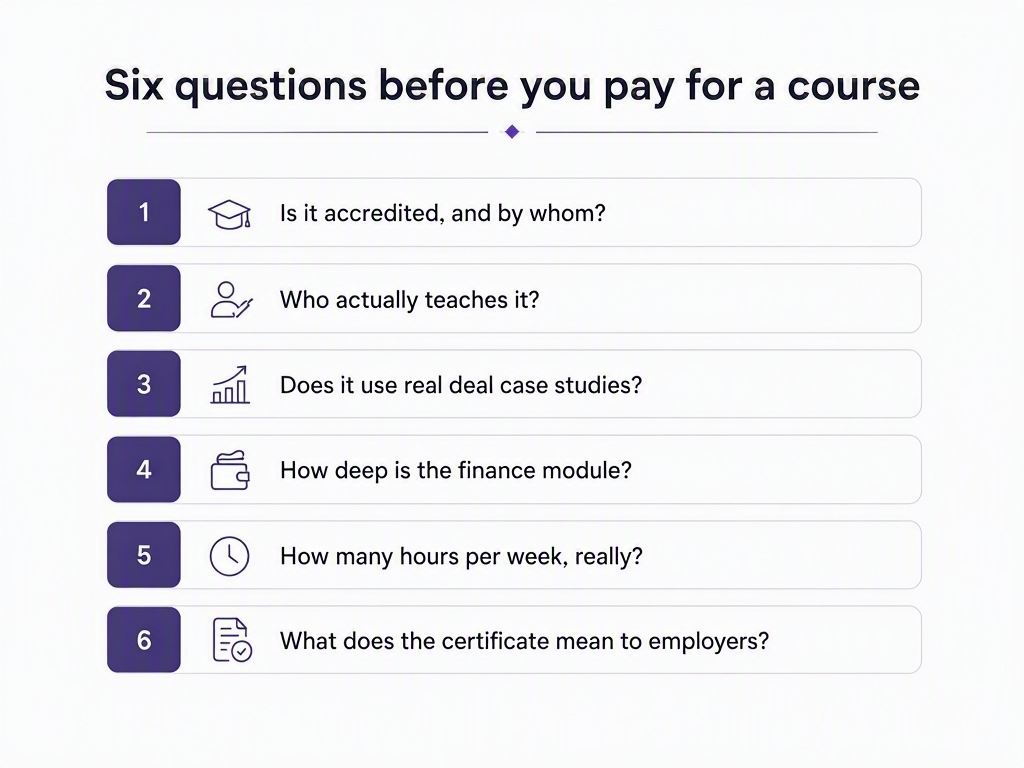
Is it accredited, and by whom? RICS in the UK (and increasingly Australia), API and AIB in Australia, nothing equivalent for US short courses. If your career needs chartered status, this question ends the search before price does.
Who actually teaches it? Named faculty and practitioners (Ashuri and Cullen at ULI, Wellstead at Cornell, Property Council's industry instructors) versus "our expert team." The £15 courses don't have a teacher; that's why they're £15.
Does it use real deal case studies? Property Council Advanced ends in a case presentation to a mock board. Cornell ends in a project pitch. Harvard's is lecture. Development is learned by defending assumptions, and the format tells you whether you'll have to.
How deep is the finance module? A development course that stops at "debt and equity" without building a waterfall or a sensitivity table leaves you unable to answer a lender. If the syllabus doesn't mention feasibility modeling, pair it with the Udemy modeling course or UWE's appraisal module.
How many hours a week, really? Providers publish a range (Cornell says three to seven; Rice says seven to ten). Plan for the top of it. Yeah… nobody finishes on the bottom number.
What does the certificate mean to employers? Ask one. A hiring manager at a UK consultancy will know UBE and Reading and will not know uAcademy; a Sydney developer will know the Property Council diploma. A certificate is a signal, and signals only work on people who can read them.
The module none of these courses includes
Every syllabus above teaches market analysis, feasibility, and comparable sales. None of them teaches where the data for those comes from, or how to pull it for a specific site in an afternoon instead of commissioning a report. The developer who can check asking prices, recent sales, and rents for a postcode before the feasibility meeting has an edge that the course fee doesn't buy.
That part you can do today, in any of the three markets. Our ARV calculator and rental property calculator handle the back-of-envelope numbers every course spends its first week on. For live inputs, RealtyAPI returns structured listing, sold-price, and rent data from Rightmove and Zoopla in the UK, Domain in Australia, and Redfin and Realtor in the US, and our guides to market analysis and running a CMA from an API show the workflow. Bring a real feasibility to class and you'll be the student the instructor remembers.
Key takeaways
Different phrasing, different market. "Property development course" is UK and Australian English; the US catalogue lives under "real estate development." Search both or you'll miss half the options.
Accreditation is the first filter in the UK and Australia. RICS (UBE, Reading, UWE, UNSW, RMIT, Bond) and API/AIB (UNSW, RMIT, Bond) separate qualifications from e-learning. None of the sub-£350 UK courses carry either.
The best value structured course is online and American. Cornell's $3,900 four-month development certificate teaches the full development package for about $43 a contact hour and works from anywhere.
In Australia, start with the Property Council. Core at AUD 1,020 (members) is one day, the Advanced three-day course adds a board-style case, and the full Industry Diploma earns credit toward RMIT's master's.
Two UK names changed this year. UCEM is now the University of the Built Environment (fees and accreditation unchanged), and Westminster's MSc Real Estate Development wasn't listed for 2026 entry when we checked. Verify before you apply.
Pick one course from the table, then spend an hour before it starts pulling live comps and rents for a site you know through the free plan (250 requests a month, no card). Run the numbers through the calculators. You'll walk into the first session already doing the thing the course is about to teach.