Best Executive Real Estate Development Programs for Investors & Developers (2026)
The honest problem with every "best executive real estate programs" list we read while researching this one is that none of them print a price. Seventeen programs from Wharton to Oxford, ranked, with glowing paragraphs, and not a single tuition figure. That's not a ranking; it's a brochure rack. So this guide does the boring thing: every executive real estate development program below has its format, duration, tuition, and who it's actually for, read from the official program page on August 22, 2026, with the dates and deadlines that are live for late 2026 and 2027. Prices move and cohorts fill, so treat the numbers as a snapshot and the comparison as the durable part.
"Executive" is also doing quiet work in that search phrase. We take it to mean non-degree programs for people already working: short online courses, professional certificates, week-long campus intensives, and the year-long leadership programs. If you want a master's (MIT MSRED, Columbia, USC Price, Berkeley), our top 10 real estate developer classes covers the degree route. One disclosure before the list: we sell property data, not diplomas, and nobody on this page pays us. We wrote it because a lot of you searched for it and landed on the wrong post.
Investor or developer: decide this first
The single most useful filter is one the rankings skip. Investor programs teach you to price risk someone else built; developer programs teach you to create it. They overlap on finance, and both will show you a pro forma, but the second half of each syllabus goes in opposite directions: investors toward capital structures, portfolio allocation, and REIT and fund mechanics; developers toward entitlements, site control, design and construction management, and schedule risk. A developer who takes Wharton's four-day commercial real estate investment program will learn a great deal and still not know how to run an approvals process. An investor who takes Harvard's Real Estate Development 101 will spend two of four sessions on feasibility and entitlements they'll never personally manage.
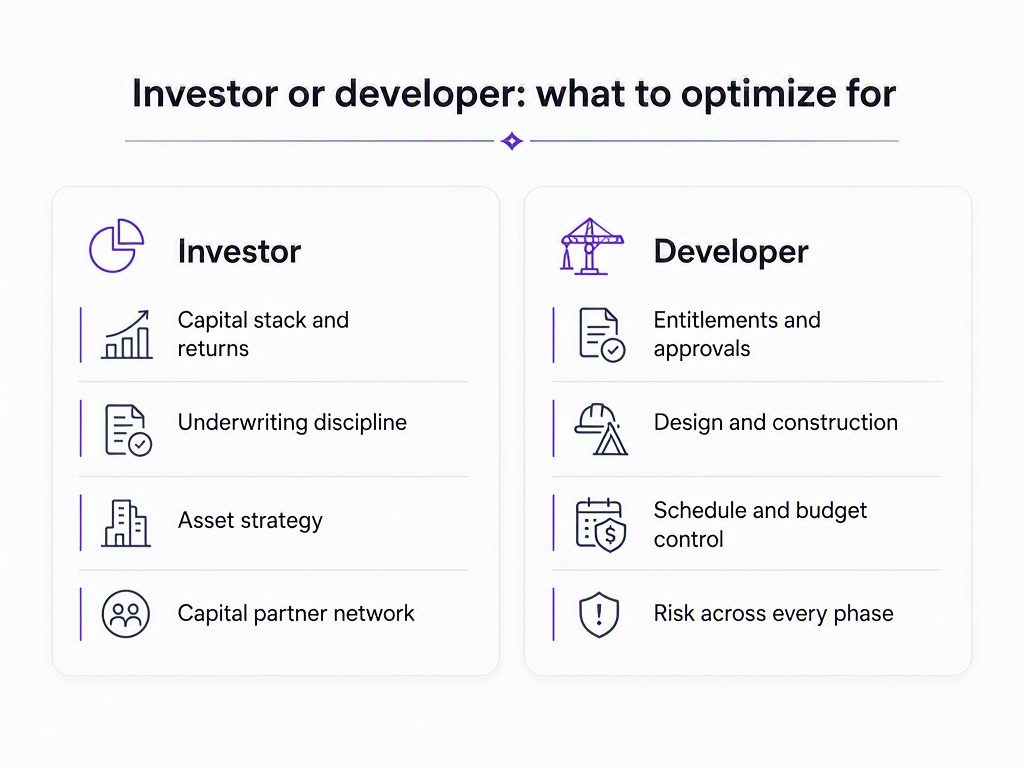
A few programs genuinely serve both, and they're the expensive ones, because "both" means a six-day or one-year format with room for everything. We've tagged each program below as Developer, Investor, or Both. If you're a developer raising capital, or an investor who keeps getting pitched development deals, pick from the Both tier or pair one short course from each track. That's usually cheaper than one flagship.
The 2026 comparison table
Tuition is the listed price for an individual; where a member and non-member price exist, both are shown. "Hours" is the contact time stated on the program page (or its CEU equivalent); where a program only lists days, we've left the per-hour column blank rather than guess.
| Program | Format | Duration | Tuition (USD) | Approx. cost per contact hour | Fit | Next cohort / deadline |
|---|---|---|---|---|---|---|
| Harvard GSD, Advanced Management Development Program in Real Estate (AMDP) | One year; 5 weeks on campus across 3 terms plus remote team and independent projects | 12 months | $52,000 | n/a | Both (senior) | Class 28 application opens late September 2026 |
| Harvard GSD + HBS, Real Estate Management Program | In person, residential (fee includes accommodation and most meals) | 6 days plus 12 to 15 hours of pre-work | $16,000 | n/a | Both | January 10 to 15, 2027; apply by January 4, 2027 |
| MIT Sloan + MIT CRE, Shaping the Future of Real Estate | In person, MIT campus | 6 days | $12,500 | n/a | Both (strategy and technology) | November 8 to 13, 2026 |
| Wharton Executive Education, Assessing Commercial Real Estate Investments and Markets | In person, Philadelphia | 4 days | $10,750 | n/a | Investor | December 8 to 11, 2026 |
| MIT CRE + Maastricht, Global Real Estate Leaders Program | 4 one-week modules over two years (Boston and Maastricht) | 4 weeks over 2 years | $10,000 per module (20% off for alumni and PREA, CREW, NAREIT, ULI members) | n/a | Both (10+ years' experience) | September 20 to 25, 2026 (Boston); April 4 to 9, 2027 (Maastricht) |
| Columbia Business School, Real Estate Investing (in person) | In person, 3 consecutive days | 3 days | $8,400 | n/a | Investor (includes a development session) | October 20 to 22, 2026; May 19 to 21, 2027 |
| USC Lusk Center, Ross Program in Real Estate | Online or in person; cohort capped at 25 | 4 weeks, roughly 3 full days a week | $6,000 (in-person sessions; remote fee not stated) | n/a | Developer (finance-heavy, capstone development project) | September 10 to October 2, 2026, remote; fall deadline was August 14 |
| Wharton Online + Wall Street Prep, Real Estate Investing and Analysis Certificate | Online, self-paced with weekly live office hours | 8 weeks, about 80 hours | $4,800 (or 5 × $960); $200 off before September 8, 2026 | $60 | Investor (one development module) | October 5 to December 6, 2026 |
| NYU SPS Schack, Certificate in Development and Land Use | Online (some courses also onsite in Midtown Manhattan) | 6 courses within 3 years | Est. $4,788 total at 2024–25 prices; e.g. The Real Estate Development Process is $840 | $42 (Development Process course, 2 CEUs) | Developer | Fall 2026 sections from September 14; self-paced online from October 27 |
| Cornell eCornell, Real Estate Development Certificate | Online, 100% | 4 months; 7 two-week courses; 3 to 7 hours a week | $3,900 (or 7 × $608) | $43 (90 professional development hours) | Developer | September 16, October 14, November 11, December 9, 2026; January 6, 2027 |
| Rice Business (via GetSmarter), Real Estate Investment and Development | Online | 8 weeks, 7 to 10 hours a week | $3,234 | $40 to $58 | Both | September 9, 2026 |
| Columbia Business School (via Emeritus), Real Estate Investing Strategies | Online | 6 weeks, 4 to 6 hours a week | $2,650 | $74 to $110 | Investor | September 23 to November 11, 2026 |
| Harvard GSD, Real Estate Development Fundamentals | In person, Harvard campus | 2 days (14 AIA learning units) | $2,150 (10% off with joint registration) | $154 | Developer | June 9 to 10, 2026 has passed; no 2027 date posted yet |
| CREDA (formerly NAIOP), Certificate of Advanced Study in Commercial Real Estate Development | Online, on demand; 4 courses | 24 to 32 hours within 2 years | $1,671 members / $2,646 non-members (including application fee) | $52 to $110 | Developer | Start any time |
| MIT SA+P (via GetSmarter), Real Estate Financial Analytics | Online | 6 weeks, 7 to 8 hours a week | $1,960 | $41 to $47 | Investor (quantitative) | October 21, 2026 |
| Harvard GSD, Real Estate Development 101 (online) | Online, live sessions | 4 sessions × 2 hours | $1,990 (10% off with joint registration) | $249 | Developer (beginner) | October 29, 30, November 3, 4, 2026 |
| Harvard GSD, Real Estate Finance 101 (online) | Online, live sessions | 4 sessions × 2 hours | $1,990 | $249 | Investor (beginner) | November 13, 16, 17, 18, 2026 |
| ULI Learning, Foundations of Real Estate certificate | Online, on demand; 5 courses | 20 hours; 450 days' access | $1,175 members / $1,580 non-members | $59 to $79 | Both (foundations) | Start any time |
| ULI Learning, Introduction to the Real Estate Development Process | Online, on demand | 7 hours; 180 days' access | $395 members / $525 non-members | $56 to $75 | Developer (beginner) | Start any time |
| CREDA, Advanced Development Practices course | Online, on demand; 8 modules | 16 hours | $345 members / $555 non-members | $22 to $35 | Developer | Start any time |
The per-hour column is the one the brochures would rather you didn't compute. Harvard's two online 101 courses cost about $249 per contact hour; eCornell's development certificate and NYU Schack's individual courses cost about $42. That's a six-fold spread for material that, at the fundamentals level, overlaps heavily. You're not paying for the syllabus; you're paying for the name on the certificate and the people in the Zoom. Sometimes that's exactly right. Just know it's what you're buying.
How the tiers work
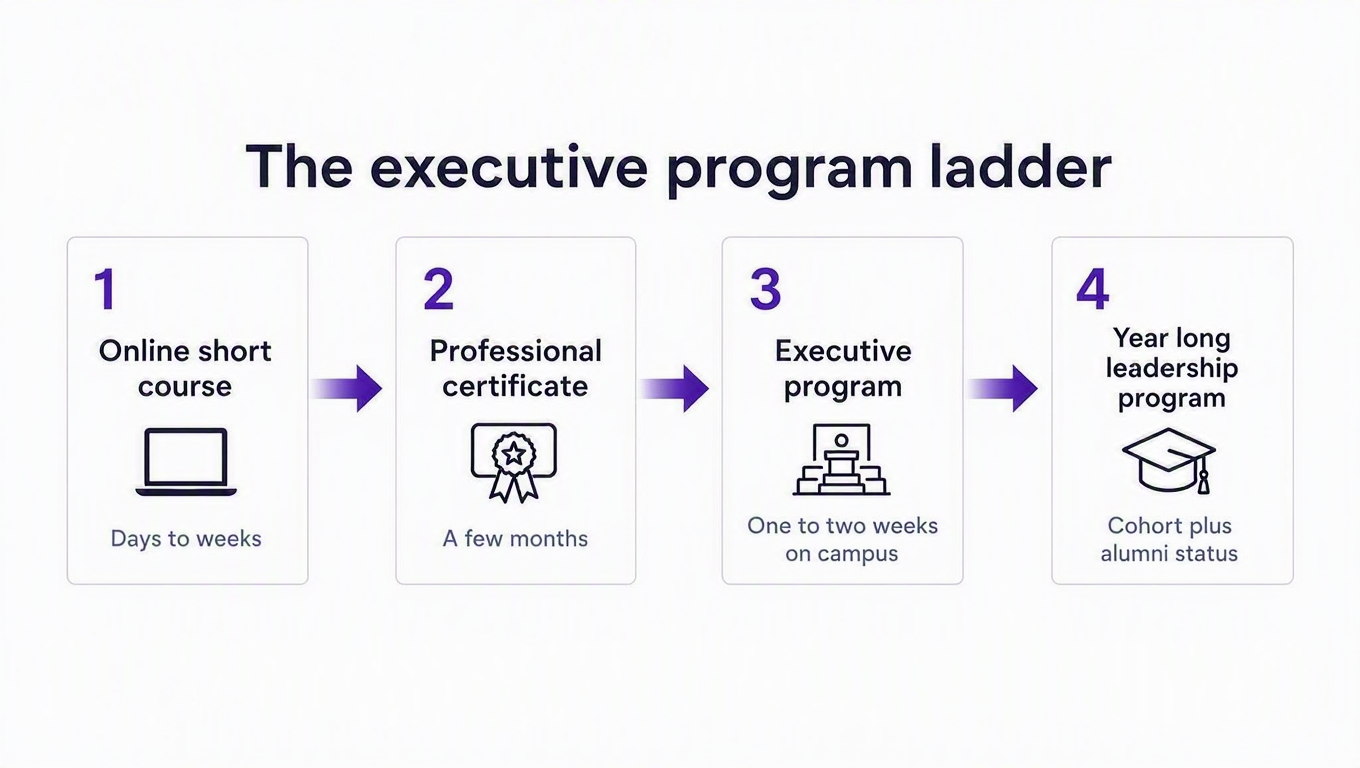
Tier 1: year-long leadership programs
Harvard GSD's AMDP is the only one of its kind on this list: twelve months, five weeks on campus across three terms (Term 1 ran July 6 to 16, 2026; Terms 2 and 3 fall in March and July 2027), remote team and independent projects in between, taught by the case method across leadership, development, finance, planning and design, technology, and strategy. Tuition is $52,000, and graduates become Harvard Alumni Association associate members, which is the part most applicants are quietly paying for. The page asks for "many years" of real estate experience in leadership roles, and the Class 27 application has closed; Class 28 opens in late September 2026. If you run a development company or a fund and want a peer cohort of people who do the same, this is the program. If you're three years into an analyst seat, it isn't, and admissions will say so.
Here's Harvard's own short explainer of what the program is built on:

The Global Real Estate Leaders Program (MIT CRE with Maastricht University) is the closest alternative: four one-week modules over two years, alternating Boston and Maastricht, at $10,000 a module with 20% off for alumni and members of PREA, CREW, NAREIT, or ULI. It asks for ten or more years of experience and awards a professional diploma after all four modules. It's the pick for someone whose deals cross borders; AMDP is the pick for someone whose career is in the US.
Tier 2: the week on campus
Four programs sell the same basic product: a few days in a room with senior faculty and fifty peers, at $2,000 to $3,000 a day.
Harvard GSD + HBS Real Estate Management Program (January 10 to 15, 2027; $16,000; apply by January 4). Six days, residential, and the fee covers accommodation and most meals, which matters when you compare it with the others. Curriculum spans sector opportunities, climate-aware design, financing and capital markets, data analytics and generative AI, and organizational structure. The joint GSD and HBS faculty is the draw. It's the most genuinely "Both" program on this list.
MIT Sloan Shaping the Future of Real Estate (November 8 to 13, 2026; $12,500). Six days on the human, digital, and physical future of the asset class: technology adoption, digital twins, workplace policy, portfolio operations, change management. This is a strategy program for senior executives, not a development how-to. If your job is deciding what your firm does about AI and data, it's the right room; if your job is getting a site entitled, it's the wrong one.
Wharton Assessing Commercial Real Estate Investments and Markets (December 8 to 11, 2026; $10,750). Four days aimed squarely at institutional investors, CIOs, family offices, and their advisors: cycles and risk, cash flow and cap rates, liquidity and capital structures, REITs and private equity, portfolio allocation, inflation hedging. Pure investor track; there's no development content to speak of.
Columbia Business School Real Estate Investing (October 20 to 22, 2026 and May 19 to 21, 2027; $8,400). Three days, and the cheapest of the four per day. Fundamentals and valuation, investment transactions, and a block on development, housing, and data centers. It earns three credits toward Columbia's Certificate in Business Excellence, which is the upsell.
The question to ask yourself about this tier: will I use the people? These programs are network products with a curriculum attached. If you'll follow up with the cohort, the price is defensible. If you'll take notes and go home, the online certificates below cover most of the same ground at a tenth of the cost. Ask me how I know.
Tier 3: professional certificates (the working developer's tier)
This is where most readers should actually shop, and it's the tier the rankings ignore because none of these schools buys ads.
Cornell eCornell Real Estate Development Certificate ($3,900 or seven payments of $608; four months, seven two-week courses, three to seven hours a week). One hundred percent online, with monthly starts through early 2027. The seven courses walk the development package end to end: introduction to commercial development, managing development projects, site selection, the development package, the project pitch, basis of design, and resiliency. Ninety professional development hours and a certificate from the SC Johnson College of Business. At about $43 an hour it's the best value on the developer track, and it's the one we'd point a working analyst or broker to first.
NYU SPS Schack Certificate in Development and Land Use (estimated $4,788 total at 2024–25 prices; two required courses plus four electives within three years). The required pair is The Real Estate Development Process ($840, two CEUs, six Monday evenings in Midtown from September 14 or self-paced online from October 27) and Navigating Zoning, Land Use, and Development Planning. Electives include market analysis and feasibility, financing development projects, multifamily and hotel development, construction essentials, the NYC building code, and affordable housing. The New York specificity is the feature: if you build in the five boroughs, nothing else on this list teaches you the building code. Schack also runs a Certificate in Real Estate Investment (estimated $5,067 to $5,262) for the other track.
CREDA Certificate of Advanced Study in Commercial Real Estate Development ($1,671 for members, $2,646 for non-members, application fee included; four on-demand courses, 24 to 32 hours, within two years). Two required courses (Essentials of the Development Process and Advanced Development Practices) plus two electives from finance, AI in commercial real estate, and adaptive reuse. Note the name: NAIOP became the Commercial Real Estate Development Association on July 1, 2026, so the NAIOP certificate your colleague recommended is this one, and old naiop.org links redirect. The standalone Advanced Development Practices course (16 hours; $345 members, $555 non-members) is the cheapest serious developer content anywhere on this page, at roughly $22 to $35 an hour, covering acquisitions, financing, market studies, environmental, approvals and permits, improvements, transportation and accessibility, and disposition.
Wharton Online Real Estate Investing and Analysis Certificate ($4,800 or five payments of $960, with $200 off before September 8, 2026; eight weeks, about ten hours a week; October 5 to December 6, 2026). Built with Wall Street Prep, taught by Wharton faculty including Todd Sinai and Benjamin Keys, with weekly live office hours and 65 CPE credits. Eight modules run from Real Estate 101 through debt financing, equity partnerships, market analysis, risk, and a dedicated real estate development module plus capstone. It's the strongest investor-track certificate, and the development module makes it the most developer-friendly of the investor options.
USC Lusk Center Ross Program in Real Estate ($6,000 for in-person sessions; four intensive weeks, roughly three full days a week, cohort capped at 25; fall 2026 runs September 10 to October 2 remotely). Historically the Ross Minority Program, its stated mission is members of underrepresented groups and those investing in emerging communities. The curriculum is concentrated in real estate finance with practitioner sessions and a capstone team development project, and fee-reduction grants are available. The fall deadline was August 14, so plan for the next session. For a developer in Southern California it's the most hands-on program in this tier.
Rice Business Real Estate Investment and Development ($3,234; eight weeks, seven to ten hours a week; starts September 9, 2026). An online GetSmarter program with modules on the economic feasibility of development projects and equity partners, which is why it's tagged Both. The credential isn't stated on the program page, so ask before you enroll if the paper matters to you.
Tier 4: short courses and foundations
Harvard GSD Real Estate Development 101 ($1,990; four live two-hour sessions on October 29, 30, November 3, and 4, 2026) and its sibling Real Estate Finance 101 (same price; November 13, 16, 17, 18). Taught by David Smith of the Affordable Housing Institute, the development course covers opportunity identification, feasibility across zoning, environmental, design, market, and financial dimensions, site control and entitlements, team and entity, debt and equity, and construction management. Each earns one AMDP elective unit and a certificate of completion; CEUs are listed as pending. Registration closes three hours before the first session. Also on the GSD calendar: Real Estate Investment Strategy, AI Models, and Data Analytics: US Multifamily ($1,650 through October 15, then $1,750; December 2, 4, and 7, 2026) and the four-day on-campus International Real Estate Strategies and Deal Negotiation ($4,500; September 29 to October 2, 2026). Harvard's two-day on-campus Real Estate Development Fundamentals ($2,150) ran in June and hasn't posted a 2027 date as of this writing.
MIT SA+P online short courses via GetSmarter: Real Estate Financial Analytics ($1,960; six weeks at seven to eight hours a week; October 21, 2026), Sustainable Real Estate: Analysis and Investment ($1,960; October 7), and Data Science in Real Estate ($2,100; start to be confirmed). Quantitative, investor-leaning, and good value per hour. One caution: the long-running Commercial Real Estate Analysis and Investment course, which our earlier post recommended, currently redirects to a generic GetSmarter page and no longer appears in their real estate catalog. MIT's own description page is still up, but we couldn't verify a price or a start date, so treat it as paused until it reappears.
ULI Learning: the Foundations of Real Estate certificate ($1,175 for members, $1,580 for non-members; five courses, 20 hours, 450 days of access, with pro forma modeling and finance taught by faculty including Mark Eppli and Charles Tu) and Introduction to the Real Estate Development Process ($395 members, $525 non-members; seven hours). All pre-recorded, start any time, certificate on passing module exams. The right first purchase for a career changer who wants to know whether they like the material before spending four figures.
MIT Professional Education's Professional Certificate in Real Estate Finance and Development deserves a mention and a caveat: five on-campus courses over two consecutive summers, priced per course from $1,200 to $4,800 with a $325 application fee, but the program page lists no 2026 or 2027 dates and no total. If you're considering it, email them; don't rely on the decade-old press-release pricing that still ranks in search.
How to choose
Three questions sort almost everyone.
Do you need the signal or the skill? If a specific name has to appear on your LinkedIn for a promotion, a fundraise, or a board seat, you're in Tier 1 or 2 and the per-hour column is irrelevant. If you need to be able to build a development pro forma by November, you're in Tier 3, and eCornell, NYU Schack, or CREDA will get you there for under $5,000.
Which half of the deal do you own? Developers: eCornell's development certificate, NYU's Development and Land Use certificate, CREDA's certificate, Harvard's RED 101, ULI's development process course, USC Ross. Investors: Wharton Online's certificate, Wharton and Columbia's campus programs, MIT's financial analytics course, Harvard's Finance 101, NYU's investment certificate. If you own both halves (you develop and you raise), the Harvard and HBS management program and the Rice online program are the two built for that, at very different prices.
How much time can you actually give it? A live online program with fixed sessions (Harvard's 101s, Wharton's office hours) fails if you miss a third of it. On-demand programs (ULI, CREDA) fail if nothing forces you to finish; ULI's 450-day window is generous because people need it. Cohort programs with weekly hour targets (eCornell, Rice, MIT SA+P) sit in between, and they publish the hours per week for a reason. Believe the upper number.
The part no program teaches: data
Here's the blind spot we see from our side of the industry. Every curriculum above teaches you to underwrite a deal. Almost none teaches you where the inputs come from or how to check them at scale. The pro forma assumes a rent; the feasibility study assumes comps; the market analysis assumes a trend line. A developer who can pull live listing, sold, and rent data for a submarket in an afternoon has an edge that a $16,000 week on campus doesn't confer.
You don't need a course for that part. Our ARV calculator and rental property calculator are free and cover the back-of-envelope math that every program above spends its first week on. Our guides to market analysis, valuation methods, and running a CMA from an API cover the data side the syllabi skip. Read those alongside whichever program you pick, and you'll be the person in the cohort who can answer "where did that number come from?"
Key takeaways
Sort by track before you sort by brand. Developer programs (eCornell, NYU Schack, CREDA, Harvard RED 101, USC Ross) and investor programs (Wharton, Columbia, MIT SA+P analytics) diverge after the finance basics. Picking the wrong track wastes half the tuition no matter how good the school is.
Compute cost per contact hour. On August 22, 2026 it ran from about $22 (CREDA's Advanced Development Practices) to about $249 (Harvard's online 101s). The spread is what the name costs; decide consciously whether you need it.
Tier 3 is where working professionals should shop. eCornell's $3,900 development certificate, NYU Schack's roughly $4,800 certificate, and CREDA's $1,671 member certificate teach the full development process online for less than one day of a campus program.
Check the calendar, not just the price. Wharton Online's $200 discount ends September 8, 2026; Harvard's RED 101 starts October 29; the HBS/GSD management program closes applications January 4, 2027; AMDP Class 28 opens in late September. Several fall 2026 deadlines have already passed.
NAIOP is now CREDA. Same certificates, same Center for Education, new name as of July 1, 2026. Old links redirect; old rankings haven't caught up.
Whichever program you choose, the deliverable at the end is a pro forma you can defend. Build the first one with real numbers: pull the comps and rents for a submarket you know with the free plan (250 requests a month, no card), run them through the ARV and rental calculators, and bring the result to class. Faculty love a student who shows up with live data, and so do lenders.