What Is Webhook Integration Explained
Webhook integration is an event-driven HTTP pattern where a sender pushes data to a receiver's URL in near real time when a specific state change occurs, eliminating the need for constant polling. A 2023 analysis found that 83% of 100 APIs offered webhooks, rising to 85% in a 2024 follow-up. The SVIX State of Webhooks report shows why this pattern has become a normal expectation, but adoption doesn't make webhook delivery reliable by itself.
A real estate platform makes the problem easy to recognize. Your service polls listing APIs for price changes, availability, or status updates. Most requests return nothing new, while occasional network failures create uncertainty about whether you missed an update. When a listing changes between polling cycles, your search index, alerting system, or investment dashboard can remain stale until the next check.
Webhooks replace that repeated question with an event notification. The provider sends an HTTP request when something happens, and your system accepts, validates, queues, and processes the event. The production challenge is not understanding the push model. It's handling duplicate deliveries, events that arrive out of order, retry storms, malicious requests, and integrations nobody in security knows exist.
The Shift From Polling to Event-Driven Data
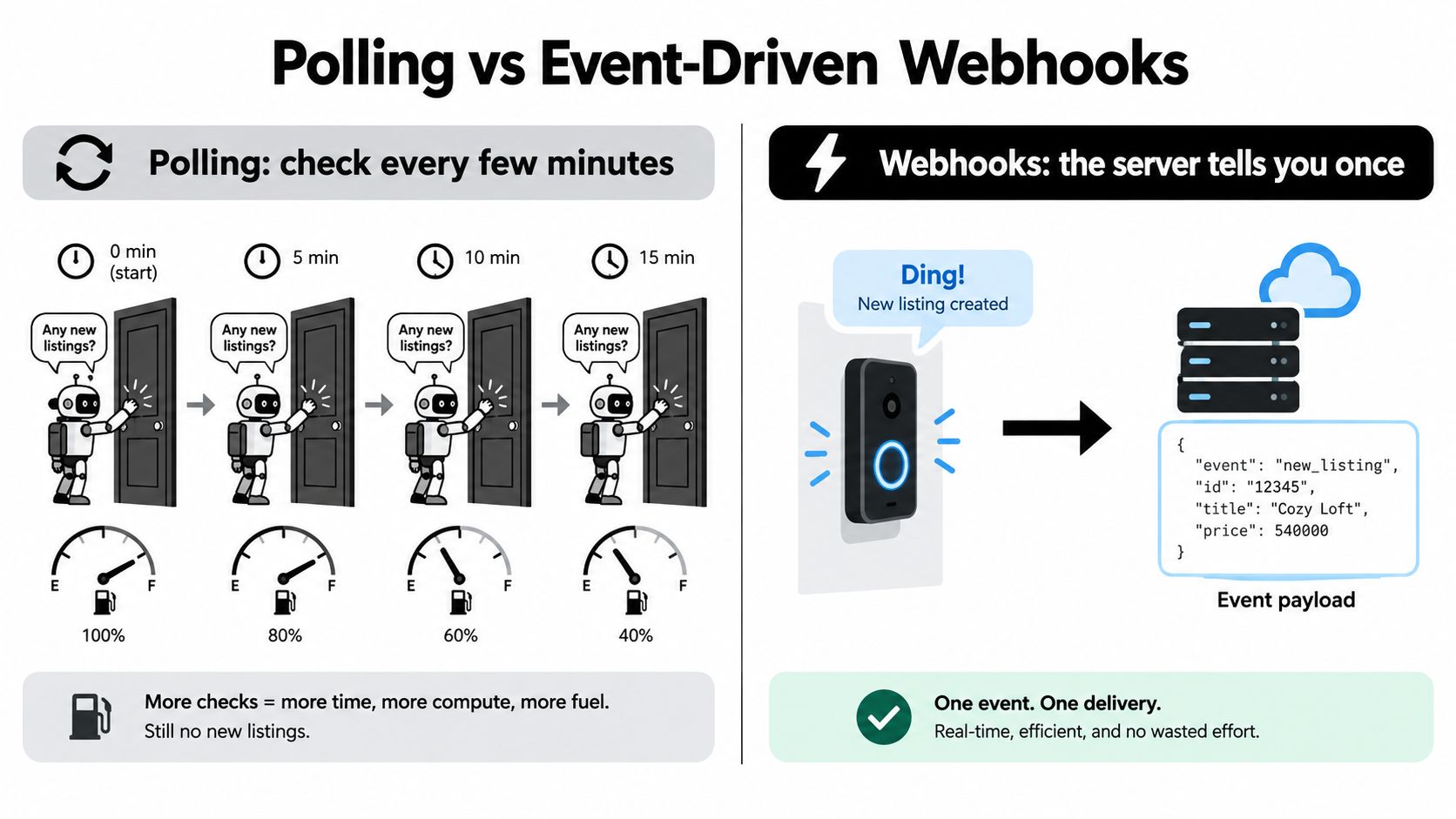
A property price can change minutes after your worker finishes its scheduled request. Until the next poll, your search index, alerting workflow, and investor dashboard may show the old value. A failed request creates a second problem: the system cannot tell whether nothing changed or the network prevented the check.
Polling remains straightforward for a prototype. A worker asks a property data API for updates, compares the response with stored records, and repeats the cycle. At production volume, that means repeated requests that usually discover nothing, plus a delay determined by the polling interval.
A webhook reverses that flow. The source sends an HTTP POST to your callback URL when a defined event occurs. A listing.price_changed event can carry the property identifier, previous and new values, an event identifier, and a creation timestamp. Your application receives a signal and can update its records without querying every source on a fixed schedule.
Why the pattern became standard
Webhooks emerged as a distinct integration pattern in 2007, when developer Jeff Lindsay coined the term for a user-defined HTTP callback or HTTP POST mechanism that fires when an event occurs. Igalia's discussion of the origin of webhooks places the idea in the shift from polling integrations to push-based delivery over the web.
The history matters for architecture. Webhooks are established infrastructure, not a convenience feature that can be assumed reliable just because a provider offers them. Providers are expected to publish event contracts, delivery behavior, and recovery options. Your integration still needs its own controls for duplicate events, out-of-order delivery, and a callback that becomes unavailable.
Real estate synchronization rarely supports a pure push-only design. Use webhooks for timely changes, then run periodic reconciliation to detect missed events, repair stale records, and recover after an outage. Keep the reconciliation job bounded and observable so it does not become an untracked second integration. RenderIO's notification approach provides a useful comparison of provider-specific polling and webhook designs.
For property search, listing aggregation, and market monitoring, treat the webhook as an event signal rather than an unquestionable database command. Store the event ID, validate the entity version or timestamp when available, and make the update idempotent. That prevents a late or repeated notification from overwriting newer property data. Teams evaluating delivery options can review the RealtyAPI integrations documentation to compare supported integration patterns.
Shadow integrations create another production risk. A forgotten callback may still receive listing data, bypass current ownership and security review, or continue retrying after its consumer has been retired. Maintain an inventory of endpoints, owners, subscribed events, and last-seen activity. Event-driven architecture reduces unnecessary polling, but it does not remove the operational work of governing every delivery path.
Anatomy of a Webhook Payload and Event Flow
A webhook request usually contains two different kinds of information. Event metadata describes the notification itself, while entity data describes the business object that changed.
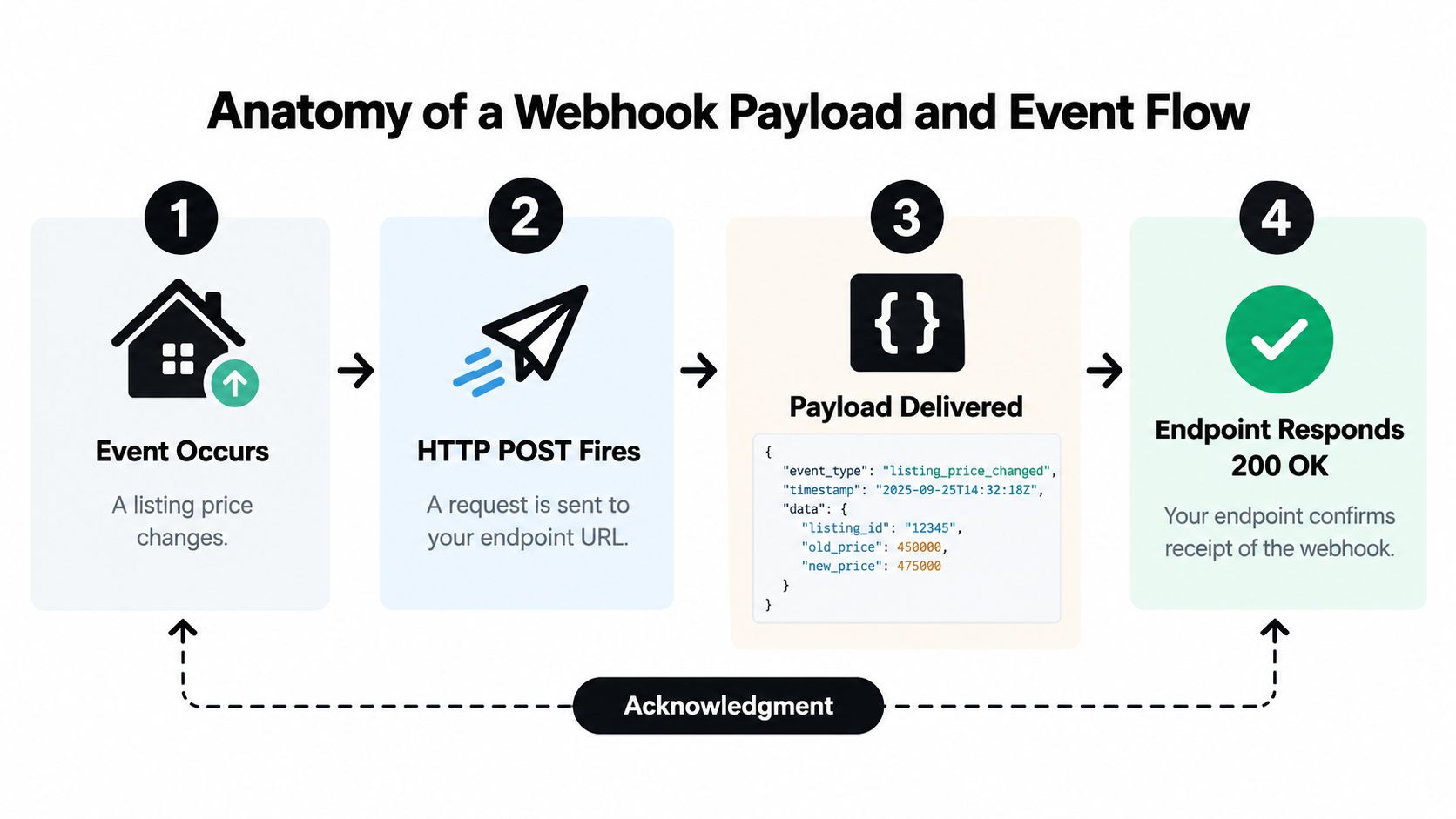
Consider a property whose asking price changes. A useful payload might include an event type such as property.price_changed, a stable event ID, the time the source created the event, and a data object containing the property ID, updated price, currency, and source status. The exact field names vary by provider, so your handler should validate the contract rather than assume every sender uses the same schema.
Separate receipt from processing
The HTTP lifecycle should be short:
- The provider detects a supported state change.
- It sends an HTTP POST to your endpoint.
- Your endpoint authenticates and validates the request.
- Your handler records or queues the event and returns a 2XX response.
- A background worker applies the business change.
The callback shouldn't fetch additional property details, rebuild search indexes, notify every subscriber, and recalculate analytics before acknowledging the request. Synchronous processing makes provider timeouts more likely and turns a slow downstream dependency into a delivery failure.
A queue-first handler is safer. After signature verification and schema validation, persist the raw event or an immutable normalized representation, record its event ID, enqueue work, and acknowledge. The worker can then enrich the listing, update the read model, and trigger downstream actions independently of the provider's request timeout.
Practical rule: A webhook handler should confirm durable receipt quickly, not prove that every downstream operation has finished.
Design around event metadata
Treat the event ID as operational data, not decoration. You'll need it to detect duplicates, trace a delivery through logs, inspect failures, and replay an event safely. The timestamp helps with ordering decisions and replay defenses, but it shouldn't be your only deduplication key because two legitimate events can occur close together.
The entity identifier matters just as much. If a property receives a price update followed by an availability update, workers need a stable property key to route each event to the correct aggregate. A version, sequence value, or source update timestamp can help resolve conflicting changes when the provider includes one, but your system should define what happens when that information is absent.
Before integrating, use a controlled request against the RealtyAPI API playground or the provider's test facility. Capture the raw body and headers, document optional fields, and test malformed payloads before production traffic reaches the endpoint.
Designing for Internet Unreliability and Retries
The network can fail after the sender transmits a request but before the sender receives your response. Your application can process the event successfully, lose the response, and then receive the same event again. That's why at-least-once delivery and receiver-side idempotency belong in the baseline design, not in a later hardening project. The webhook reliability guidance from DevLume describes this relationship directly.
Duplicate delivery is normal
A provider generally treats a delivery as unsuccessful when it gets a connection error, timeout, or non-2XX response. It then retries, often with exponential backoff and jitter. Backoff spaces attempts out, while jitter prevents many clients from retrying at the exact same moment after a shared outage.
The receiver must assume that every event can appear more than once. Store a processed-event record keyed by a stable event ID, and enforce uniqueness in the database. The check and the state transition need transactional protection. A process that checks for an ID, crashes before inserting it, and then retries can still create a duplicate unless the database constraint closes that race.
Keep retries from becoming a storm
A temporary database outage can produce a difficult feedback loop. Your endpoint responds slowly or returns an error, the sender increases its retry activity, and your application receives more work while it's already degraded. The handler should remain lightweight, place accepted events into durable infrastructure, and apply backpressure in workers rather than allowing request threads to perform unbounded processing.
A practical event path looks like this:
- Receive: Read the raw request body and headers without altering the bytes needed for signature verification.
- Authenticate: Reject requests that fail signature or freshness checks before business logic runs.
- Persist: Store the event, delivery metadata, and stable event ID durably.
- Deduplicate: Let a uniqueness constraint decide whether the event is new.
- Queue: Dispatch new work to an asynchronous consumer.
- Acknowledge: Return a successful 2XX response only after the event is safely accepted.
- Quarantine: Move exhausted or repeatedly invalid events into a dead-letter queue.
Ordering requires a separate decision. Providers may deliver a listing's availability update before its earlier price update, especially when retries and multiple workers are involved. If order affects correctness, partition work by property ID, compare source versions, or use a reconciliation read after processing. Don't assume arrival order equals event order.
Rate limits also influence recovery. A failed consumer that immediately fetches enrichment data for every retried event can create a second incident, so coordinate queue concurrency with the source's documented rate-limit behavior. The objective isn't to process everything immediately. It's to preserve events and make forward progress without overwhelming dependencies.
Security Defenses and Governance at Scale
A webhook endpoint is a public route into application logic. HTTPS encrypts the connection, but it does not establish sender identity or prove that the body was unchanged. Verify authenticity before business logic runs, then address replay and tampering risks using the controls described in Nylas webhook best practices.
Verify before you trust
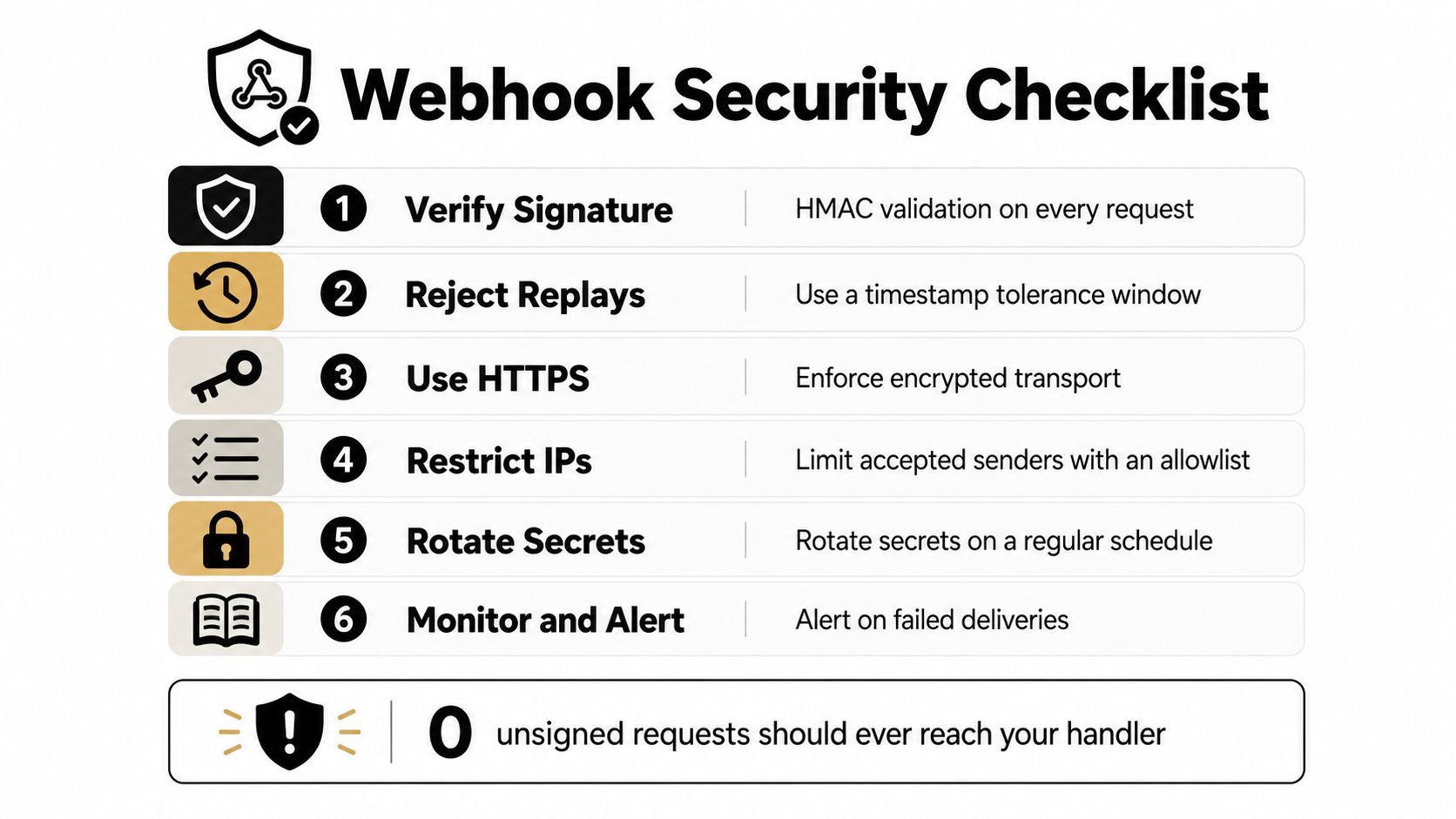
Production webhook schemes commonly use HMAC or another signature calculated from the raw request body. The receiver computes its expected value with the shared secret and compares the two values with a constant-time function. Parse JSON only after verification. Parsing first can change whitespace, escaping, or key representation, which makes an otherwise valid signature fail.
Freshness controls address a separate attack. An attacker can capture a valid signed request and submit it again later. Require a provider timestamp, enforce an acceptable tolerance window, and reject stale requests. Store recently accepted event IDs so the same event cannot be replayed repeatedly within that window.
Apply layered controls where the provider supports them:
- HTTPS: Encrypt traffic in transit and reject insecure delivery.
- Signature verification: Validate every request before sending it to business logic.
- Timestamp checks: Reject old payloads that could be replays.
- IP allowlisting: Restrict network sources when provider ranges remain stable and maintainable.
- Secret rotation: Support overlapping secrets during planned rotation so delivery continues.
- Least privilege: Give each endpoint only the permissions required for its event class.
Govern the connections nobody sees
Security reviews often cover the official integration in the architecture diagram, while a developer or power user creates a direct webhook from a vendor dashboard to an internal endpoint, automation service, or personal environment. These shadow integrations bypass review, distribute secrets outside approved systems, and complicate incident investigation.
Treat webhook subscriptions as inventory and align retention and data handling with your privacy policy. Record the owner, source, destination, event types, secret status, data classification, and last observed delivery. Require approval for new production connections, log configuration changes, and alert on failed signature checks or unusual delivery patterns.
A dedicated ingress layer can centralize authentication, rate controls, logging, and routing before events reach domain services. It costs more infrastructure than exposing each team's handler directly, but it gives security and operations one place to enforce policy. For organizations synchronizing many property sources, that governance boundary matters as much as the cryptographic check.
Real-Time Real Estate Data with RealtyAPI
Real estate systems rarely have one clean source of truth. A marketplace may combine listing details, pricing changes, availability, reviews, host attributes, and location data from different platforms, each with its own update behavior and delivery contract. Polling every source independently forces the application team to manage schedules, response comparison, rate limits, and recovery logic across several integrations.
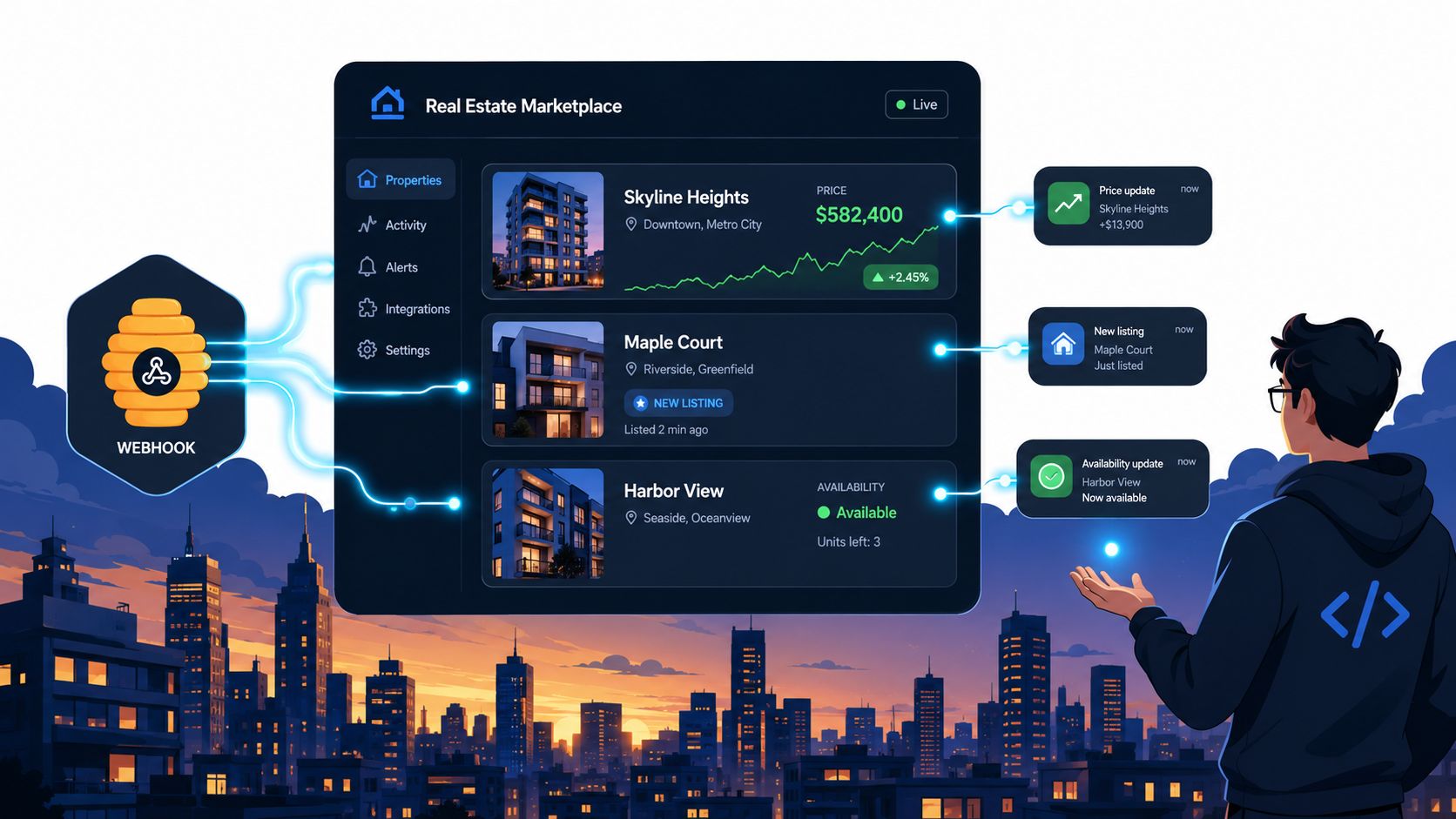
RealtyAPI.io provides a unified real estate data layer with REST, GraphQL, and webhooks. Its stated use cases include property search, live market monitoring, listing aggregation, and downstream synchronization across publicly available data from platforms such as Redfin, Realtor, Airbnb, Zoopla, Bayut, Apartments.com, and Idealista.
For a PropTech team, the useful architectural distinction is not just that a provider offers webhooks. The integration still needs signed request handling, deduplication, durable persistence before acknowledgement, and an operational path for failed events. Those controls determine whether a price update becomes a trustworthy change in your search index or an unexplained discrepancy in a broker dashboard.
Fit the delivery model to the product
A responsive search experience may use an API request for the initial result and webhook-driven updates to refresh a local index or alerting pipeline. An investment analysis workflow may retain the incoming event, associate it with a property history, and process it asynchronously so one malformed record doesn't block unrelated updates. A short-term rental application may route availability changes to a channel-management service while keeping the source event available for audit.
Global delivery and retry handling can reduce the amount of infrastructure a small team must assemble, but they don't remove receiver responsibilities. You still need observability around event IDs, signature failures, queue age, processing outcomes, and dead-letter volume. You also need a reconciliation path for cases where a source event was unavailable or your own system was down.
A product walkthrough can help teams connect the API contract to the application flow. Use the video below after reviewing the event lifecycle and deciding where your queue, deduplication store, and business workers belong.
RealtyAPI.io's publisher information describes 99.9% uptime, sub-second latency, no rate limits, auto-scaling infrastructure, and global edge delivery. Those are provider-level characteristics, not substitutes for an application's own delivery guarantees. Validate the actual webhook contract, retry behavior, payload schema, and security controls against your workload before committing to the integration.
Testing and Debugging Webhook Integrations
Webhook bugs often hide at the boundary between systems. A local handler may work with a copied JSON body but fail when the provider sends a different header, signature format, content type, or retry sequence. Production logs may show only a timeout, while the actual cause is a validation error that occurred after the response window closed.
Build a repeatable local loop
Expose a local endpoint through a secure tunneling tool, register that temporary URL with a test subscription, and capture both headers and the exact body. Don't test only the happy path. Send valid events twice, alter one body byte, remove required fields, use an old timestamp, and delay the handler long enough to simulate a timeout.
Your local test should verify four outcomes:
- Valid request: The handler authenticates, persists, queues, and acknowledges it.
- Duplicate request: The second delivery produces no duplicate business write.
- Invalid signature: The request stops before parsing triggers business logic.
- Slow dependency: The HTTP handler remains bounded while background processing handles the work.
Provider dashboards are useful for controlled replay, especially when a real event failed after reaching your endpoint. Replay against a staging consumer first, and make sure the event ID remains unchanged so your deduplication behavior is realistic. If you're working with notification systems beyond property data, a focused utility such as PullNotifier's tool to debug Microsoft Teams webhooks can help isolate request formatting and response behavior.
Read the failure evidence
A dead-letter queue should contain more than a payload. Preserve the event ID, source, delivery attempts, validation result, last error, timestamps, and relevant trace identifier. That information lets an engineer distinguish a malformed event from a temporary database outage without guessing.
Test recovery too. Stop the worker, deliver events, restart it, and confirm that persisted events resume processing. Then force a downstream failure and verify that retries back off, duplicates remain harmless, and operators receive an alert before the queue becomes an unnoticed source of stale listings.
Evaluating Webhook Providers for Production
A provider's webhook checkbox tells you almost nothing about its operational quality. Evaluate the delivery contract as carefully as the data schema. A useful provider should document event types, payload fields, authentication, timeout behavior, retry timing, retry limits, replay support, and the conditions under which an event leaves the retry path.
The success rule is especially important. Webhook endpoints are typically considered successful only when they return any 2XX HTTP status code. Non-2XX responses, connection failures, and timeouts are treated as failures and trigger retries, as documented in Kit's webhook retry guidance.
Questions worth answering before integration
| Area | What to verify |
|---|---|
| Delivery | Does the provider use at-least-once delivery, and can events arrive out of order? |
| Retry behavior | Are transient failures retried with backoff and jitter? Is the retry window bounded? |
| Failure handling | Are exhausted events visible in a dead-letter queue or replay interface? |
| Security | Are signatures calculated over the raw body, and can secrets be rotated safely? |
| Observability | Can you search by event ID, inspect attempts, and correlate provider logs with yours? |
| Contract | Are schemas versioned, and are breaking changes announced clearly? |
| Recovery | Can you reconcile current entity state after an outage or missed event? |
| Operations | Can teams inventory subscriptions, owners, destinations, and event permissions? |
A provider that offers fast delivery but no replay tooling may force you to build more operational infrastructure. A provider with rich retries but unclear ordering guarantees may still require per-entity sequencing or reconciliation. An in-house system offers control, but your team then owns delivery persistence, retry scheduling, signing, monitoring, support, and failure recovery.
For a real estate application, the strongest design usually combines event delivery with durable local state and a reconciliation process. Webhooks keep the system responsive; idempotency and queues protect correctness; observability tells operators what happened; periodic reconciliation repairs gaps without making polling the primary synchronization mechanism.
RealtyAPI.io offers unified access to publicly available real estate listings, pricing trends, availability, reviews, and market signals through REST, GraphQL, and webhooks. If you're building a PropTech search, marketplace, analytics product, or live monitoring workflow, visit RealtyAPI.io to get an API key and evaluate the delivery model against your event architecture.