Website Search API: Real Estate Guide

The popular advice is to start with a search box, connect an endpoint, and worry about production later. That approach breaks quickly in real estate. A property query isn't just text. It can combine geography, price, property type, amenities, availability, source-specific identifiers, sorting, pagination, and data freshness. A website search API is useful only when it keeps those dimensions predictable under real traffic.
The practical question isn't whether you can make a search request. You can. The question is whether the underlying index, response schema, latency, retry behavior, JavaScript handling, and pricing model will still work when listings change, users combine filters, and demand spikes. The strongest implementation treats search as infrastructure to integrate and operate, not a small feature to bolt onto a frontend.
What a Website Search API Actually Is
Building search from scratch sounds easier than it is. A serious search system needs collection, crawling or ingestion, parsing, indexing, ranking, filtering, deduplication, freshness management, and failure handling. In a property marketplace, it also needs normalized addresses, coordinates, currencies, room counts, listing status, and source-specific fields. Writing the first query is straightforward. Maintaining trustworthy results is the engineering job.
A website search API exposes that capability through programmatic requests. Your application sends a query and parameters, and the service returns structured results, often as JSON. Depending on the product, the API may search a provider's web index, a configured collection of sites, a private application index, or a specialized real estate dataset.

Search is an integration boundary
The API boundary lets your product team separate user experience from retrieval infrastructure. The frontend can request “two-bedroom homes near a station,” while the backend translates that intent into filters, coordinates, pagination tokens, and source-specific parameters. That separation matters because providers change schemas and availability rules more often than your interface should change.
Google's Search Console API illustrates a different but important category. Its searchAnalytics.query() endpoint exposes query-level search traffic for a property, grouped by dimensions such as country, device, page, or query. Google recommends daily querying to remain within quota, says results are typically available after 2–3 days, and caps pagination at 25,000 rows per page in its documented guidance (Google's Search Console API documentation). That API analyzes how a site appears in search. It doesn't power the search box on your property platform.
For ecommerce teams, the same distinction appears in guidance on how to turn browsers into buyers with search. Discovery search, internal site search, search analytics, and web search may share vocabulary, but they solve different problems.
A useful mental model is simple: search is something you integrate, while relevance and product behavior are something you own. Start with the RealtyAPI.io introduction to see how a real estate data layer can expose property retrieval without making your team maintain every upstream source.
Core Search Architectures Explained
Three architectures cover most website search implementations. They differ less in the search box than in where data lives, who maintains the index, and how much control your team has over ranking and retrieval.
Client-side search
Client-side search downloads a dataset or prebuilt index into the browser and searches locally. It works well for a small, stable collection such as a neighborhood guide, a property taxonomy, or a static directory. The browser can respond immediately after loading the index, and there are no search requests for each keystroke.
The limitations are structural. Large listing inventories increase page weight, expose data to the client, complicate updates, and make access control difficult. Client-side search also struggles when results depend on live availability, geospatial calculations, user permissions, or constantly changing prices. It can be a useful enhancement, but it shouldn't be the primary architecture for a marketplace with live inventory.
Hosted site search
A hosted provider crawls or ingests your content, builds the index, and returns results through an API. Google Custom Search JSON API, for example, returns web or image results in JSON over RESTful requests. Google's documentation describes 100 free search queries per day, followed by $5 per 1,000 queries, with usage up to 10,000 queries per day (Google Custom Search JSON API overview).
Hosted search reduces operational work, but the trade-off is control. You may get limited ranking rules, restricted field modeling, provider-specific quotas, and less control over JavaScript-heavy pages. Brave Search API takes another route, using an independent web index that Brave says crawls and indexes billions of pages, with web results intended for human consumption and optional local or rich-data enrichments (Brave Search API).
Full-text search engines
A full-text engine such as Elasticsearch or Solr gives your team control over analyzers, field weights, synonyms, faceting, geo queries, ranking, and index lifecycle. That flexibility suits a property platform with complex filters and a normalized internal catalog.
Control creates work. Your team must build ingestion, monitor cluster health, design mappings, reindex safely, manage capacity, and decide what happens when source data arrives incomplete. A managed search cluster can reduce infrastructure chores, but it doesn't remove the responsibility for relevance or data quality.
Comparing Search API Approaches
The right choice depends on the boundary you need between your application and the search system. A small static directory values simplicity. A marketplace values live filters, predictable response shapes, and control over ranking. A research product may care more about corpus breadth and citations than about internal field-level relevance.
| Architecture | Setup Complexity | Scalability | Cost at Scale | Best For |
|---|---|---|---|---|
| Client-side search | Low at first, rising as data and update requirements grow | Limited by browser payloads and device resources | Low infrastructure cost, but data delivery and maintenance costs can grow | Small static catalogs and lightweight directories |
| Hosted site search | Low to moderate | Provider-dependent, with quotas and request limits | Predictable initially, subject to provider pricing and usage rules | Websites that need managed indexing with limited customization |
| Full-text search engine | Moderate to high | High when designed and operated correctly | Infrastructure and engineering costs require active management | Complex marketplaces, geo search, and custom relevance |
| Specialized real estate API | Low application-side setup | Depends on provider capacity, source coverage, and endpoint design | Request-based pricing and provider terms determine economics | Live listing retrieval and cross-source property experiences |
Where hosted search struggles
Hosted search often looks attractive during prototyping because it removes ingestion and index operations. Real estate adds pressure that generic site search may not handle well. A user might combine a polygon or radius, a price range, bedroom count, pet policy, furnished status, and listing freshness. If those fields aren't modeled natively, the application ends up filtering after retrieval, which produces incomplete pages and inconsistent counts.
JavaScript rendering is another fault line. If a provider only sees the initial HTML while listings appear after client-side requests, the index may omit the content that users need. A scraper-like workflow can also become fragile when markup, anti-bot behavior, or consent flows change.
A practical decision matrix
Choose client-side search when the entire dataset is small, public, and safe to ship to the browser. Choose hosted search when you need a managed index and your ranking and filtering needs are modest. Choose a full-text engine when your team owns normalized data and needs detailed control over relevance, geography, and faceting.
For live property discovery across external sources, evaluate a specialized API separately from generic website search. The important test isn't the prettiness of its demo. Run representative queries, inspect missing fields, test repeated requests, and measure the cost of a successful result rather than the cost of a request that requires retries.
Real Estate Search API Use Cases
A property search application usually starts with a location input, but the backend should turn that input into a structured request. Autocomplete can resolve a place into a stable identifier, while the search endpoint applies coordinates, radius, property type, price, and listing status. The response should be normalized before it reaches the frontend, so every card uses the same fields for title, image, price, address, coordinates, and source URL.
A location-first workflow is especially useful when a user enters a neighborhood, city, or landmark rather than a precise address. An endpoint such as RealtyAPI.io's location autocomplete can support that first interaction, while a separate listing request handles the result set. Keep autocomplete responses lightweight. Don't fetch full property details until the user selects a suggestion or opens a listing.
Aggregation without a brittle frontend
Listing aggregators face a different problem. Each source may use different labels for property type, different currency formats, different image rules, and different identifiers. The ingestion service should map those fields into a canonical model, retain the original source values for debugging, and attach provenance to every record.
A sensible pipeline looks like this:
- Resolve location: Convert free text into a place, coordinate, or source-specific identifier.
- Fetch results: Send bounded requests with explicit filters and pagination.
- Normalize fields: Standardize prices, dates, amenities, coordinates, and property types.
- Deduplicate records: Use source IDs where available, then combine address and listing signals cautiously.
- Serve a stable schema: Keep frontend contracts independent from upstream response changes.
Market monitoring dashboards use search differently. They may collect repeated result sets, store snapshots, and compare asking prices, inventory composition, or listing status over time. The search API supplies retrieval, but the analytical system owns historical storage and definitions. A live response isn't automatically a trend dataset.
Investment tools can combine current listings with internal underwriting assumptions, historical transactions, and geospatial boundaries. Keep those layers separate. A listing source can change or remove a record, while an investment model may need an immutable snapshot for auditability.
Marketing teams working with investment listings may also benefit from practical guidance on how to attract stronger offers. That advice belongs beside the data workflow, not inside the retrieval layer. Search finds and structures opportunities, while positioning and buyer communication influence what happens next.
Integration Patterns That Work
A production integration starts with a narrow server-side adapter. Don't expose a provider key in browser code, and don't let the frontend send arbitrary provider parameters directly. Your adapter should validate input, apply safe defaults, translate your public schema into the provider's schema, and return a versioned response that your UI can depend on.
Request boundaries
Use an allowlist for filters. For a property search, that might include location, coordinates, radius, price bounds, bedrooms, property type, amenities, sort order, and a page token. Reject impossible ranges before making an upstream call. Normalize casing and units at the boundary, because inconsistent input creates cache misses and confusing analytics.
A minimal JavaScript adapter might look like this:
async function searchListings(params, signal) {
  const query = new URLSearchParams({
    location: params.location ?? "",
    page: String(params.page ?? 1),
    limit: String(Math.min(params.limit ?? 20, 100))
  });

  const response = await fetch(
    `
    {
      headers: { Authorization: `Bearer ${process.env.SEARCH_API_KEY}` },
      signal
    }
  );

  if (response.status === 429) {
    throw new Error("upstream_rate_limited");
  }
  if (!response.ok) {
    throw new Error(`upstream_error_${response.status}`);
  }

  return response.json();
}
The URL above is illustrative. The important pattern is server-side credentials, bounded pagination, explicit status handling, and a timeout signal.
Retries and pagination
Retry only transient failures. A timeout or temporary server error may be retried with exponential backoff and jitter. An invalid filter, authentication failure, or malformed response should fail fast and generate an actionable alert. Never retry every error, because a burst of retries can turn a provider incident into your own traffic storm.
Prefer cursor pagination when the provider supports it. Offset pagination can produce duplicates or skips when listings change between requests. Store the provider's cursor with the session, and don't let clients invent arbitrary offsets against a live external index.
Python services should separate transport errors from domain errors:
async def get_page(client, url, headers):
    try:
        response = await client.get(url, headers=headers, timeout=3.0)
        response.raise_for_status()
        return response.json()
    except TimeoutError:
        raise RuntimeError("search_timeout")
    except Exception as exc:
        raise RuntimeError("search_unavailable") from exc
Use a schema validator after decoding JSON. A successful HTTP response with a missing price, malformed coordinate, or changed field name is still a data failure.
Caching and observability
Cache normalized results for repeated identical queries, but keep cache keys explicit. Include location, filters, sort, page token, and API version. Don't cache personalized or permission-sensitive output without separating those dimensions.
For a broader integration checklist, consult the RealtyAPI.io integrations documentation. Track request latency, upstream status, retry counts, empty-result rates, schema validation failures, cache hit rate, and freshness. Those signals tell you whether users are seeing fewer properties because the market is empty or because the integration is broken.
Performance and Reliability at Scale
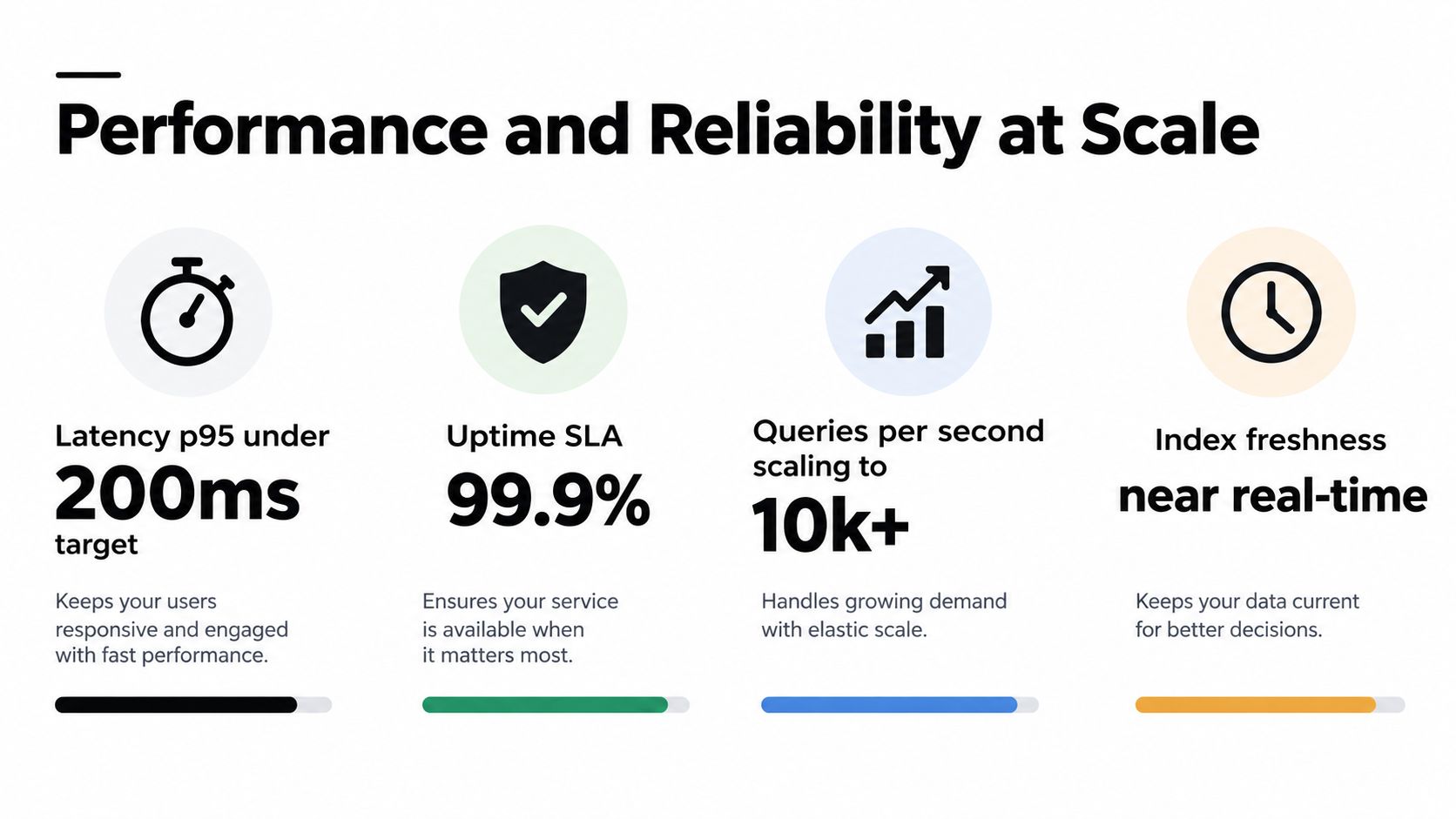
A search API can be technically available and still feel broken. Latency affects every autocomplete request, filter change, and agent loop. A September 2026 benchmark measured mean factual-lookup latency as low as 348 ms, with Exa Instant at 398 ms and Tavily Basic at 1.88 seconds, a roughly 4–5x spread between configurations (independent web search API benchmark). Those figures describe benchmarked web-search configurations, not a guaranteed real estate SLA, but they show why provider and architecture choices matter.
For interactive property search, measure the complete path, not just the upstream call. Include DNS and connection setup, your adapter, normalization, serialization, and frontend rendering. A fast provider can still produce a slow experience if your service makes sequential calls for geocoding, inventory, details, and availability.
Design for partial failure
Use deadlines at every network boundary. A search request shouldn't wait indefinitely for one source while the rest of the page is ready. A circuit breaker can stop calls to a failing provider, while stale cached results or a reduced filter set can preserve a useful experience.
Operational rule: A degraded result page is usually better than a blank page, but label freshness honestly.
Burst traffic needs admission control. Queue noninteractive enrichment work, coalesce identical autocomplete requests, and apply per-user and per-tenant limits before traffic reaches the provider. For background market monitoring, schedule requests and respect provider quotas instead of competing with user traffic.
Search quality also needs a production test. Independent 2026 guidance recommends running 50–100 real production queries with identical defaults, then measuring end-task success and cost per successful task rather than raw recall alone (agent search evaluation guidance). That is a better test for a property workflow: can a user find the intended listing, with the right location and usable fields, without repeated attempts?
Track index freshness separately from API uptime. A provider can return valid JSON from a stale corpus. For real estate, compare known listing updates, removed properties, and changed prices against observed API results. Reliability means the response arrives, the schema remains usable, and the content still represents the market you claim to show.
Security and Data Compliance
Property search combines user intent with location. Queries can reveal where someone wants to live, which neighborhoods they monitor, or which investment areas they investigate. Listing data may also contain owner, host, access, or contact details that shouldn't pass through every client or appear in logs.
Keep API keys in server-side secret storage and scope them to the smallest useful permission set. Never include credentials in browser bundles, query strings, analytics events, or exception messages. Redact search terms and coordinates from ordinary logs, and apply retention rules to request traces.
Protect the response surface
Return only fields the client needs. A provider response may contain internal identifiers, source metadata, raw contact information, or fields intended for licensed users. Map it into a public schema and enforce authorization before returning saved searches, private listings, or account-specific data.
Use encryption in transit and at rest, but don't treat encryption as the whole privacy design. Minimize stored query history, explain why location data is collected, and provide deletion and consent controls where applicable. European platforms should document their lawful basis and retention behavior under GDPR, especially when searches can be linked to an account or device.
A provider's stated privacy terms matter, but your implementation determines what you retain. Review the RealtyAPI.io privacy policy alongside your own data-flow documentation before connecting live user traffic.
Evaluate claims with evidence
Security and performance reviews should separate facts from marketing. Ask for documented retention behavior, incident procedures, schema guarantees, quotas, and regional processing details. For web-search integrations, source quality matters as much as encryption. An API that returns stale or incomplete sources can create compliance and trust problems when your application presents them as current.
Google's Web search documentation describes a model workflow in which the Responses API, and in some cases Chat Completions, lets models access current internet information and provide sourced citations (OpenAI Web search guide). That pattern is useful for AI-assisted property research, but citations don't correct an unsafe data boundary. Your service still needs authorization, redaction, and retention controls.
Making the Right Search Decision
There isn't one universally correct website search API architecture. The right choice follows from your data ownership, freshness requirement, query complexity, team capacity, and tolerance for provider dependency.
Use client-side search for small, public, slowly changing datasets. Use a hosted site-search product when managed indexing matters more than custom ranking and your pages expose crawlable content. Use a full-text engine when you own the catalog and need precise geo filters, faceting, synonyms, scoring, and operational control. Use a specialized real estate data API when the main problem is retrieving live property information across external sources rather than indexing content you already own.
Test the failure modes first
A demo query proves very little. Build a representative evaluation set that includes common locations, ambiguous place names, empty results, extreme filters, pagination, changed listings, and JavaScript-rendered source pages. Run it through the same adapter and defaults you'll use in production.
For each result, inspect:
- Task completion: Can a user find the intended property or market signal?
- Field integrity: Are price, coordinates, dates, amenities, and source identifiers usable?
- Freshness: Do changed and removed listings behave as expected?
- Operational behavior: Does the API handle timeouts, rate limits, retries, and burst traffic?
- Economics: What does a successful, normalized result cost after retries and enrichment calls?
Google's Indexing API shows why scope must be checked carefully before adoption. It is limited to pages containing JobPosting or BroadcastEvent in a VideoObject, and it notifies Google about added, updated, or removed pages to encourage fresh crawling (Google Indexing API quickstart). It isn't a general-purpose way to force indexing for an entire real estate inventory.
The same discipline applies to broader search providers. Google remains around 89–90% of global search share in 2025, while Brave Search API usage was cited at more than 1.5 billion searches per month in an industry analysis, and Perplexity was cited at about 22 million monthly active users and roughly 780 million queries in May 2025 (search API market analysis). Those figures indicate a large ecosystem, not proof that any provider fits your property workflow.
Start with a controlled pilot, document the assumptions, and keep your application adapter replaceable. RealtyAPI.io offers REST, GraphQL, and webhooks for real estate data retrieval, with search by location, coordinates, place ID, or URL, plus code examples for common backend languages. Visit RealtyAPI.io to evaluate its endpoints against your real estate search, aggregation, and market-monitoring requirements.