Web Scraping Service Guide for PropTech Teams

Your property search product works in staging. The listing pages render, addresses look plausible, and the first data export reaches your database. Then a target site changes its markup overnight. By morning, your pipeline is returning empty fields, a wave of 403 Forbidden responses, and a support queue full of users asking why yesterday's homes have disappeared.
That failure rarely comes from the parser alone. A production real estate data pipeline must manage browser rendering, proxy infrastructure, retries, normalization, duplicate listings, observability, and the legal boundaries around public data. A web scraping service can absorb much of that operational burden, but it can't remove the need for sound architecture or compliance decisions.
For a PropTech team, the central question isn't whether scraping is technically possible. It's whether raw extraction is the right product dependency, or whether a managed real estate API gives you a more dependable path to structured data.
What Buying a Web Scraping Service Actually Involves
A property search pipeline can fail long after the first prototype appears stable. A target may move listing data behind JavaScript, rename a CSS class, introduce a bot challenge, or reject requests from the same server address. Each change creates work beyond rewriting a selector.
A commercial web scraping service handles part of that operating burden. It coordinates requests, manages proxy pools, renders JavaScript when required, maintains session state, detects failed responses, adapts parsers to changing structures, and returns data your application can use. The trade-off is control: you depend on the vendor's coverage, diagnostics, update process, and limits.
Practical rule: Buy extraction infrastructure when your product advantage comes from using property data, not from maintaining the machinery that retrieves it.
What the service handles
A vendor may provide browser automation through Playwright or Selenium, request scheduling, CAPTCHA workflows, proxy selection, and parser maintenance. These features matter because an initial document may contain little listing data. Useful fields can arrive only after scripts run, API calls complete, or interactive filters update the page.
Start vendor discussions with failure modes rather than feature checklists. Ask how the service separates a temporary origin error from a layout change. Confirm that structurally invalid responses can be rejected instead of stored as empty records. Check whether your team can inspect the raw page, extracted fields, parser version, and request outcome for an individual listing.
Mordor Intelligence's web scraping market overview cites one estimate of USD 1.56 billion in 2026, projecting USD 3.49 billion by 2031 at a 17.39% CAGR from 2026 to 2031. The same page presents a separate, lower estimate of USD 754.17 million in 2024, reaching USD 2.87 billion by 2034 at a 14.3% CAGR. Treat these figures as competing estimates, not a single precise market size. Both point to continued demand for outsourced extraction infrastructure.
The hidden bill
A subscription covers only one part of ownership. Your team still needs monitoring, schema validation, deduplication, historical backfills, source-specific tests, incident response, and a policy for incomplete records. If one marketplace changes its markup, someone must determine whether the fault affects one page, one region, or every request.
Operational complexity also appears during anti-bot escalation. A higher success rate may require more browser execution, proxy rotation, session handling, or slower request patterns. Those choices can increase latency and operating cost, while aggressive collection can create compliance exposure. Public availability does not automatically grant permission for every use, storage period, or redistribution model.
Review the case study on adaptive scraping to see why extraction that works today needs safeguards against changing page structures. One implementation does not settle your architecture, but it illustrates the maintenance gap between a script and a production system.
If your team needs structured property access rather than raw extraction operations, compare the workflow and commercial model on the RealtyAPI.io pricing page. Base the decision on total engineering ownership, compliance review, failure handling, and data reliability, not only on the apparent cost per request.
How Distributed Scraping Architectures Work
A scalable scraper is a distributed job system with a browser attached to some of its workers. Treating it as a loop over URLs creates avoidable problems because request scheduling, execution, persistence, and recovery become tangled inside one process.
The resilient pattern separates three layers:
- Orchestration creates jobs, applies priorities, tracks state, and decides when work should be retried.
- Worker execution fetches pages, renders JavaScript, extracts fields, and emits structured results.
- Persistent storage records raw responses, normalized records, errors, metadata, and processing history.
A scheduler places URL tasks in a durable queue. Stateless workers pull tasks as capacity becomes available, perform the work, and write results to a persistent sink. Workers shouldn't depend on local memory to know what happened before. That design lets you add or remove workers without moving shared state between machines.
Why the queue matters
The queue is more than a list of URLs. It provides backpressure when the origin slows down, isolates slow jobs from fast ones, and gives operators a place to observe queue depth and retry volume. A job can carry a domain, request priority, crawl policy, parser version, and attempt history.
This architecture also changes how you reason about failure. A worker timeout shouldn't erase the task. A parser exception shouldn't cause the scheduler to re-submit every successful request. A malformed result should move to a quarantine stream for review rather than entering the property database without inspection.
The ScrapeHero guide to distributed scraping with serverless functions describes this separation of orchestration, workers, and storage as the scalable pattern. The reasoning is straightforward. Stateless workers can multiply independently, while the queue controls retries, throughput, and monitoring.
What to ask a vendor
Ask whether the vendor exposes per-domain concurrency controls rather than only a global throughput setting. Ask how it handles duplicate URLs, stale queue items, poison jobs, and partial extraction. You'll also want to know whether raw HTML or rendered content is retained long enough to debug a bad record.
For your own application, keep ingestion and serving separate. Store the provider response, normalize it into your property model, and expose your internal schema to downstream services. That way, a source-specific change doesn't force every consumer to understand a new response shape.
A rate-limit policy should be visible in both the provider contract and your client. The RealtyAPI.io rate-limit documentation is an example of the kind of operational detail developers need before they connect a data source to production traffic.
The following video provides another visual explanation of scraping-service architecture and operational controls.
Navigating Anti-Bot Walls and Compliance Risks
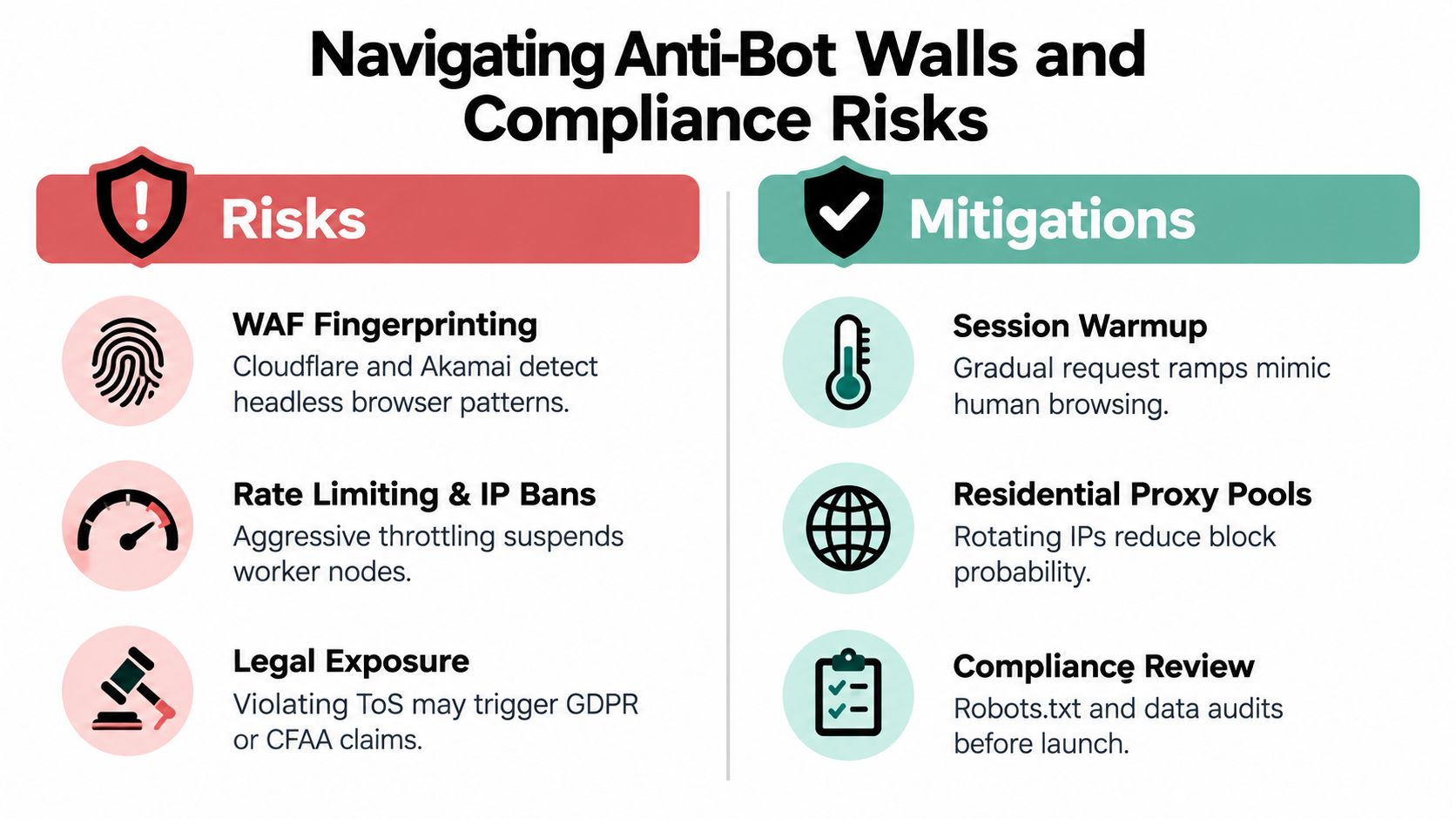
A PropTech team can collect a listing page successfully on Monday and receive challenge pages, empty fields, or blocked sessions by Friday. “Publicly visible” describes access for a person in a browser, not permission to collect, retain, or redistribute the content. The review must separate personal data, copyrighted expression, database rights, technical access controls, and contractual terms.
The technical environment is demanding. Crawlora's 2026 web scraping report reports that 53.5% of reachable top-1M sites operate a managed anti-bot or WAF wall, while Cloudflare protects about 45% of the reachable web and 84% of protected sites. It describes TLS fingerprinting, behavioral analysis, canvas fingerprinting, JavaScript traps, and machine-learning defenses that can change quickly. The report also cites a separate security analysis attributing 70.9% of bad bot traffic to web scraping.
A basic HTTP request test therefore proves little. Origins can evaluate browser characteristics, interaction timing, session history, and request patterns together. Repeated retries, broad concurrency, and proxy rotation may increase operating costs without solving the underlying detection problem.
Compliance gates to examine
Begin with the source's access rules. Parse robots.txt before the first request, apply any stated crawl delay, and record which paths are permitted. Industry guidance recommends a practical baseline of one request per second per domain, with exponential backoff and lower rates after 429 or 503 responses, as described in HexProxies' web scraping ethics guidance.
Then classify the fields. Property listings may contain names, phone numbers, host profiles, photographs, descriptions, and location details. Decide which fields the product needs, whether personal information will be retained, how deletion requests will work, and who may access raw records. Keep an audit trail for those decisions.
Terms deserve separate treatment. A click-through agreement can create contractual questions even when content is publicly viewable. Review the RealtyAPI.io terms of service as an example of how a data provider documents permitted use. Copyright and database-rights analysis also changes when a team copies expressive descriptions, images, or a substantial collection instead of extracting limited factual attributes.
Scale can change the legal and operational assessment. DataImpulse's legal overview explains that a workflow acceptable at 1,000 requests per day may need fresh legal review at 10 million requests per day. Examine whether the crawler bypasses a technical gate, collects personal data, copies protected creative material, or conflicts with accepted terms.
Design for restraint
CAPTCHA solving and proxy rotation do not establish permission to ignore source controls. A service should support domain-level throttling, audit logs, exclusion lists, retention controls, and an escalation path for blocked access. If those controls are absent, the team inherits the work of building them, plus the cost of investigating unreliable records.
If your product uses Cloudflare Turnstile or a similar challenge, product and security teams should distinguish legitimate user verification from attempts to circumvent access controls. Portreeve's guide to reduce checkout friction via Turnstile provides a useful user-experience reference, framing challenges as part of an access flow rather than merely an obstacle to automation.
Before launch, record approved sources, fields, purposes, retention rules, request policies, and review ownership. Put those constraints beside the pipeline configuration so engineers see them when adding a target. For a narrow, high-value property dataset, a managed real estate API may be cheaper and easier to govern than maintaining a scraper that repeatedly escalates against anti-bot defenses.
Evaluation Criteria for Scraping Vendors
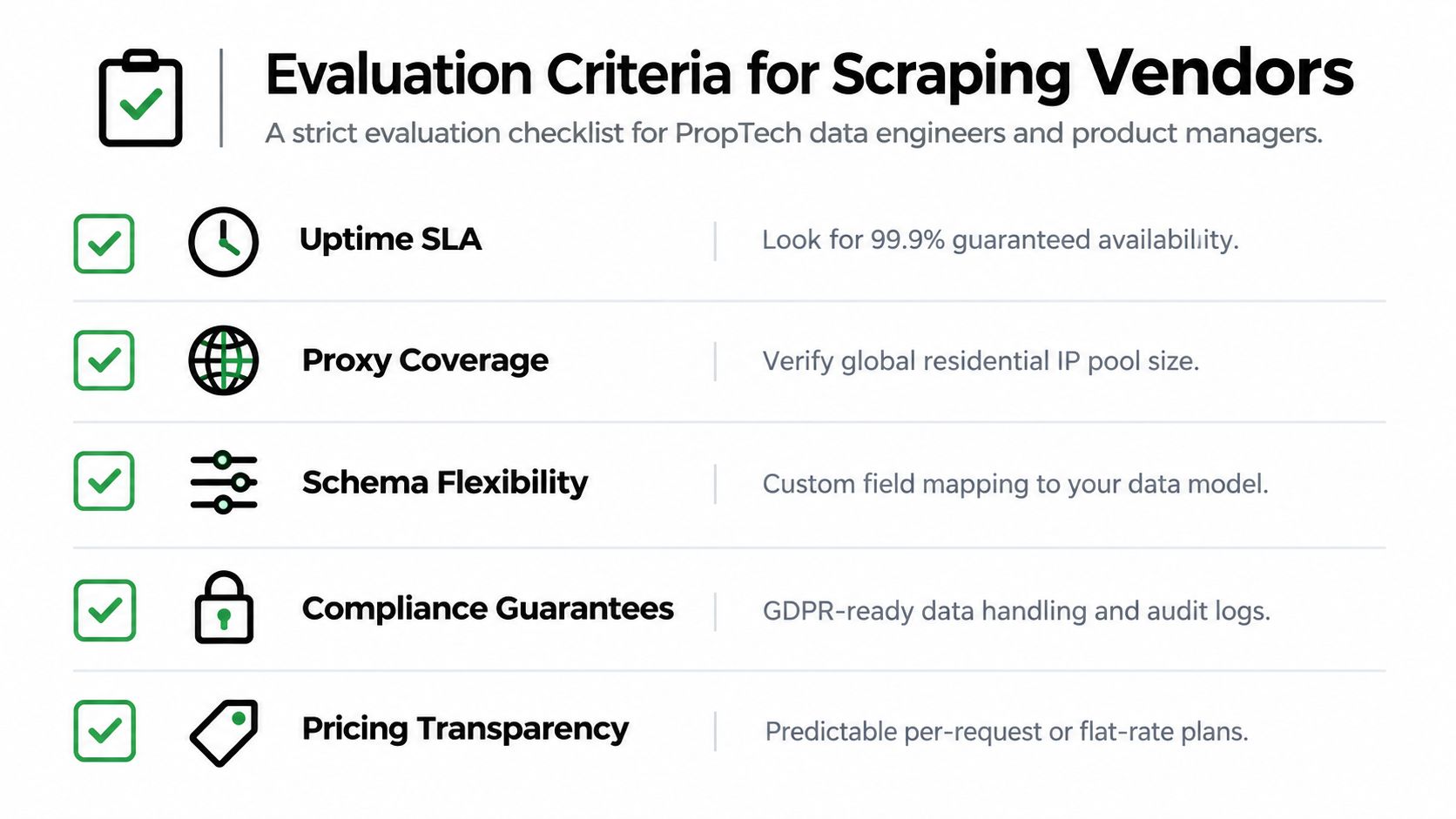
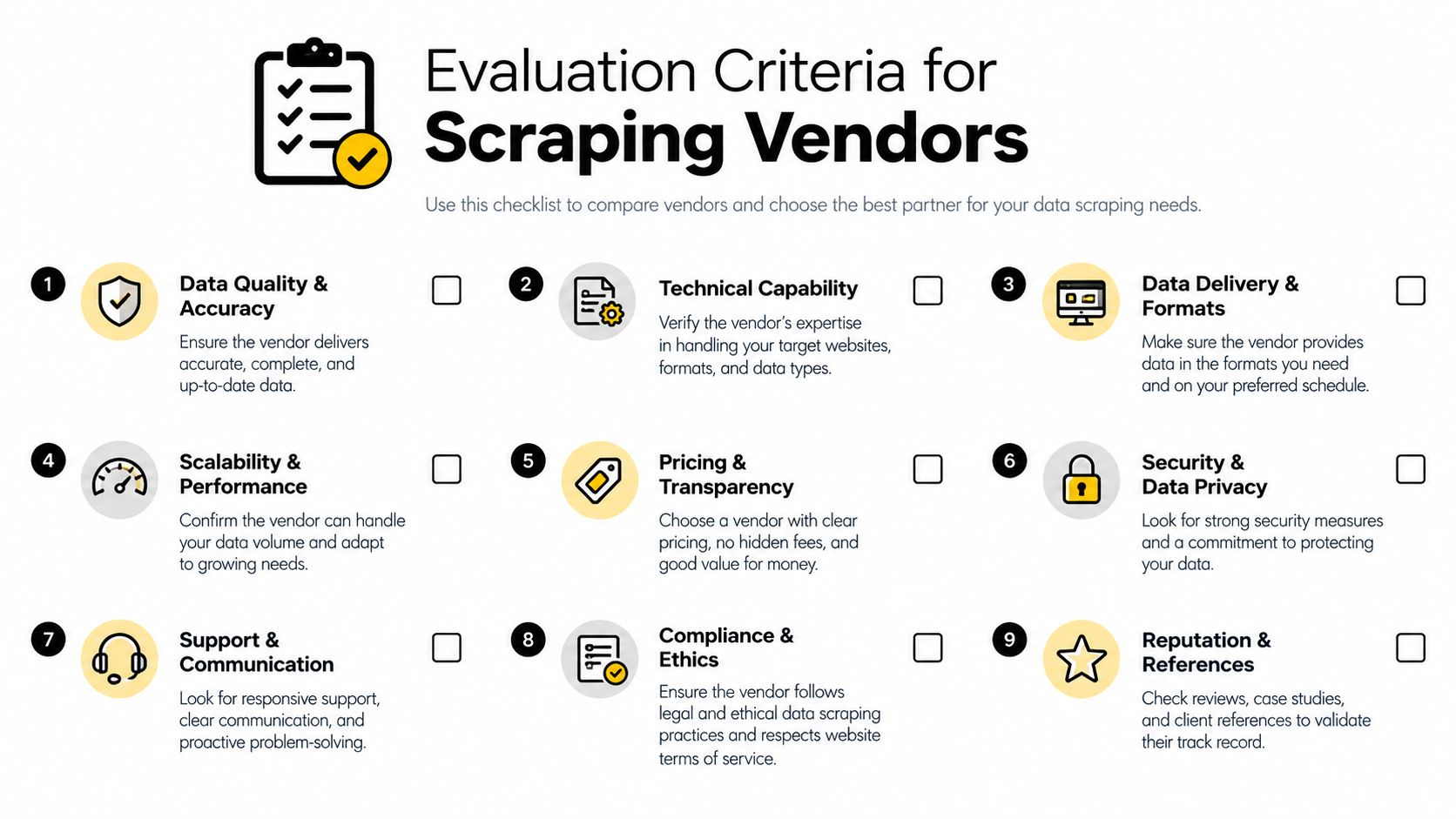
A vendor demo proves very little. Ask for a controlled evaluation using the actual domains, fields, geographic coverage, and failure conditions your product will face. The test should measure not only whether a page returns data, but whether the returned data remains trustworthy when the source changes.
Start with source coverage
Give the vendor representative property pages, search pages, pagination paths, and JavaScript-heavy views. Include pages with missing prices, multiple rooms, sold or unavailable listings, and inconsistent address formats. You're testing whether the service communicates uncertainty instead of manufacturing completeness.
Proxy quality needs more nuance than “we have residential IPs.” Ask how the service chooses a location, isolates domains, manages session affinity, and responds when a network range is blocked. A rotating address won't fix a fingerprint or request pattern that still looks automated.
Test parsing resilience
Define a contract for every field. Decide whether a missing value is null, an empty string, or a rejected record. Store source timestamps and extraction metadata so your downstream systems can distinguish “not present on the page” from “parser failed.”
Run a layout-change exercise during the trial. Modify a copied fixture, remove a selector, reorder fields, and introduce a new price format. The vendor should either continue extracting correctly or generate an observable failure. Silent success with incorrect values is worse than a visible outage.
Use this compact acceptance checklist:
- Field accuracy: Compare representative records against the rendered source, including edge cases.
- Schema controls: Confirm whether you can add fields, preserve unknown fields, and version mappings.
- Retry behavior: Require documented handling for timeouts, origin errors, and throttling responses.
- Rendering support: Verify that JavaScript execution is available where the target needs it.
- Observability: Inspect request outcomes, extraction errors, latency, and rejected records.
- Freshness controls: Set schedules or triggers appropriate to the business meaning of each field.
- Data delivery: Check whether results arrive through an API, webhook, file sink, or queue integration.
- Service terms: Review availability commitments, support response, retention, and export rights.
- Cost model: Map browser rendering, proxy usage, retries, storage, and failed requests to your expected workload.
A vendor that only reports successful requests is hiding the most important part of the system.
Validate the contract
An SLA should define the service boundary. Does availability cover request acceptance, completed extraction, or correct fields? Does it include all regions and rendering modes? What happens when the target site changes?
Read the documentation before signing. The RealtyAPI.io introduction documentation illustrates the type of implementation detail a development team needs, including how a developer-facing data layer exposes structured property data. Whether you choose that model or a generic scraper, your team should be able to build against clear request, response, authentication, and error semantics.
Finally, test exit conditions. Export a sample of your data, remove credentials, and verify that your application can replace the vendor without rewriting its entire domain model.
Generic Scrapers vs Managed Real Estate APIs
A generic scraper returns what the source exposes. A managed real estate API returns a data product with a defined model. That distinction determines where the maintenance work lives.
With a generic service, your team usually specifies URLs, extraction instructions, or selectors. You own the meaning of the fields after delivery. With a domain-specific API, the provider's responsibility extends further into normalization, deduplication, source mapping, and consistent query behavior.
| Feature | Generic Scraping Service | Managed Real Estate API |
|---|---|---|
| Input | URLs, selectors, schemas, or extraction prompts | Property search parameters, coordinates, place IDs, or source URLs |
| Output | Raw HTML, parsed fields, JSON, CSV, or custom records | Structured property and market responses |
| Source changes | Your team or vendor updates extraction logic | Provider maintains source adapters and response contracts |
| Data model | Often source-specific | Normalized across supported real estate platforms |
| Deduplication | Usually your responsibility | May be included as part of the data layer |
| Browser and proxy work | Configured per target or plan | Hidden behind the API interface |
| Best fit | Niche sources and unusual content | Search, analytics, aggregators, and recurring property workflows |
| Main trade-off | More control, more maintenance | Faster delivery, less control over extraction internals |
The raw HTML tax
Property platforms don't agree on address formats, amenity names, availability states, price representations, or listing identifiers. Even if a generic service extracts every visible field correctly, your team still has to reconcile those differences before search and analytics can work.
Deduplication is another underestimated task. The same property may appear under different URLs, source identifiers, listing states, or localized versions of a page. Matching records requires rules for addresses, coordinates, host or broker identifiers, historical prices, and changes over time. Those rules become part of your product infrastructure.
A managed API moves that work outside your application. RealtyAPI.io, for example, presents a unified interface for public real estate data from platforms including Redfin, Realtor, Airbnb, Zoopla, Bayut, Apartments.com, and Idealista. Its documented delivery options include REST, GraphQL, and webhooks, while the publisher describes structured responses for property searches and URL-based lookups.
Control versus delivery speed
DIY extraction offers control over source selection, field definitions, storage, and refresh behavior. It can be the right choice when the source is niche, the data is unstructured, or the extraction logic itself is a differentiator.
The managed route gives you less visibility into the retrieval machinery. You're trusting the provider to maintain source integrations and deliver a stable contract. That trade-off is often sensible for a consumer search product, an investment dashboard, or a channel manager where engineering time should go into ranking, workflows, and user experience rather than parser repair.
Choose raw scraping when you need access to a narrow source that domain APIs don't cover. Choose a managed real estate API when consistent property objects matter more than owning the extraction layer.
When to Choose Which Data Strategy
The decision becomes clearer when you classify the product by data shape, refresh pressure, source diversity, and consequence of stale results. A small internal research tool has different needs from a public marketplace that users trust to show current availability.
| Product situation | Sensible starting point | Why |
|---|---|---|
| Niche local classifieds | Generic scraper or focused custom crawler | The source may not be covered by a property API, and its unusual fields may matter |
| Forum or review sentiment | Generic extraction workflow | Unstructured language and discussion context are often more valuable than a normalized listing schema |
| Internal market research | Small controlled scraper or vendor trial | Limited consumers make manual validation and source changes manageable |
| Consumer property search | Managed real estate API | Search requires consistent fields, predictable latency, and dependable refresh behavior |
| Investment analytics | Managed API plus your own historical warehouse | Normalized records simplify comparisons while your warehouse preserves analytical history |
| Short-term rental channel management | Managed API with event delivery | Availability and listing updates need a stable integration surface |
| Listing aggregation | Managed API, subject to source permissions | Cross-source identity, deduplication, and normalization dominate the workload |
| Experimental one-off extraction | Narrow scraper | A short-lived project may not justify a broader data contract |
Use a generic service deliberately
A generic service makes sense when the target is outside a managed provider's coverage or when the page contains information that a normalized property model would discard. Local notices, planning documents, niche classifieds, and community discussions often fall into this category.
Keep the scope narrow. Define allowed paths, fields, refresh rules, retention, and an explicit shutdown condition. Don't let a temporary research crawler become an undocumented production dependency.
A team with strong browser automation and data-platform skills can also choose generic infrastructure when it needs precise control over sessions, rendering, or extraction logic. That control has value, but it should be counted as an ongoing engineering responsibility rather than a one-time build.
Choose an API when reliability is part of the product
A unified API is usually the rational default for high-traffic property search, investment analytics, and rental operations. These products need a stable internal model across sources. They also need predictable error handling, caching, historical storage, and a way to distinguish unavailable data from an empty result.
Team composition matters. An early startup with limited backend capacity may lose more time maintaining source adapters than it saves by avoiding provider fees. A larger data engineering group may accept that burden when source coverage, custom fields, or control over collection methods creates a strategic advantage.
If implementation capacity is the constraint, an external team can help assess or build the integration. Hire Developers is one route for finding development support, but keep ownership of the data contract, compliance record, and operational dashboards inside your company.
The best strategy can also be hybrid. Use a managed real estate API for core search and availability, then add a tightly governed scraper for a source or research signal that the API doesn't provide.
Integrating Your Chosen Data Pipeline
Start with a boundary between your application and the data provider. Your product should call an internal repository or service, not scatter provider-specific requests throughout controllers, page components, and background jobs.
Build the client safely
Keep API keys in a secret manager and inject them at runtime. Never place credentials in browser code, logs, analytics events, or committed configuration files. Give separate credentials to development, staging, and production so a test client can't affect live workloads.
Define request behavior before writing the first feature:
- Pagination: Persist the provider cursor or page token, and stop when the response indicates there are no more results.
- Timeouts: Set bounded client timeouts so one slow source doesn't consume every worker.
- Retries: Retry transient failures with exponential backoff, but don't repeat validation errors or unauthorized requests.
- Caching: Cache stable property details separately from volatile availability and pricing signals.
- Idempotency: Use a stable source identifier and request key so replayed jobs don't create duplicate records.
- Validation: Reject impossible field combinations and quarantine records that fail schema checks.
- Monitoring: Track response errors, empty results, freshness, latency, and changes in field completeness.
Keep serving separate from ingestion
A background process should fetch and normalize data into your database or search index. User-facing requests should read from that controlled layer whenever the product can tolerate asynchronous refresh. This protects the interface from source latency and gives you a place to apply deduplication, permissions, and business rules.
For live workflows, use webhooks where available rather than polling every property at the same frequency. For batch research, schedule refreshes according to how quickly the underlying field changes. A listing description and a booking availability calendar shouldn't necessarily share one refresh policy.
Provider documentation and ready-made examples can shorten the first integration, but they don't replace production safeguards. Build a fixture suite from real response shapes, test pagination and error paths, and record the provider version or schema revision with each ingestion run.
If the pipeline starts returning empty fields, stop publishing new records until validation confirms whether the source changed or the provider is experiencing an outage. In real estate products, a visible delay is easier to explain than confidently serving incorrect prices, availability, or locations.
RealtyAPI.io offers a unified developer-facing layer for structured public real estate data, with search by destination, coordinates, place ID, or URL and delivery through REST, GraphQL, and webhooks. If maintaining proxies, parsers, normalization, and source-specific retries is distracting your PropTech team from the product, visit RealtyAPI.io to evaluate the integration.