Real Estate Expired Listings: A 2026 Guide to Closing

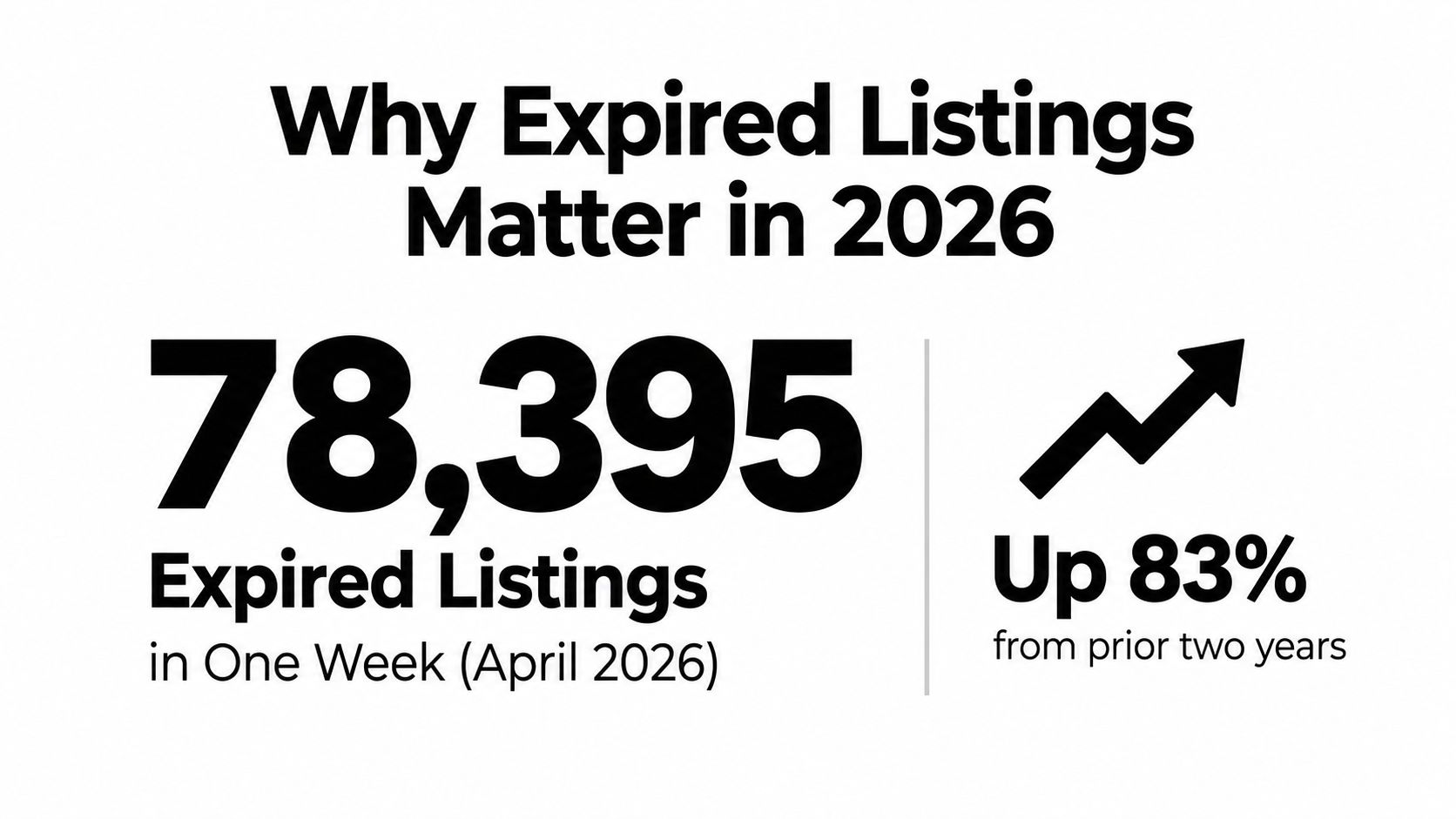
78,395 expired listings were tracked across the United States in one week in April 2026, an 83% increase over the prior two years. That volume makes expired listings more than a side tactic, they're a market signal and a pipeline opportunity for agents with a disciplined process.
A listing expiration tells you that a seller tried to move, invested in a marketing plan, and reached the end of an agreement without a completed sale. It doesn't tell you that the property is unsellable. It tells you that the previous combination of price, presentation, exposure, timing, or representation didn't produce the required result.
The mistake is treating every expired property as an identical lead. The useful approach is to build a system that identifies the event, validates the owner and property, checks outreach permissions, chooses the right channel, and records every next action.
Why Expired Listings Matter in 2026
The April 2026 figures show why expired listings deserve a defined operating process. Across all 50 U.S. states, tracking recorded 78,395 expired listings in a single week, an 83% increase over the prior two years. In Texas, weekly expirations rose from 5,348 in May 2024 to 13,648 by April 2026, a 155% increase, as documented in The market report documenting the 2026 expiration surge. The figures do not mean every state will follow the same pattern. They show how quickly a prospect pool can expand when properties remain unsold and listing agreements reach their end dates.
Expiration is a contract event
An expired listing occurs when the listing agreement ends before the property sells. The property leaves active market status, and the agent's agreement with the seller ends unless both parties sign a new one. Redfin's explanation of expired real estate listings separates this status from an ordinary off-market property.
Listing agreements commonly last three to six months. Once the contractual end date passes, the MLS status changes to Expired. Historical records may still show the original price, price changes, and days on market, giving a new agent context for a useful conversation. RealAnalytica's overview of expired listings explains why the agreement's expiration date drives this status change.
The category matters because the seller's situation differs by status. A canceled listing ended early through a decision by the seller or agent. An expired listing reached its scheduled term. An off-market property may never have been publicly listed, while a pre-foreclosure property involves separate financial and legal concerns. A system that treats all four as the same lead produces generic messaging and increases the risk of inappropriate outreach.
The seller has already tested a strategy
An expired seller has usually accepted a price, prepared the property, accommodated showings, and waited for a sale that did not happen. That experience creates a reason to contact them, but it also makes a vague “I can sell your home” pitch easy to dismiss.
The useful conversation starts with diagnosis. Review the pricing path, exposure period, presentation, and likely buyer objections before contacting the owner. Record those findings in the CRM, along with the specific change a new listing strategy would need to make.
Expired listings work best as one stage in a broader pipeline, not as an isolated lead list. Combine the status event with market context, ownership validation, permission checks, channel selection, and scheduled follow-up. Housing market value data can add property context, while lead follow-up workflows for agents can help organize the operational sequence. The lead gains value when each record supports a compliant, evidence-based next action.
Finding and Validating Expired Listings
Good outreach starts with reliable records. An expired status without a verified address, current owner, or permissible contact route is not a lead. It's an unprocessed data point that can waste an agent's time and create duplicate or inappropriate outreach.
Start with the MLS when you're a licensed participant with the necessary access. MLS data can expose the expiration event and preserve the listing history that public search sites may no longer display. Public records and property-data aggregators can add ownership information, but they may lag behind a recent transfer or reflect a mailing address that isn't the seller's preferred contact location.
Build the record before you score it
For each candidate, capture a consistent set of fields:
- Property identity: Confirm the street address, unit information, parcel reference where available, and property type.
- Listing history: Record the prior list price, changes in price, days on market, listing agent, and expiration date.
- Ownership: Compare the listing record with a current ownership source rather than assuming the former listing contact is still the owner.
- Contact path: Separate a verified mailing address from a phone number or email obtained through another source. Each channel requires its own compliance review.
- Disposition status: Check whether the property has relisted, gone pending, sold, or been withdrawn under a different record.
The point of this pass is not to collect every possible detail. It's to prevent the most common operational failure, contacting a person who no longer owns the property or pursuing a listing that has already returned to the market.
A secondary search for off-market records can supplement the process, but it shouldn't replace the expiration event itself. Off-market property search data may help identify related opportunities, yet an off-market result doesn't prove that a listing agreement expired or that the owner wants a new agent.
Score fit, not just recency
Once the records are clean, rank them by the evidence you can support. A property with a long marketing history and repeated price changes may need a different conversation from one that expired after limited exposure. Geographic concentration can make an outreach block more efficient, while property type can determine whether your marketing plan is credible.
Use a simple scorecard that answers four questions:
- Can I explain what happened?
- Can I offer a specific correction?
- Can I reach the correct owner through a permitted channel?
- Can I follow up without losing the record?
Don't inflate a lead's score because the estimated value looks attractive. A high-value property with stale ownership data and no defensible outreach route belongs in validation, not in an automated campaign.
Finally, remove duplicates before assigning leads. Match on address, parcel information, and owner identity where lawful and available. Log the source and date of each field so a teammate can understand why the record was accepted, rejected, or held for review.
Legal and Privacy Considerations for Contacting Sellers
An expired listing isn't a free pass to contact someone through every channel you can find. The end of a listing agreement may change the seller's relationship with a former agent, but it doesn't eliminate federal communications rules, state do-not-call requirements, brokerage policies, or platform-specific restrictions.
The first distinction is the source of the data. A licensed agent may have access to MLS information under rules that govern use, sharing, and solicitation. Public-record information may be available for a different purpose and still require careful handling. Don't export MLS fields into a broad marketing database or share them with an unlicensed vendor without confirming that your MLS and brokerage agreements allow it.
Treat phone and text as separate risk decisions
Calling and texting aren't interchangeable. Automated calls, prerecorded messages, and automated text campaigns can create obligations under the Telephone Consumer Protection Act, while state rules can add requirements around consent and do-not-call lists. The exact answer depends on the technology, the recipient, the number, the message, and the jurisdiction.
Before launching a campaign, document:
- Consent status: Determine whether the recipient has given the type of consent required for the planned communication.
- Registry screening: Check applicable federal and state do-not-call requirements and maintain evidence of the screening process.
- Internal suppression: Keep an immediate opt-out and do-not-contact list that every dialer, CRM, and vendor respects.
- Caller identity: Make the business identity clear and provide a lawful, usable way to stop future contact.
- Vendor controls: Review how a dialer, enrichment service, or automation provider handles numbers, recordings, opt-outs, and retention.
Compliance checkpoint: If you can't explain why you have the contact detail, why you're permitted to use it, and how you'll honor an opt-out, pause the campaign.
A personal, manual call may still be regulated. A message sent by a human may still be a solicitation. Automation increases scale, but it doesn't transfer responsibility to the software provider.
Keep the opening respectful
The seller has already had a listing experience. Don't imply that the prior agent acted improperly unless you have a documented basis and professional reason to raise the issue. State why you're calling, acknowledge that the property was previously listed, and ask whether the owner is open to discussing a new plan. If they decline, record the request and suppress future outreach as required.
Use counsel or your broker for questions about state real estate commission rules, agency relationships, advertising language, calling technology, and data licensing. A privacy policy can explain how a data platform handles information, but it doesn't replace your own legal review. For platform-specific handling details, consult the RealtyAPI.io privacy policy before designing an integration.
Outreach Strategies That Actually Work
Expired sellers respond to relevance, clarity, and respect. No channel rescues a message that ignores the seller's previous experience, and no script can compensate for an inaccurate record.
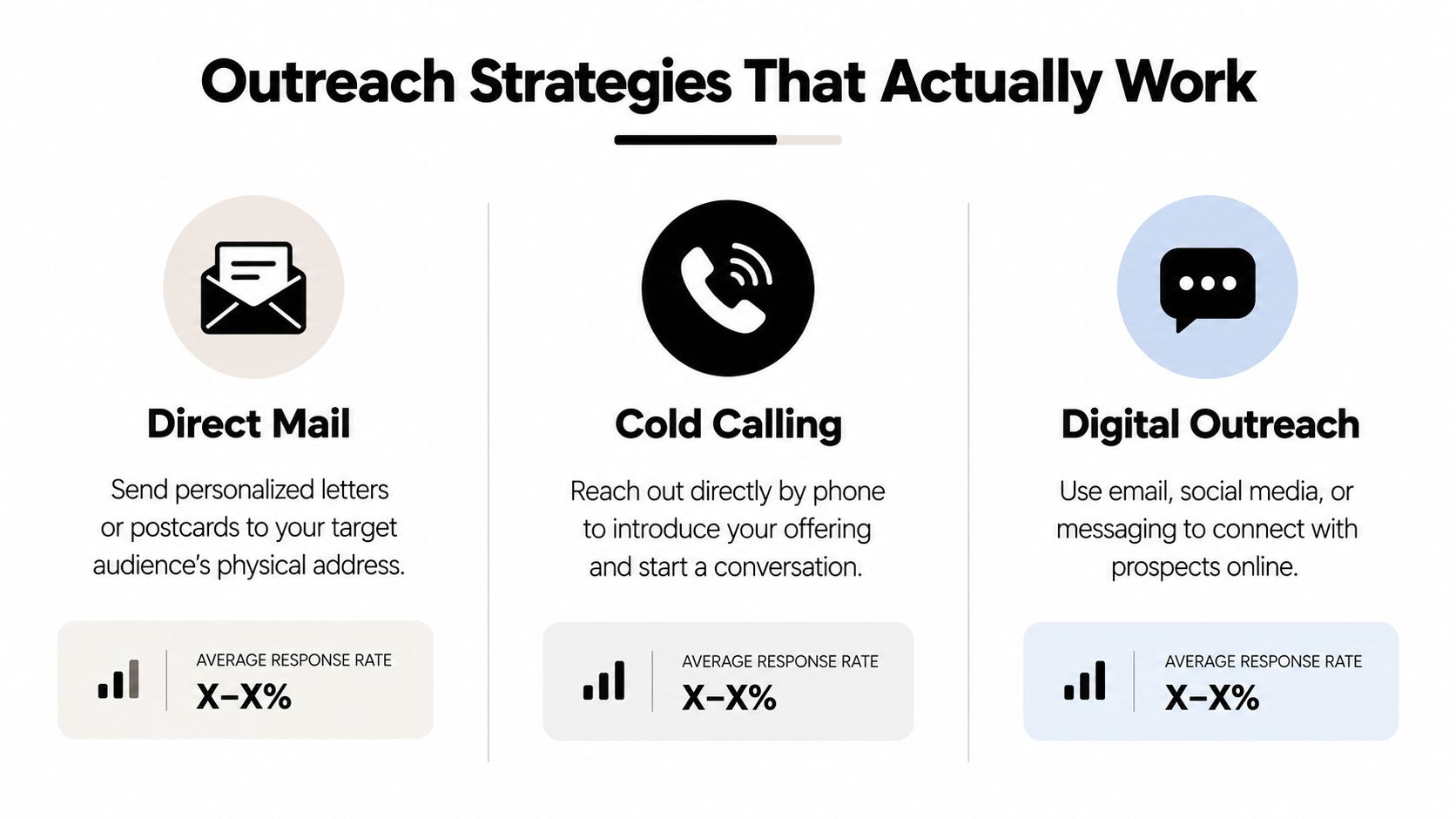
The right mix depends on your market, your license and compliance setup, your budget, and your ability to follow up. Direct mail creates a slower, more tangible touch. Cold calling creates immediate dialogue when permitted and handled well. Digital outreach can organize follow-up and deliver useful information, but it requires clean consent and careful automation.
Direct mail earns attention through preparation
A letter or postcard works best when it demonstrates that you looked at the property. Mention the previous listing period without criticizing the former agent, then point to one concrete area you'd review, such as pricing alignment, buyer presentation, showing friction, or positioning against competing homes.
Mail is easier to review for compliance than an improvised phone conversation, but it costs more per individual contact and doesn't provide immediate feedback. It also requires current mailing data and a process for removing owners who have sold, relisted, or asked not to be contacted.
A strong piece usually has one action, not several. Invite the seller to request a pricing review, reply to schedule a conversation, or visit a page explaining your relaunch process. Avoid claims about guaranteed results.
Cold calling is fast, but the conversation is the product
A call can reveal whether the owner is still considering a sale, whether circumstances changed, and what went wrong with the former listing. It also exposes weak preparation immediately. If you don't know the property history, your opening will sound like a list purchase rather than professional advice.
The first call should qualify, not force a listing appointment. A practical sequence is:
- Identify yourself and your brokerage clearly.
- Confirm that you're speaking with the owner or the appropriate decision-maker.
- Reference the prior listing factually.
- Ask whether they're still considering a sale.
- Listen for timing, objections, and preferred next steps.
- Honor a refusal or opt-out immediately.
- Record the conversation and the next permitted action.
For teams developing a calling operation, guidance on real estate agent lead generation can help with process design. The tool is secondary to accurate records, compliant dialing, and a human opening that doesn't sound copied.
Digital outreach supports continuity
Email, CRM reminders, appointment pages, and educational content can keep a qualified conversation organized. They're useful when a seller isn't ready today but may want a market review later. They become counterproductive when an agent imports every discovered address into a bulk sequence without verified permission.
Use digital follow-up to deliver something specific. A short relaunch checklist, a property-specific review, or an explanation of how you would test a new price can be more useful than a series of generic “just checking in” messages.
The most effective sequence is usually a coordinated one, not a single-channel bet. Mail can introduce the agent, a permitted call can clarify intent, and a CRM task can prevent the lead from disappearing. Each touch should add context rather than repeat the same pitch.
Building an Automated Expired Listing Pipeline
Automation should remove repetitive handling, not remove judgment. A reliable expired-listing pipeline moves records through controlled stages, with a human or rule-based review at each point where accuracy, permission, or message quality matters.
A practical architecture has five layers:
- Collection: Pull expiration events from an authorized MLS feed, a public-data source, or a real estate data API.
- Enrichment: Add ownership, property characteristics, listing history, and permitted contact fields.
- Validation: Check duplicates, current status, owner identity, and suppression lists.
- Routing: Send qualified records to the CRM, a task queue, or an approved outreach system.
- Measurement: Track contact status, replies, appointments, relisting decisions, and closed-loop outcomes.
The data layer should preserve the original event and the time it was observed. Don't overwrite an expired status just because a later query returns a different status. Store an event history so the team can distinguish a new expiration from a relist, withdrawal, pending transaction, or stale record.
Use rules that reflect the actual sales process
Filtering can be simple at first. Route a record for review when the address is inside your service area, the owner is identifiable, the property hasn't already relisted, and the listing history gives you enough context to make a relevant approach. Add a hold when ownership is uncertain, the contact path is suppressed, or the property status conflicts across sources.
A REST or GraphQL integration can retrieve records for an application or internal dashboard. Webhooks can pass events into downstream systems when the source supports them, while scheduled queries work when the team prefers controlled polling. Ready-made snippets in languages such as Python or JavaScript can reduce setup work, but the implementation still needs logging, retries, error handling, and access controls.
For a low-code workflow, connect the data event to a CRM task, then require a validation step before any communication is queued. An n8n integration workflow can help connect data retrieval with internal systems, provided the resulting automation respects data permissions and suppression rules.
At the CRM stage, use meaningful statuses rather than a single “expired” label:
- Needs validation
- Validated, not contacted
- Contact attempted
- Conversation completed
- Not ready
- Do not contact
- Appointment set
- Relisted or sold
The status should tell the next person what to do. Add the last contact date, the seller's stated timeline, the objection, the next action, and the person responsible. If a seller says they aren't ready, that isn't a failed record. It's a different follow-up category.
Automation can also coordinate calling and task management. Teams comparing vendors may evaluate an auto dialer with CRM sync, but they should test whether the product supports consent controls, suppression updates, audit logs, and clear ownership of outreach records.
Use the following operational test before activating a workflow:
- Can the system stop outreach immediately after an opt-out?
- Can a reviewer see the source and timestamp for each record?
- Can the workflow detect a relist before assigning another task?
- Can the CRM distinguish a human conversation from an automated attempt?
- Can the team export an audit trail without exposing unnecessary personal data?
If the answer to any of these is no, keep that stage manual until the gap is fixed. A smaller pipeline with trustworthy records will outperform a large queue that sends agents after stale or prohibited contacts.
The video below can serve as a visual reference while you map the data and workflow layers.
Turning Expired Listings into Closed Deals
The repeatable playbook is straightforward, even though execution requires discipline. Find the expiration event, validate the property and owner, check the outreach rules, review what happened during the previous listing, and choose a message that addresses the seller's situation rather than your own résumé.
Then route the record to a clear next action. A validated seller who wants to talk needs a prompt personal follow-up. Someone who isn't ready needs a respectful nurture task. A person who opts out needs suppression, not another sequence.
Use this audit before you scale:
- Data: Are expiration events current and deduplicated?
- Diagnosis: Can the agent explain a plausible reason the property didn't sell?
- Compliance: Are channel permissions, registry checks, and opt-outs documented?
- Message: Does the opening acknowledge the previous listing without attacking the former agent?
- Follow-up: Does every conversation create a dated next action?
- Measurement: Can the brokerage see which records became conversations, appointments, relists, or closed transactions?
The opportunity in real estate expired listings isn't the status label by itself. It's the combination of timely market intelligence, careful validation, compliant outreach, and consistent follow-through. Agents who connect those pieces can turn a volatile lead source into a dependable operating process.
RealtyAPI.io provides a developer-first real estate data layer with REST, GraphQL, and webhook options for property research, market monitoring, and workflow integrations. Visit RealtyAPI.io to evaluate how its data tools could support a validated expired-listing pipeline.