Privacy Preserving Data Explained for PropTech Teams

You're staring at a product dashboard that looks useful on the surface, but every new field you keep feels like a future privacy headache. A PropTech team might want rent trends, search behavior, and lead routing signals in one place, yet the moment personal data starts piling up, the product gets harder to ship, harder to audit, and harder to trust. Privacy preserving data gives you a way to learn from real estate signals without building a liability machine, especially when your workflow can start with public data instead of user profiles. For teams already thinking about secure AI and hosted infrastructure, privacy for AI agent hosting is a useful reference point, and if you work with live real estate feeds, the RealtyAPI.io introduction shows how a public-data-first layer fits into that kind of architecture.
Introduction Why Privacy Preserving Data Matters Now
A PropTech team starts with a practical request: show where prices are changing, which listings attract attention, and how supply shifts across neighborhoods. During implementation, the schema grows to include accounts, device IDs, saved searches, and lead histories. A dashboard built to analyze the housing market can become a system storing far more personal data than its features require.
Privacy preserving data matters because the design decision comes before the security layer. Begin with public real estate sources, collect only fields that answer a defined product question, and aggregate signals before they reach analytics or reporting systems. A public-data-first workflow, such as the one described in the RealtyAPI.io introduction, can provide market inputs without making individual behavior the default raw material.
That approach also gives engineering teams clearer boundaries. A price trend API may need property attributes and location at an appropriate geographic level, while a demand report may need counts by area and time period. Neither automatically needs a tenant's identity, a buyer's complete search history, or a lead's full interaction record. For teams reviewing hosted AI workflows, privacy for AI agent hosting offers a related reference for thinking about data exposure beyond the core application.
The field has matured beyond research demonstrations. The U.S. Census Bureau's work on differential privacy illustrates how privacy-preserving publication can support national-scale public statistics. Google's differential privacy milestones describe deployment across close to three billion devices over the prior year. Together, these examples show that privacy controls can support useful releases and production systems, provided teams define the output and its risks carefully.
Names alone do not determine safety. Pseudonymized records can remain linkable when another dataset supplies matching details, so a property, rental, or marketplace export requires more than removing direct identifiers.
Practical rule: if a feature works with public market data and aggregated signals, do not collect personal data simply because the schema permits it.
What Privacy Preserving Data Really Means
A PropTech team calls a public real estate API to compare rents across neighborhoods. The useful result may be a trend by area, while the risky result is a trail connecting a tenant, buyer, or agent to individual searches and listings. Privacy-preserving data keeps the market signal and limits the personal detail exposed behind it.
The core idea in plain language
Core principle: a system should reveal the pattern, not the person.
The principle extends beyond removing names. GDPR Recital 26 distinguishes anonymous data from personal data, while research on anonymization explains that pseudonymization replaces direct identifiers such as a name, phone number, email address, or national insurance number without automatically making the record anonymous GDPR and pseudonymization discussion. A shuffled ID can still be connected to a person when a team holds the lookup key or another dataset contains matching details.
For product teams, “no names in the table” is an incomplete test. Ask whether a user could still be singled out, linked across systems, or inferred from the result. A combination of a rare property feature, a precise location, and a timestamp may identify a household even when the schema contains no obvious personal field.
A practical API design starts with the question the product must answer. If a dashboard needs average rent by postal area, return the aggregate rather than every viewing event. If a listing search needs public property attributes, avoid retaining a complete search history unless the workflow requires it.
How to explain it to teammates
Use this shorthand with engineers and PMs. Anonymous means the data cannot reasonably be tied back to a person. Pseudonymized means direct identifiers were replaced, but the record may remain linkable. De-identified describes a reduction in identifying detail, with protection depending on the method and the surrounding data.
If another dataset could reconnect the record, treat it as still sensitive.
Privacy-preserving data is therefore a design discipline. Data minimization reduces what enters the system, and technical controls reduce exposure in storage, processing, and API responses. The product can answer, “What are average rents doing in this ZIP code?” without building a dossier on every person who viewed a listing.
The data protection for DFW firms guidance reinforces that privacy depends on what a team shares as well as what it stores. For PropTech developers, the sound default is to use aggregated public signals and introduce identifiers only when a defined workflow needs them.
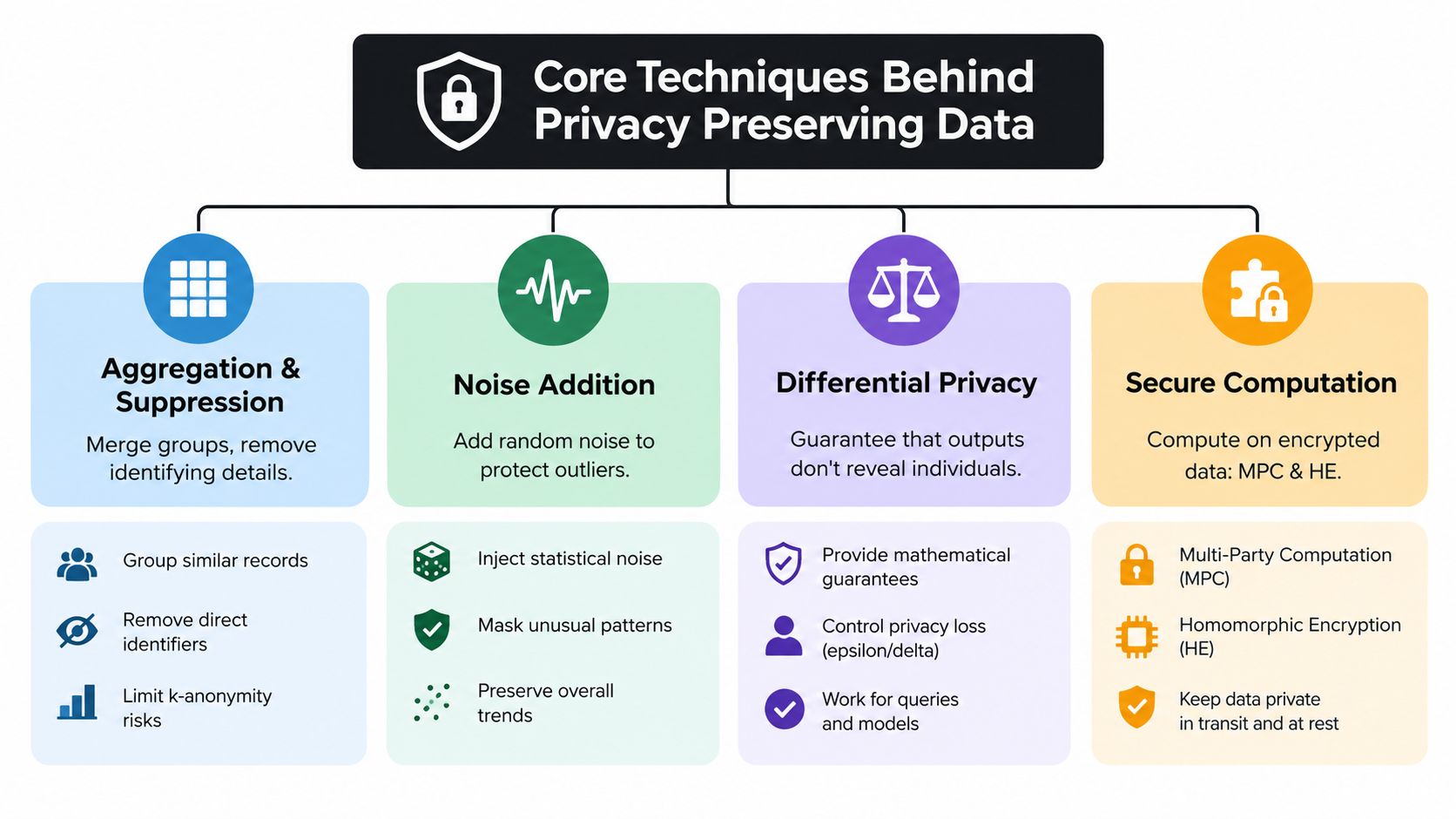
Core Techniques Behind Privacy Preserving Data
A PropTech team building a public real estate data API might need neighborhood rent trends, not the viewing history behind each request. The technique should match that output: release useful market signals while limiting exposure of tenants, buyers, landlords, and agents.
The main families of methods
Aggregation and suppression provide the simplest control. Group records by a meaningful area or cohort, hide very small groups, and remove fields that do not affect the product decision. A market dashboard can return average rent by neighborhood rather than apartment-level records or a complete trail of user activity.
Noise addition changes exact values while preserving broader patterns. A system might perturb counts, rankings, or trend points so one record has less influence on the response. This works well when users need directional insight rather than exact per-record truth.
Differential privacy turns that protection into a measurable rule. The formal ε-differential privacy definition describes a privacy budget in which ε represents the permitted privacy loss and δ represents a bounded probability that the guarantee may fail. Smaller ε generally provides stronger privacy. In an API, that budget can govern repeated aggregate queries instead of leaving protection to an informal promise.
Secure multi-party computation and homomorphic encryption address computation itself. The technical foundation for these methods allows parties to calculate over protected inputs without exposing their raw records. With homomorphic encryption, the decrypted result corresponds to the result of performing the calculation on plaintext. That makes these methods suitable for collaboration between firms that need shared analysis but cannot exchange source data.
When each method fits
- Aggregation and suppression: use them when the answer works at a grouped level, such as a market heatmap or cohort summary.
- Noise addition: use it when the product needs more detail than a simple aggregate, while reducing the effect of any individual record.
- Differential privacy: use it for repeatable, policy-driven releases with an explicit privacy budget.
- Secure computation: use it when multiple parties need joint analysis and each party must keep raw records private.
These methods protect different workflow layers. Aggregation and noise mainly control what an API releases. Secure computation protects inputs during collaborative processing. Differential privacy can govern repeated outputs across both design and operations. The zero-knowledge proofs for blockchain privacy discussion offers an adjacent cryptographic example. PropTech teams can usually begin with minimization, aggregation, and access controls before adopting more complex cryptography.
Threat Models and the Privacy Utility Tradeoff
A rental analytics endpoint may return only neighborhood, property type, and price bands, yet still create privacy risk when combined with other datasets. A PropTech team must therefore evaluate both sides of the workflow: what an attacker could infer and what product users need. Privacy protection has value only when the release remains useful for its intended API or dashboard task.
What can go wrong
Linkage attacks occur when someone joins your output with public records, listing sites, location signals, or another dataset to identify a person indirectly. Real estate data is particularly exposed because many sources describe the same properties, areas, and transactions.
Singling out occurs when one record can be distinguished from the rest, even without a displayed name. A rare property type, unusual transaction pattern, or small geographic group may make one household recognizable.
Inference risk is subtler. An output can omit a private attribute while still helping someone predict it. Repeated market slices, for example, may reveal information about a property or resident that no single response states directly.
How to think about budgets and failure modes
The privacy budget makes repeated access part of the design decision. One query may be harmless, while a sequence of filters, exports, and time-based comparisons gradually exposes more detail. For differential privacy, ε captures how much privacy you're willing to spend, while δ captures a bounded probability of failure (see definition above).
Decision rule: if a query matters only at the individual-record level, it probably does not belong in a privacy-safe release.
Teams can compare three practical measures. Accuracy loss shows how far a protected result moves from the underlying value. Query sensitivity shows how much one record can change that result. Disclosure risk estimates whether the response could expose information that the API should withhold.
| Privacy Level | Technique Example | Utility Impact | Best For |
|---|---|---|---|
| Low | Minimal aggregation, light suppression | High accuracy, weaker protection | Internal exploration on low-risk public data |
| Medium | Noise-added counts and grouped metrics | Moderate distortion, useful trends remain | Market dashboards and benchmarking |
| High | Differential privacy or secure computation | More distortion or more compute cost | Sensitive analytics and cross-company collaboration |
Use lower protection only when the source is already public, the response is coarse, and exposure would have limited consequences. Choose stronger controls when results are repeatable, user-facing, unusually specific, or easy to connect with other datasets. For PropTech developers, the safest utility tradeoff often starts with asking whether the endpoint can answer the product question without collecting personal data at all.
Implementation Patterns for Engineering Teams
The cleanest privacy design starts before the database schema. In PropTech, that usually means asking whether the feature needs user data at all, or whether public listing data, market signals, and aggregate counts can solve the same problem with much less exposure.
Build privacy into the API flow
Start with data minimization by design. If a search endpoint only needs location, property type, and time range, don't log unnecessary user attributes just because the request object contains them. Field filtering matters here, especially in analytics pipelines where one oversized payload can spread personal data into logs, caches, exports, and dashboards.
Use public-data APIs when the product can rely on public real estate signals instead of collected personal data. If you're building search, benchmarking, or inventory intelligence, that approach reduces the amount of sensitive information you need to protect in the first place. Realty teams can still derive useful product behavior from marketplace and listing data without asking users for more than the workflow needs.
Protect the data as it moves
Add noise at the source when you're computing statistics that don't need exact precision. For example, a rental trend chart can often tolerate some fuzziness if the output remains directionally correct. If you're serving multiple API calls from the same source, treat the privacy budget like a shared resource and document where each release spends it.
Secure computation belongs in the workflow when multiple parties need joint analytics but don't want to exchange raw records. That's the right shape for some brokerage, lender, and platform partnerships, especially when each side needs to keep control of its own dataset.
Keep the operational details clean
- Scope webhooks tightly: only send the fields the downstream service needs.
- Handle retries carefully: retry the request, not the personal data blast radius.
- Log without PII: use request IDs, not names or emails, in observability tools.
- Rotate access deliberately: limit who can touch the raw feed and why.
- Use secure defaults in testing: sanitize sample payloads before they reach shared environments.
For teams experimenting with live property data, the RealtyAPI.io API playground is a practical way to test request shapes without building around unnecessary personal data from day one. The same principle applies whether you're wiring REST, GraphQL, or webhooks into an internal analytics layer.
Regulatory Considerations Tooling and Evaluation Guidance
A PropTech team can build a useful workflow and still fail a privacy review if it cannot explain what data it kept, why it kept it, and how it reduced the chance of re-identification. Regulators care about the legal status of the dataset, the safeguards around it, and whether the paper trail matches the actual system. Pseudonymization alone does not make a dataset anonymous when linkage is still possible through keys or auxiliary data, as discussed earlier.
How to evaluate the legal posture
GDPR analysis starts with a simple question, is the output still personal data under Recital 26. For CCPA-style review, the same practical test applies, if a record can still be tied back to a consumer or household, treat it as operationally sensitive even after identifiers are swapped. The documentation should show what was removed, what remains, and how the team reduced re-identification risk.
Public-sector practice shows how privacy methods moved from theory into real publishing workflows, as noted earlier. Large-scale production deployments show the same pattern, privacy controls can run inside distributed systems without forcing teams to collect more personal data than they need.
What to look for in tooling
Choose tooling by matching it to the release shape.
- Statistical disclosure control tools fit grouped reporting and suppression rules.
- Differential privacy frameworks fit repeated releases where a privacy budget must be tracked.
- Encrypted computation platforms fit multi-party workflows where raw inputs stay separate.
- Operational controls matter too, especially audit logs, access controls, and retention policies.
The RealtyAPI.io privacy policy is a useful reference for the kind of operational detail teams should check in a vendor. It describes access, correction, export, and deletion requests, along with retention and security controls. That kind of policy trail helps a product team explain how personal data is handled when a customer, partner, or regulator asks.
A good tool should also fit the way your API moves data. If it is hard to explain to product, hard to audit in logs, and hard to run within your normal latency profile, it is probably the wrong first choice for a PropTech stack.
Practical Examples and Next Steps for PropTech Developers
A market trend dashboard is the easiest place to start. If the product only needs neighborhood-level movement, you can build it from aggregated public signals and avoid storing user-level browsing traces. A rental price benchmarking feature can follow the same pattern, pull public listings, compare cohorts, and keep the output coarse enough that no single record carries the whole story.
Cross-platform listing analytics is where the workflow gets interesting. That's the kind of problem where teams often want to join multiple sources, compare amenities, and normalize fields across markets. The RealtyAPI.io image mask endpoint points to the kind of public-data workflow where you can work with listing media and metadata without drifting into unnecessary personal collection.
The operational checklist is straightforward:
- Audit every field you collect. Keep only the fields that change a product decision.
- Classify each output. Decide whether it needs public aggregation, noise, or stronger computation controls.
- Track privacy budgets. Treat repeated analytics releases as a shared resource, not an infinite one.
- Review logs and webhooks. Strip personal data out of observability paths.
- Reassess after launch. If a metric isn't used, stop collecting it.
If a metric helps sales but not the product, it probably belongs in a separate, more tightly controlled system.
The right long-term habit is to build on public data first, then add privacy-preserving controls only where the use case needs them. That keeps the product simpler, the compliance story cleaner, and the analytics layer easier to maintain.
If you're building PropTech products that depend on live market data, RealtyAPI.io gives you a public-data layer for listings, trends, and market signals so you can keep personal data out of your core workflows. Visit RealtyAPI.io to see how a developer-first API can support privacy-aware search, analytics, and monitoring without over-collecting from the start.