New York State Filing Receipt: A Complete Guide
You've submitted your formation documents, received a confirmation email, and now a one-page PDF is sitting in your inbox without much explanation. That document is your New York State filing receipt, and it's more important than its modest appearance suggests. It gives you the state's record of what was filed, when it was filed, under which entity name, and what fees were paid.
Treat it as a checkpoint, not a disposable acknowledgment. The New York Department of State says the receipt is the official proof of filing for an entity formation or other filing, and it warns filers to verify the document because duplicates aren't issued if the original is lost or destroyed. You should use this checkpoint to confirm the record, organize your permanent files, prepare for banking and tax registrations, complete required notices, and calendar future compliance obligations.
Why Your New York State Filing Receipt Matters
A founder often opens the receipt expecting a simple “approved” message. Instead, the PDF may contain a filing date, entity information, a summary of the submitted material, and payment details. Those fields are the first durable evidence connecting your business to a New York Department of State filing.
The state describes the filing receipt as the official proof that a filing was made. For an LLC, it's issued to the filer of the Articles of Organization. Online filers receive it by email, while paper-filed documents are returned by first-class mail, according to the New York Department of State's LLC formation guidance.
Use the receipt as a five-part checkpoint
Start with the document itself, not with the assumptions that follow from receiving it.
Verify the record. Compare the entity name, filing date, entity type, address information, and payment details with the documents you submitted. A typo is easier to correct while the filing is fresh than after it appears in bank, tax, licensing, and contract records.
Prepare for banking. A bank may ask for formation evidence before opening a business account. Keep the receipt available with the formation document and ownership records.
Support the EIN process. The receipt can help you organize the information needed for a federal employer identification number application, but it doesn't replace the IRS process or prove that every tax registration is complete.
Track public-facing requirements. Some entities must complete additional New York requirements after formation. The receipt gives you a reliable filing date from which to organize those tasks.
Set compliance reminders. Use the entity record and state instructions to identify future statements, reports, and tax obligations. Don't rely on an inbox search months later.
Practical rule: Review the receipt on the day it arrives, then save it somewhere you control. Minutes spent checking the record can prevent a much larger records problem later.
A receipt doesn't answer every question about whether the business can operate, obtain a license, open an account, or sign a particular contract. It does establish the state filing record that those later processes often need to examine.
What a New York State Filing Receipt Actually Is
In plain language, a New York State filing receipt is the Department of State's written record that it received and processed a business filing. For an LLC, the underlying filing is usually the Articles of Organization. For a corporation, it's commonly the Certificate of Incorporation.
The receipt records key administrative information, including the filing date, entity name, an extract of the submitted information, and the fees paid, as explained by the New York Department of State's business entity FAQ. It may also show the state-assigned identification information and details connected with the filing submission.
Separate the receipt from other state documents
Several New York documents can sound interchangeable, but they serve different purposes.
- Filing receipt: Shows that a specific filing was made and records the state's filing information.
- Certificate of Good Standing or Existence: Used to demonstrate a current status when a bank, lender, contracting party, or another government body requests that evidence.
- Certified copy: Reproduces the underlying formation document or another filed record with official certification.
- Formation document: The Articles of Organization or Certificate of Incorporation that established the entity record.
The receipt is therefore not the same as a certified copy, and it isn't a universal certificate of active business status. It confirms the filing record, while another organization may ask for a different document because it needs certified content or current status.
The distinction matters during onboarding. A bank might accept a filing receipt for one review and request a certified formation document or status certificate for another. A lender, licensing office, or foreign jurisdiction can apply its own document standards.
Know what you're holding
The receipt itself is an administrative record, not a certified reproduction of the complete formation document. If you're preparing a paper submission, copying the formation documents, or assembling a corporate records package, a provider offering forms for copy and print services may help with document preparation and physical records.
Don't discard the receipt merely because you have the Articles of Organization or Certificate of Incorporation. The state treats the receipt as proof of filing and may include payment accounting that isn't presented in the same way elsewhere.
How to Read and Verify the Fields on the Receipt
Read the receipt against the filing package you submitted. The goal isn't just to confirm that the business name appears somewhere on the page. You're checking whether the state's administrative record matches the legal information you intended to create.
Start with the identity fields
Look for the DOS identification number or equivalent state identifier. This number connects later searches and correspondence to the entity record, so copy it into your internal records exactly as shown.
Next, identify the filing type or entity code. A code indicating a domestic LLC, for example, should align with the formation document and the entity structure you selected. If the code suggests a different filing category, stop and investigate before using the receipt for downstream applications.
Then inspect the legal entity name character by character. Compare capitalization where relevant, spelling, punctuation, spaces, and the complete designator. An omitted “LLC,” “Inc.,” or other required suffix can create inconsistencies between the state record, tax filings, contracts, invoices, and bank documents.
Check location and contact information
Review the county and state information against the submitted formation paperwork. Then examine any registered agent or service address shown on the receipt.
Ask practical questions:
- Is the address complete? Check the street number, unit or suite, city, state, and ZIP code.
- Does the address match the filing? Compare it with the original document rather than relying on memory.
- Is the agent information accurate? Confirm the named agent or service provider agreed to receive official communications.
- Does the address represent a real receiving location? An incorrect or unusable address can cause missed notices even if the entity name is correct.
Finish with dates and payment records
The filing date assigned by the Department of State is especially important. It anchors the state record and can affect how you describe the entity's existence to banks, counterparties, and professional advisers.
Review the filer or service company information, receipt number, invoice number, and fee lines. A published New York filing receipt example shows $285.00 in total payments received, including a $250.00 filing fee in the document's payment accounting (New York filing receipt example).
If anything differs from your submitted documents, flag it promptly with the filing provider or the Department of State. Don't wait until a bank or tax application exposes the mismatch.
Processing Timelines for Online and Paper Filings
Delivery depends heavily on how the filing was submitted. New York's published guidance describes a clear difference between electronic delivery and traditional mail.
For corporations, the Department of State says filing receipts are mailed two business days after the Certificate of Incorporation is filed. Online filers may receive the receipt by email within minutes or find it attached as a PDF to the filing acknowledgment, according to the New York business corporation formation guidance.
That difference changes how you plan the first week. An online filing can put the receipt in your hands quickly, while a paper filing requires you to monitor both processing and mail delivery. Neither route removes the need to review the underlying information.
Compare the routes
| Submission Method | Typical Processing Window | Common Delay Variables | Expedited Option |
|---|---|---|---|
| Online filing | Electronic receipt delivery can occur within minutes or after a short processing delay | Filing volume, name review, incomplete information, or a submission issue | Availability depends on the filing service and current state procedures |
| Paper filing | Receipt is returned by first-class mail after processing | Mail transit, filing queues, incomplete cover pages, payment problems, or name conflicts | Check current Department of State procedures before relying on priority handling |
The state's timing information supports a practical conclusion: electronic submission can provide much faster access to the proof document than paper filing. It doesn't mean the receipt is a broader approval of every operational step.
Plan around the document you actually have
If you need to open a bank account, apply for an EIN, register for sales tax, or sign contracts in the entity's name, organize those tasks around the receipt and the formation documents. A bank may still request a certified copy, an operating agreement, ownership information, or a current status certificate.
Don't promise a counterparty that a receipt will satisfy its onboarding checklist. Ask what document it requires, then obtain the correct record rather than treating fast electronic delivery as proof that every external review is complete.
What the Receipt Proves and What It Does Not
The central distinction is simple: the receipt proves that the filing was made and recorded, but it doesn't prove that every later requirement has been satisfied.
New York describes the filing receipt as official proof of filing. That gives it real administrative value. It identifies the filing date, entity name, submitted information extract, and fee accounting, making it useful when you need to show what was submitted to the Department of State.
The mistake is treating that proof as a universal operating license. A receipt isn't the Articles of Organization or Certificate of Incorporation, it doesn't replace a certified copy, and it doesn't automatically establish good standing for every third party.
Apply the distinction to common next steps
Banking: The receipt may support an account-opening review, particularly when paired with the formation document and ownership records. The bank can still request a certified copy, a status certificate, identification, or an operating agreement.
Federal tax registration: The receipt helps confirm the legal name and state filing date for your records. It doesn't issue an EIN, determine federal tax classification, or complete tax registrations.
New York sales tax: A business may need a separate registration through the Tax Department if its activities require one. The receipt establishes the entity record, but it doesn't grant a sales tax authority or local business license.
Local licensing: Municipal agencies can impose their own licensing and permit requirements. A state filing receipt won't substitute for those approvals.
Contracts and diligence: A customer, lender, landlord, or procurement team may request proof of good standing or a certified formation record. Give them the document their checklist requires rather than assuming the receipt will be accepted.
A filing receipt answers “Was this filing made?” It doesn't automatically answer “Is this business licensed, tax-registered, insured, or approved for this transaction?”
The same caution applies when reviewing online service agreements or vendor onboarding terms. Read the document requirements carefully, including those in RealtyAPI.io's terms and conditions, and distinguish proof of filing from the broader representations a contract may require.
Storing the Receipt and Building a Permanent Record
New York says it does not issue duplicate filing receipts if the original is lost or destroyed. That rule turns document storage into a compliance control, not an administrative preference.
Save the original PDF as soon as it arrives. Don't rely on the email account that received it, because inbox access can change when a founder leaves, a service provider closes an account, or a domain is migrated.
Build a structured entity file
Use a folder hierarchy that makes the document easy to find:
- 01 Formation: Filing receipt, Articles of Organization, Certificate of Incorporation, and state correspondence.
- 02 Federal tax: EIN confirmation and federal classification records.
- 03 Governance: Operating agreement, bylaws, consents, resolutions, and ownership records.
- 04 State compliance: Biennial statements, annual reports, tax registrations, licenses, and notices.
- 05 Contracts and finance: Banking documents, lender records, major agreements, and insurance files.
Name the receipt with the entity name, document type, and filing date. For example, use a consistent format such as EntityName_NY_FilingReceipt_FilingDate.pdf, replacing those labels with the actual information. The exact convention matters less than using it every time.
Create redundancy without creating confusion
Keep the original digital file in the primary corporate records location and a mirrored copy in a separate cloud account or with the registered agent. If you maintain a physical records book, print a legible copy and note where the original digital file is stored.
A compliance coordinator, paralegal, or virtual legal assistant can help standardize naming, permissions, and document indexing without changing the underlying legal record. Restrict editing rights so the stored file remains an exact copy of the document issued by the state.
Use a separate records policy for systems that handle personal information. Review the relevant RealtyAPI.io privacy policy when evaluating how an external platform describes data handling, access, and retention.
Keep the receipt for the life of the entity. It may be needed years later during an amendment, dissolution, audit, bank review, ownership dispute, tax inquiry, contract dispute, or lender diligence. Permanent retention is the sensible default because the state won't recreate the original receipt on request.
Replacing a Lost or Destroyed Receipt
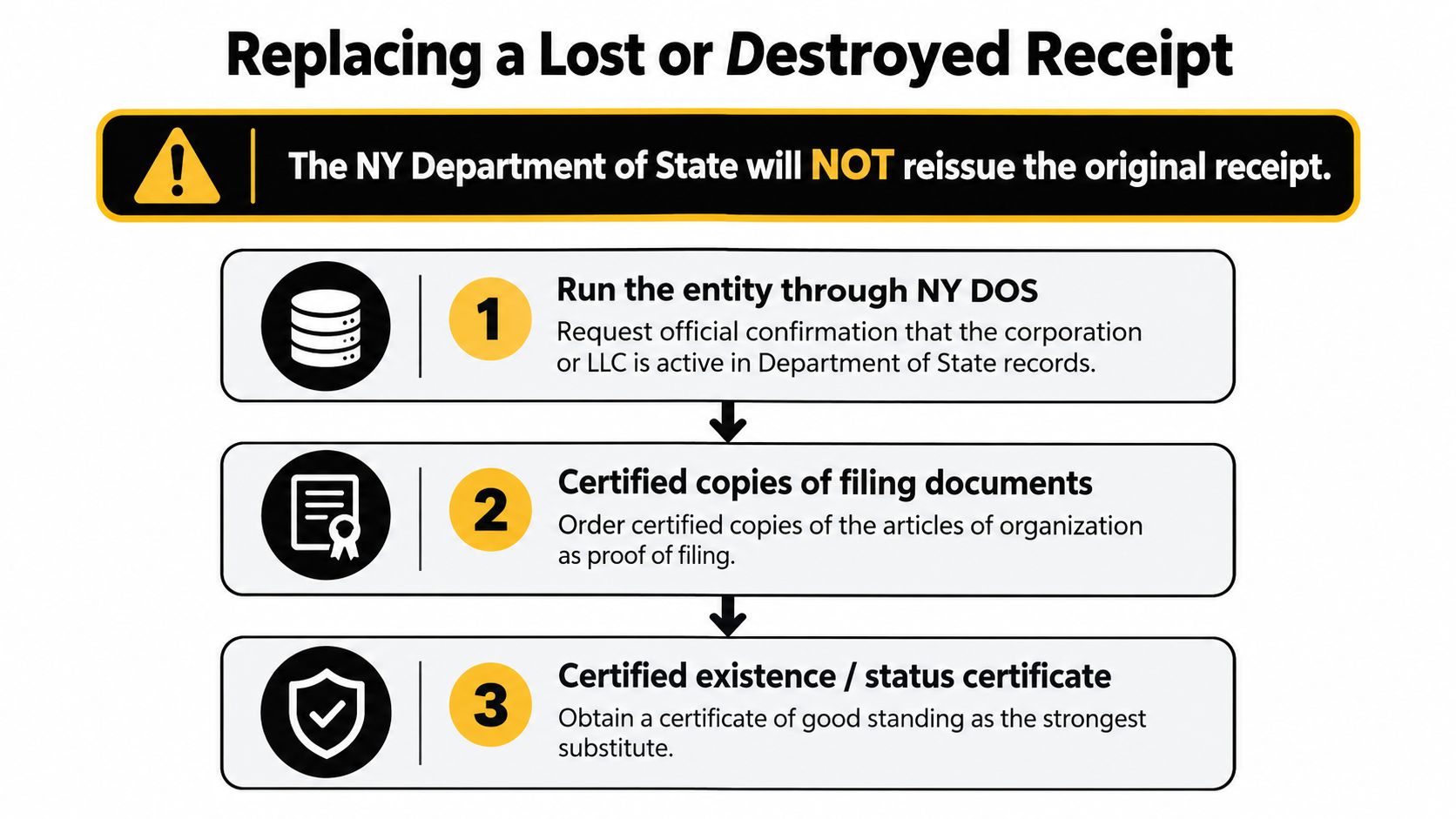
If the original receipt is gone, start with an important limitation: the New York Department of State will not reissue the original filing receipt. You can still rebuild a credible evidence package, but the replacement may be a different document with a different purpose.
Use substitutes in a sensible order
First, search the public entity record. Run the LLC or corporation through the New York Department of State's public database and save the current entity information. This can help confirm that the entity appears in state records, although it isn't the same as the lost receipt.
Next, order a certified copy of the formation filing. For an LLC, that generally means a certified copy of the Articles of Organization. For a corporation, it generally means a certified copy of the Certificate of Incorporation. A certified copy can be stronger evidence for a bank, lender, accountant, contracting party, or government office that needs the underlying filing rather than the receipt.
Finally, recover secondary evidence. Search the original filer's email account, service-provider portal, payment records, and filing acknowledgments. These materials can help reconstruct the submission history, but a third party may still insist on a certified state document.
The Department of State's published formation materials don't establish one universal replacement fee or turnaround for every certified-copy request. Contact the Division of Corporations or an authorized records service for the current fee, processing time, mailing instructions, and required request language before submitting payment.
For cross-border use, a certified copy may not be enough. A foreign authority may ask for an apostille or a Certificate of Good Standing, depending on whether it needs authentication of the document, evidence of current status, or both. Ask the receiving authority for its exact checklist.
If you need help identifying the right replacement record or coordinating a records request, use the provider's contact page and explain that the original receipt is unavailable. Keep every replacement document together with a note stating why it was obtained and which original record it replaces.
Your Next Steps After the Receipt Arrives
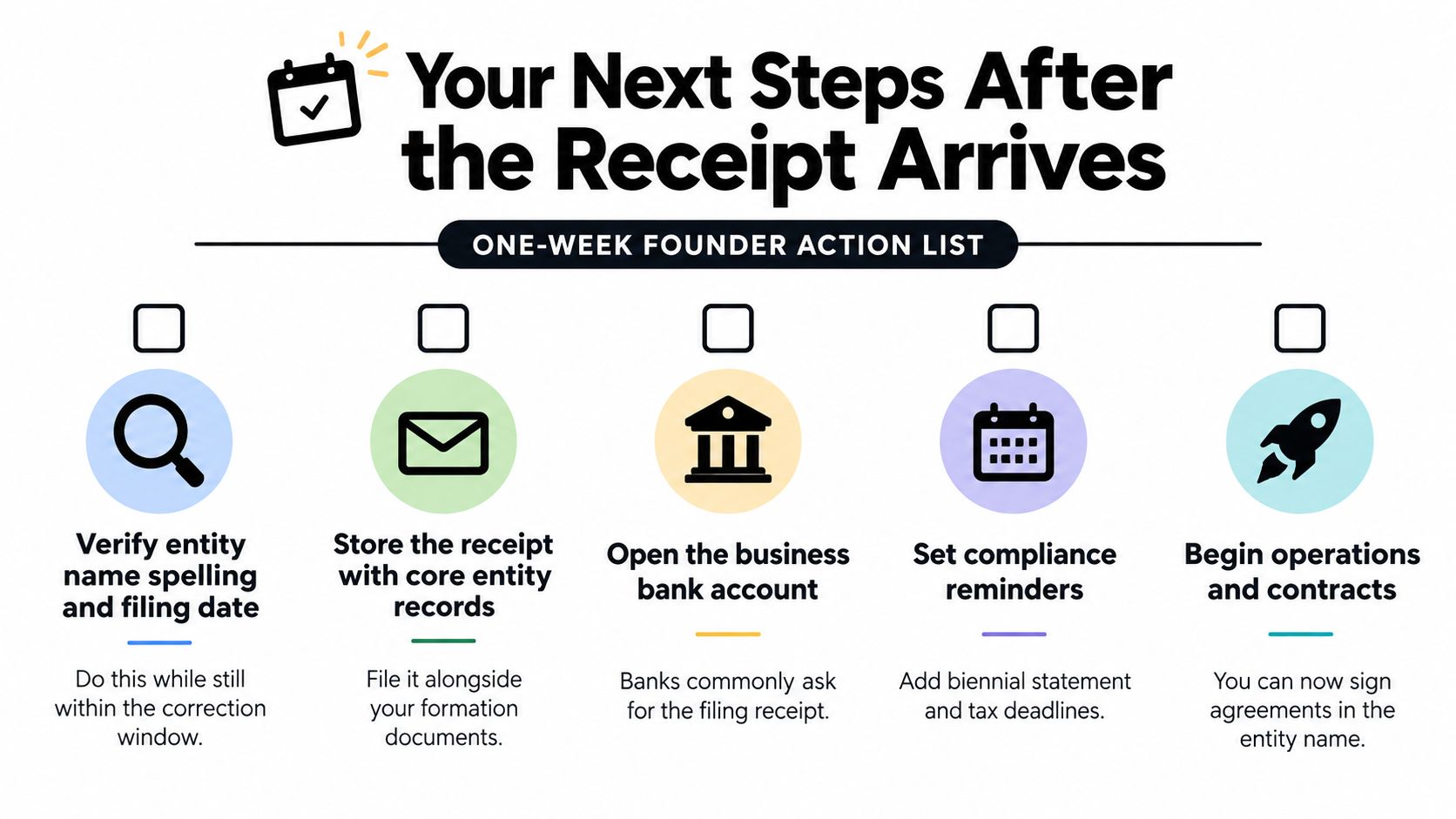
The first week after formation should be administrative, not improvised. Use the receipt to establish one source of truth for the entity's name, filing date, state identifier, and formation record.
Complete the immediate review
Begin with the high-risk details:
- Verify the legal name: Check spelling, punctuation, spacing, and the complete LLC or corporate designator.
- Confirm the filing date: Make sure it matches the date shown in your submission records.
- Save the records: Store the receipt with the formation document, governance records, and tax confirmations.
- Open the bank workflow: Prepare the receipt, formation document, ownership information, and any additional items the bank requests.
- Create compliance reminders: Calendar future state statements, reports, tax registrations, and renewal tasks based on the entity's actual obligations.
If the receipt contains an error, contact the filing provider or the Department of State promptly. Don't assume a bank, tax agency, or counterparty will correct a mismatch on its own.
Trigger dependent registrations carefully
Once the state record is confirmed, handle the tasks that apply to your business:
- Federal EIN application: Complete the IRS process if the entity needs an EIN and you haven't already obtained one.
- Multi-member LLC tax work: Ask a tax professional whether an IT-205 allocation or another filing applies to your ownership and income structure.
- Beneficial ownership reporting: Assess the entity's BOI reporting obligations under current FinCEN rules.
- Sales tax registration: Determine whether the business must register through New York's Online Accounts Management portal.
- Bank onboarding: Submit the exact documents requested by the financial institution.
- Contracts: Sign agreements in the legal entity's name only after confirming that the counterparty accepts your evidence package.
The receipt anchors these steps because it ties the entity name and formation date to the state filing record. It doesn't complete them for you.
For practical guidance on building data-driven business workflows, browse the RealtyAPI.io blog, then return to your entity records and make sure the receipt is searchable, backed up, and available to the people responsible for compliance.
RealtyAPI.io provides a developer-first API for public real estate listings, pricing signals, availability, reviews, and market data through REST, GraphQL, and webhooks. Visit RealtyAPI.io to explore the platform and get an API key for building reliable property search, analytics, or market-monitoring products.