Facebook Marketplace API: The 2026 Guide for Developers

You're probably here because you tried the obvious path first.
You searched Meta's docs, found references to commerce APIs, saw blog posts that implied a Facebook Marketplace API exists, maybe opened Graph API Explorer, and expected to find a listings endpoint somewhere under products, commerce, or marketplace. Then you lost an afternoon chasing dead ends.
That frustration is justified. The naming is confusing, the tutorials are inconsistent, and the answer most developers need is usually buried under seller-focused documentation that doesn't match the actual problem. If your goal is to retrieve general Facebook Marketplace listings, prices, seller data, or search results for analytics, aggregation, or monitoring, the simple answer is that the platform doesn't expose a public API for that use case.
The Truth About the Facebook Marketplace API
The key thing to understand is that the Facebook Marketplace API most developers think exists doesn't exist.
A lot of search results blur together two completely different ideas. One is an official commerce integration for approved businesses that want to manage their own catalog and orders on Meta surfaces. The other is the thing most engineers seek when they search for “Facebook Marketplace API”: general access to listings, prices, search results, and seller data across the marketplace. That second thing isn't publicly available.
Meta's own marketplace partnership documentation is where the confusion starts to clear. The persistent gap is the mix-up between the official but limited Commerce Partner Item API and the nonexistent public API for general listing or data access, a point reflected in Meta docs and long-running developer discussions from 2019 to 2026 in the Marketplace partnerships documentation.
Practical rule: If your product idea starts with “we'll just pull Facebook Marketplace listings through the API,” you need to stop and validate the data source before writing the first line of integration code.
This is why so many projects stall in the same place. A junior developer sees “Marketplace” in Meta documentation and assumes access to marketplace data. A PM hears “Graph API” and assumes everything on Facebook is queryable. Neither assumption survives implementation.
The constraint isn't that you missed a hidden endpoint or forgot a permission scope. The constraint is platform policy and product scope. If you need broad marketplace data access for research, aggregation, or analytics, there is no public Meta-supported endpoint for that workflow.
What Exists Officially Facebook Commerce and Graph APIs
There are official APIs around commerce. They're just narrower than often anticipated, and they exist for sellers and approved partners, not for third-party marketplace intelligence.
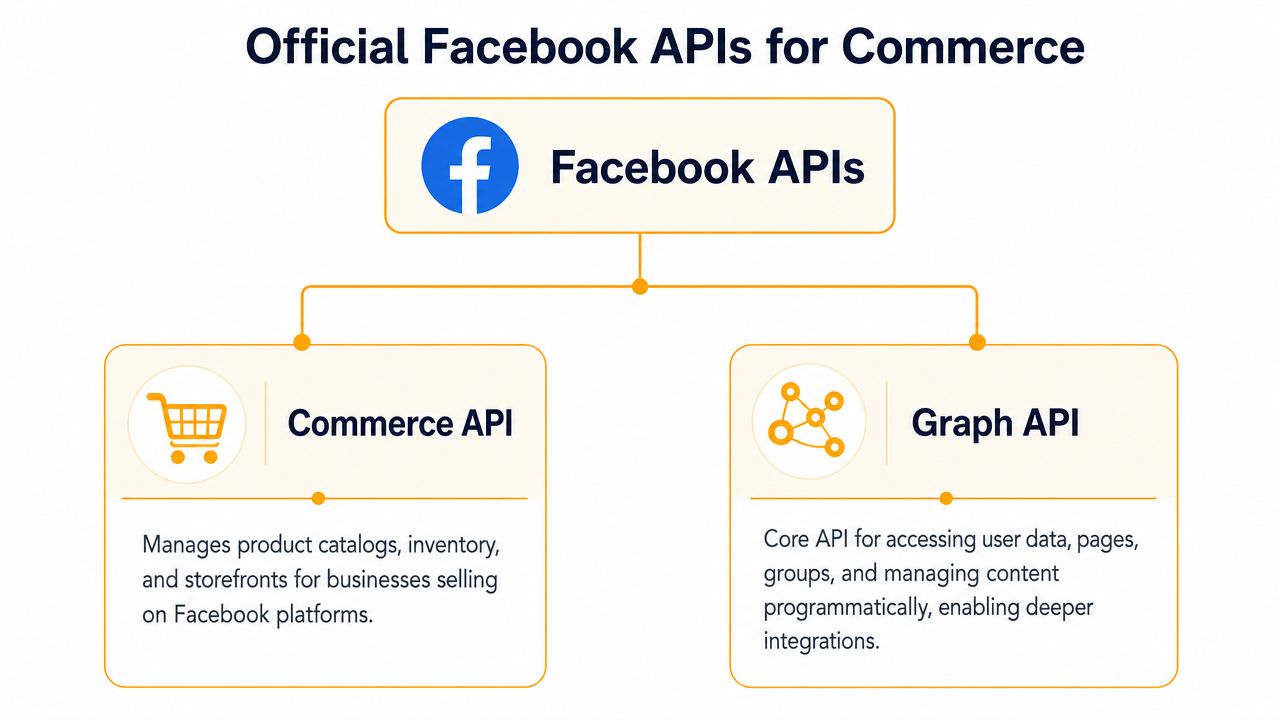
The official APIs are seller tools, not market data tools
The cleanest summary is this: Facebook Marketplace doesn't provide a public, open API for retrieving general listings. Instead, Meta offers a restricted Commerce Platform API for approved Meta partners in a limited alpha program, aimed at businesses that need to create and update listings, sync inventory in real time, and manage orders, as described in this developer guide to Facebook Marketplace API access.
That distinction matters because it changes the architecture of your application. If you're building software for a merchant who sells on Meta, official APIs may help. If you're building a search engine, pricing monitor, market scanner, or real estate intelligence product, the official routes won't give you the marketplace-wide dataset you want.
What each official path actually does
Here's the practical breakdown.
Official path | Who it serves | What it's for | Why it disappoints most developers |
|---|---|---|---|
Commerce Platform API | Approved Meta partners | Manage a seller's own products, inventory, and orders | It isn't a public listing feed |
Marketplace Approval API | Sellers seeking access | Request and check approval status | It's a gate, not a data pipeline |
Graph API | Broad Meta ecosystem integrations | Access supported Meta objects and workflows | Marketplace listing retrieval isn't the target use case |
The Marketplace Approval API is easy to misunderstand because its name sounds more expansive than it is. Meta states that this endpoint, updated on December 4, 2025, lets sellers request Marketplace approval and check request status through the Marketplace Approval API documentation. That's useful if you're onboarding a seller into Meta's commerce tooling. It doesn't grant generic search access to marketplace listings.
A few practical implications follow from that:
If you're a startup without partner approval, you shouldn't plan around direct official access to broad Marketplace data.
If your use case is analytics across many sellers, the official tools are the wrong abstraction.
If your product depends on general listing retrieval, treating the Graph API as a fallback won't save the plan.
The official stack is operational infrastructure for approved commerce participants. It isn't a public data layer for Marketplace intelligence.
That sounds restrictive because it is. But it's better to accept that early than to build a roadmap on top of assumptions Meta never promised.
The Unofficial Route Unpacking Scraping and Wrappers
Once developers realize the official path won't work, they usually end up in GitHub repos, Selenium tutorials, browser devtools, and Discord threads about internal GraphQL requests. Technically, that rabbit hole is real.
There are wrappers and scripts that can pull listing data by piggybacking on the web app's internal behavior. They're not using a sanctioned public API. They're imitating how the browser talks to Facebook's internal systems.
How HAR-based wrappers work
One common approach uses browser developer tools. You load Marketplace in a browser, capture the network traffic, export a HAR file, and inspect requests that return raw JSON. Some wrappers then replay or parse those request patterns to extract listing IDs, prices, and availability.
That mechanism is described directly in the open-source marketplace-api repository on GitHub, which explains unofficial listing retrieval by intercepting and parsing raw JSON responses from network traffic captured through HAR exports of GraphQL requests.
In plain English, the workflow looks like this:
Open Marketplace in a real browser
Watch network calls in developer tools
Identify GraphQL requests carrying listing payloads
Export the request metadata in HAR format
Feed those details into a wrapper that reconstructs structured output
That's why these tools can look surprisingly effective in demos. They're not scraping static HTML in the old sense. They're harvesting the structured data the frontend already receives.
Why developers keep trying them
From a developer's point of view, the appeal is obvious.
Fast proof of concept: You can often get sample data sooner than you can finish a partner approval application.
Structured payloads: JSON is much easier to normalize than messy rendered markup.
No official onboarding: You're not waiting on business development or platform review.
Useful fields: Listing IDs, pricing, and availability are exactly what many analytics pipelines want.
But there's a catch hidden in the setup itself. When a method depends on captured browser traffic, internal request signatures, and undocumented GraphQL schema details, your integration isn't standing on a contract. It's standing on observed behavior.
A wrapper around internal GraphQL can look like an API in your codebase while behaving like a scrape in production.
That difference is where teams get burned. The prototype feels clean. The maintenance story is not.
The High Price of Unofficial Data Legal and Technical Risks
The hard part of unofficial access isn't getting the first response. The hard part is keeping the system alive, keeping counsel comfortable, and keeping your data pipeline stable after launch.
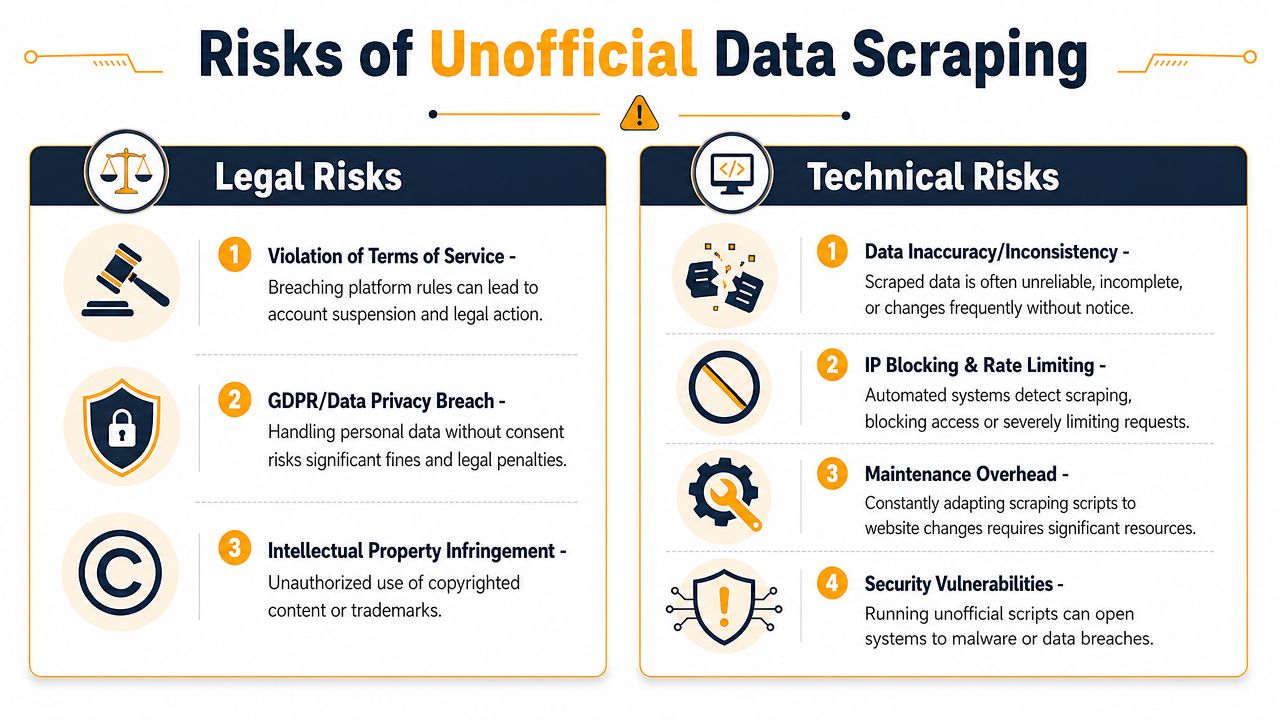
The integration usually fails operationally first
Teams frequently feel the technical pain before they feel the legal pain.
An unofficial scraper or wrapper can fail when Meta changes an internal field name, adjusts request validation, rotates anti-automation defenses, or alters how the frontend packages marketplace responses. With HAR-based approaches, you may have to re-capture traffic and re-tune filters just to restore continuity. That means your ingestion pipeline can degrade even when your code “hasn't changed.”
Typical failure modes include:
Schema drift: Internal GraphQL fields or shapes change without notice.
Blocked automation: Request patterns trigger rate limiting, friction, or outright denial.
Session fragility: Browser-based or authenticated flows become hard to reproduce reliably.
Escalating maintenance: Engineers spend time babysitting collection instead of shipping product logic.
It's not a matter of if this overhead shows up, but when.
Later in the implementation cycle, teams also run into governance questions. Security asks where the data came from. Compliance asks what rights you have to store it. Product asks why data freshness is inconsistent. None of those questions are fun to answer with “we reverse-engineered an internal web request.”
In this context, provider terms matter. If you consume external data in production, your own contracts and usage rules should be explicit and reviewable, which is why teams usually insist on reading documents like a provider's API usage terms and service conditions before they commit to a dependency.
Compliance risk is harder to clean up than broken code
The more serious issue is that many tutorials treat scraping as merely a technical challenge. It isn't.
A reliable warning comes from the broader discussion around these tools: risky scraping setups are often promoted without enough attention to instability, scalability limits, or compliance exposure, especially for PropTech teams in the US, EU, and UK where privacy rules are stricter, and Meta stepped up enforcement against automated scrapers in 2025–2026 according to this discussion of Marketplace scraping risk and enforcement.
Here's the practical takeaway:
Terms risk: Unofficial collection can conflict with platform rules.
Privacy risk: Listing data may intersect with personal or location-linked information.
Business risk: An unstable source can break customer-facing features with no notice.
Audit risk: You may struggle to explain provenance and permission during diligence.
A clever extraction script can become a liability fast. That's why mature teams usually stop asking, “Can we scrape it?” and start asking, “Can we defend this architecture six months from now?”
Here's a useful walkthrough on the broader risk profile before using any unsupported collection method:
Practical Alternatives for Marketplace Data Integration
Once you rule out unsupported collection, the options get narrower but much healthier. You stop trying to force Facebook Marketplace into acting like an open dataset and start choosing a data strategy that can survive production.
Three realistic paths depending on your use case
For many teams, there are only three serious options.
First, there's manual or semi-manual collection. This works for tiny research projects, founder validation, or one-off comparisons. It doesn't scale, it's hard to keep fresh, and it turns engineers into operators.
Second, there's official seller-side integration if your actual use case is helping approved merchants manage their own inventory and orders on Meta surfaces. If that's your product, stick to the official stack and design around approval constraints.
Third, there's third-party aggregation through a unified data layer. For analytics, market monitoring, and category-specific applications, this is usually the path that maps best to business reality. Instead of scraping unsupported surfaces yourself, you consume a provider that specializes in collecting and normalizing public market data through a stable API interface. A developer evaluating this model can compare category coverage, response shape, and onboarding details from a unified real estate and public listing API provider.
What a professional team should optimize for
When people say they need a Facebook Marketplace API, they usually mean they need four things:
Structured search results
Reliable updates
A legal reviewable setup
A stable developer interface
That's why the right alternative often isn't “another Facebook scraper.” It's a source strategy built around public data normalization in the domain you care about.
If your business goal is market visibility, not platform-specific hacking, optimize for data continuity and compliance before you optimize for surface-level source coverage.
For real estate, that usually means stepping back from Marketplace as the center of the design. Property search, pricing, and market signals are available through providers that aggregate across multiple public platforms and expose one cleaner integration layer. For a PropTech app, that's often more useful than trying to squeeze unsupported data out of a single social marketplace.
Integrating Real Estate Data with a Unified API
Real estate is where this problem becomes concrete. Many teams start with Facebook Marketplace because they want rental listings, local sale inventory, or neighborhood-level signals. But if the actual product is a property search app, investor dashboard, broker workflow, or comps engine, a unified property API is a much better fit than a brittle marketplace workaround.
Why unified real estate APIs fit this problem better
A dedicated real estate data layer usually gives you a stable schema across multiple public sources, predictable authentication, and a workflow built for search rather than reverse engineering. You query by destination, coordinates, place, or listing URL. You get normalized property details back. Your app logic stays focused on ranking, enrichment, alerts, and analytics.
That's a much cleaner contract for a data team.
If you're evaluating implementation details, the developer introduction for a unified real estate API is the kind of documentation worth looking for: clear authentication, explicit endpoints, consistent response patterns, and examples in common languages.

A practical request flow
A junior developer usually asks, “What would this look like in code?”
At a high level, you want a flow like this:
Accept a user query such as city, coordinates, or place ID.
Send that query to a unified property search endpoint.
Normalize the returned listings into your own internal model.
Cache responses where appropriate.
Layer your app-specific ranking, alerts, or analytics on top.
A simple Python example might look like this:
import requests

API_KEY = "YOUR_API_KEY"

params = {
    "destination": "Miami, FL",
    "check_in": "2026-07-01",
    "check_out": "2026-07-07"
}

response = requests.get(
    "https://api.realtyapi.io/v1/search",
    headers={"x-api-key": API_KEY},
    params=params,
    timeout=30
)

response.raise_for_status()
data = response.json()

for item in data.get("results", []):
    print(item.get("id"), item.get("name"), item.get("price"))
The exact endpoint and parameters will vary by provider and product surface, but the important part is the integration model. You're calling a documented API with stable auth and expected response handling. You are not replaying browser traffic captured from an unsupported web app.
That difference changes everything downstream: monitoring, retries, onboarding, legal review, and customer trust.
Best Practices for Consuming Third-Party Data
Once you move to any external data provider, the engineering job changes from “how do we extract this?” to “how do we consume this responsibly and resiliently?”
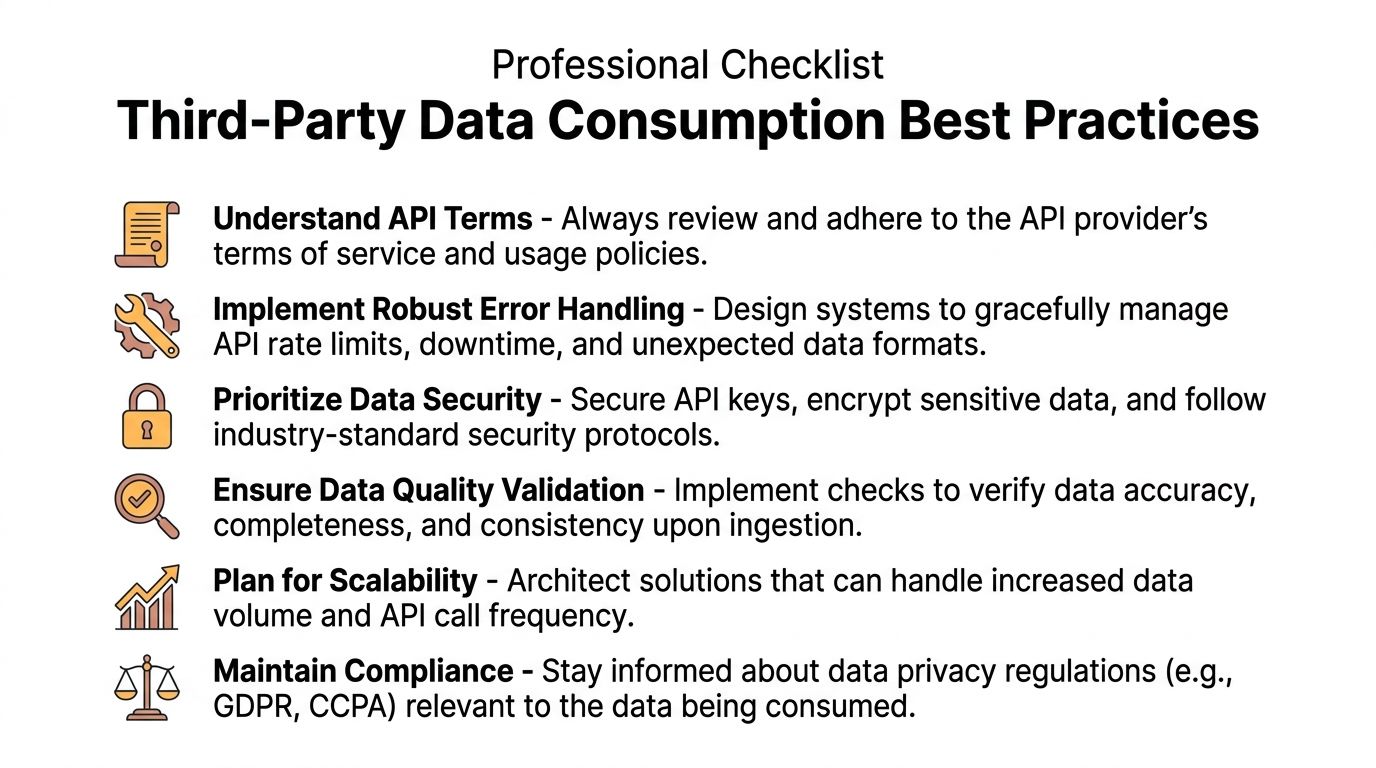
Build for change, not for happy-path demos
Third-party APIs always evolve. Good integrations assume partial failure.
Store secrets properly: Keep API keys out of source control and client-side code.
Add retry logic: Use bounded retries and backoff for transient failures.
Validate responses: Treat schema assumptions as testable, not permanent.
Cache intentionally: Reduce repeat calls for data that doesn't need instant refresh.
If you want a concrete example of provider-side guidance, review things like documented API rate limit behavior and request-handling guidance before you size your workers and queues.
Treat provider rules as part of the interface
Developers often think the interface is just JSON shape plus authentication. It isn't. Terms, usage constraints, and approval mechanics are part of the interface too.
Meta's own seller tooling makes that visible. The Marketplace Approval API exists specifically to request access and check approval status before a seller can proceed into the broader commerce flow. If a platform requires a gate before use, that gate is part of the product, not an administrative side note.
Good integrations don't just parse data correctly. They also respect the rules attached to that data.
For any provider you adopt, keep three disciplines in place:
Compliance review early: Don't wait until launch to ask legal where the data came from.
Observability from day one: Log failures, payload anomalies, and upstream latency.
Abstraction in your codebase: Isolate provider-specific logic so you can swap sources without rewriting the app.
If you came looking for a Facebook Marketplace API for public listing access, the honest answer is disappointing. But it's also clarifying. Stop searching for the hidden endpoint. Design around data sources and providers that support the product you're trying to build.
If you're building a real estate app, analytics pipeline, or market monitoring product and need a stable, developer-first data layer, RealtyAPI.io is the practical path. You can test with a free key, work from clear docs, and integrate public real estate data through one API instead of gambling on unsupported Marketplace scraping.