Address Search for Business: API Guide 2026

The most popular advice about business address search is also the most dangerous: clean the string, send it to a geocoder, and trust the result. That workflow can return a perfectly valid postal address while attaching the wrong company, a virtual office, a vacant property, or a hijacked listing to your record.
Production systems need a different mental model. Address search for business is an evidence-gathering workflow, not a formatting utility. It must help users find a location, but it should also show how confidently that location belongs to the business in question, which sources support the match, and when those sources were last checked.
Why Valid Addresses Do Not Mean Verified Businesses
A valid address proves that a location exists in an addressing system. It doesn't prove that a particular business operates there. That distinction matters for property marketplaces, lenders, insurers, delivery platforms, and lead-generation products, where a false location can route money, customers, or risk assessments to the wrong entity.
Research into abusive Google Maps listings found that attackers sometimes used legitimate addresses belonging to restaurants and hotels, then exploited verification processes without the owners' consent. During the observation period, abusive listings captured about 0.5% of user impressions, according to the research on abusive Google Maps listings. Separate reporting found that, in one New York plumber search, 13 of the top 20 results displayed false addresses.
That isn't a corner case for a platform that depends on location quality. A copied address can create duplicate businesses, misdirect deliveries, distort neighborhood analytics, or make a non-operating entity appear established. A virtual office may be legitimate for correspondence but unsuitable as a storefront. A residential address might be a real operating location for a permitted home business, or it might be copied from an unrelated resident.
Practical rule: “Address found” and “business verified” must be separate outputs in your data model.
The distinction is especially important because location discovery drives offline activity. In the United States, 80% of consumers search for local businesses online at least once per week, and 32% search daily. Google Search is used by 72% of consumers for local business information, while 51% use Google Maps. Also, 76% of consumers who perform a “near me” search visit a related business within 24 hours, and Google has reported that 46% of all searches have local intent. These figures are compiled in local search behavior research.
For a business-address API, the response should therefore distinguish between:
- Location existence, whether the address parses, geocodes, and matches a recognized delivery or map point.
- Entity association, whether evidence connects the address to the requested business.
- Operational status, whether the business appears active at that location.
- Verification confidence, the weighted result of those checks, with evidence timestamps.
A property-data integration can add useful context when a searched business appears to occupy, lease, or share a known property. For example, a workflow may use Bayut agency details as one input, not as proof of ownership. The system should still compare independent sources and expose uncertainty instead of converting one listing into a definitive identity claim.
Anatomy of a Reliable Search Pipeline
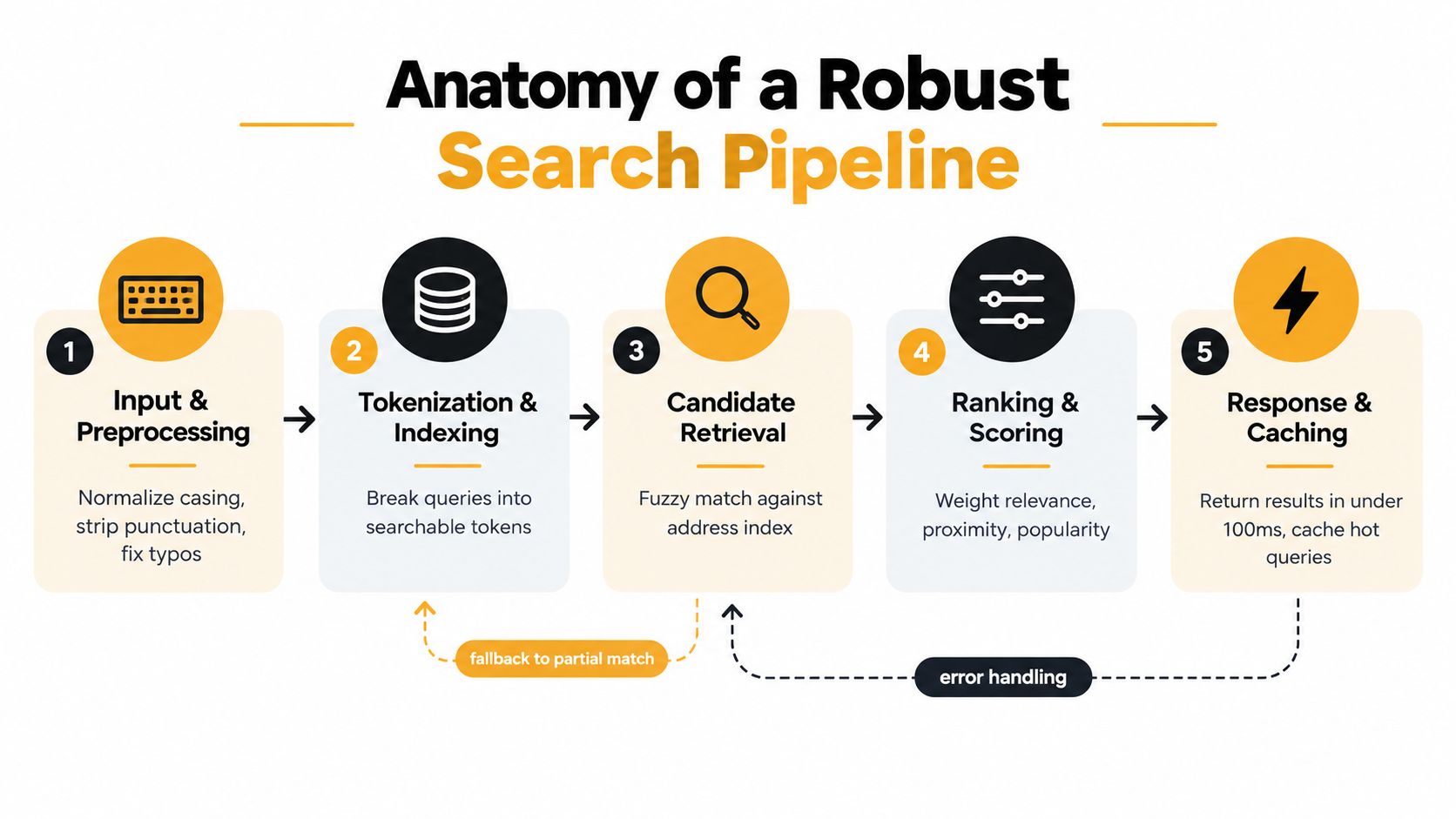
When candidate retrieval, normalization, validation, entity classification, and ranking collapse into one fuzzy string query, a single bad match becomes impossible to diagnose. In production, that failure can attach the wrong tenant to a property, route a delivery to a neighboring entrance, or turn a valid postal address into a false business verification. Treat each stage as a separate evidence-gathering step, with outputs that can be inspected and challenged.
Start with an auditable query
Keep the raw user input unchanged. Create a separate normalized representation for search, and retain both values so an operator can compare what the user entered with what the system transformed.
Tokenization should identify likely fields such as:
- Business identity, including trading name, legal name, domain, and phone number.
- Street components, including building number, street name, directional terms, unit, floor, and entrance.
- Locality fields, including neighborhood, city, region, postal code, and country.
- Geographic hints, including coordinates, a place identifier, or a known property identifier.
Normalization must be locale-aware. Expand or map common abbreviations, standardize punctuation, handle Unicode variants, preserve meaningful diacritics, and support transliteration when a search is performed in a different script from the source record. Keep apartment or suite information separate from the street line. In a multi-tenant building, that field may distinguish the correct company from its neighbor.
Retrieve candidates through several keys
Exact matching has value, but it is only one retrieval strategy. Generate candidates from combinations such as business name plus postal code, street number plus street name, phone number, website domain, and geographic proximity. Users may omit the company name, misspell it, or enter fields in a local order that reverses the expected street and locality sequence.
Use geospatial retrieval as a fallback and supporting signal, not as an identity decision. A nearby result helps when a postal code is missing, but proximity alone cannot establish that two records describe the same business.
The validation layer should test whether the candidate's components agree. In the United States, USPS DPV is designed to confirm that an address corresponds to an active delivery point, while DSF2 can distinguish business and residential deliveries, identify vacant addresses, and categorize delivery types, as described in the USPS delivery-point validation documentation. Postal validity answers whether delivery is possible. It does not prove that the requested company operates there.
Rank evidence instead of trusting one score
Use weighted evidence for name similarity, address-component agreement, postal-code consistency, coordinate distance, source freshness, and business-status signals. Set the weights according to product risk. A delivery application may prioritize a confirmed entrance and serviceability, while a lender may require stronger entity and occupancy evidence.
Return an explanation with every result. It might state that the business name and postal code agree, the coordinates are nearby, and the source was recently refreshed. It should also expose conflicts, such as a matching street address paired with a different business category. Those conflicts are fraud signals and review triggers, not details to hide behind a high aggregate score.
Accept high-confidence matches automatically only when the supporting evidence is consistent. Ambiguous names, shared buildings, conflicting coordinates, and missing unit numbers should return ranked alternatives. Send low-confidence results to a review queue instead of placing them in the primary record. Teams connecting this workflow to property and listing systems can consult the integration documentation for a real-estate data layer, while keeping address matching separate from completed business verification.
Handling Cross-Border Normalization and Privacy
There is no universal street-address format. A schema designed around a North American street number, street name, city, and postal code will break on rural delivery points, buildings without conventional numbers, apartment identifiers, local landmarks, and markets where the postal code carries more operational weight than the street line.
Deutsche Post's 2025 address study reported that 91.3% of addresses were current on average, while public-sector databases reached only about 82% correct and up to date. The same study connects address quality to GDPR's accuracy principle, which requires organizations processing personal data to keep it correct. Enterprise survey data in that source also reported that 84% of organizations struggled with inaccurate or duplicate data, while 30% used address verification, 32% were affected by outdated contact information, and 25% cited evolving data regulations. These figures appear in the Deutsche Post 2025 address study.
Keep local meaning inside a global schema
A practical schema should separate raw, normalized, and derived fields rather than replacing local data with a supposedly universal format. Useful fields include:
- Raw address, preserved exactly as received, with source and ingestion timestamp.
- Localized components, represented according to the country's conventions.
- Canonical components, mapped to stable field names for cross-market queries.
- Coordinates and precision, including whether the point represents a rooftop, parcel, street segment, locality, or approximate area.
- Administrative hierarchy, such as neighborhood, municipality, region, and country.
- Business-use classification, distinguishing storefront, service area, registered office, residential, virtual, vacant, and unknown where evidence supports it.
- Provenance and correction history, recording which source supplied each field and when it changed.
Don't discard a local building name because it doesn't fit a street-number field. Don't infer a precise unit location from a geocode that only identifies the building. When precision could expose a private individual or create a misleading level of certainty, return an approximate location and explain the precision level.
Treat privacy as part of data quality
Accuracy and minimization work together. Retain enough provenance to reproduce a match, but avoid copying unnecessary personal details into every downstream record. Store evidence references and timestamps separately from sensitive payloads, restrict access to raw fields, and define retention rules for correction history.
A privacy policy should explain what address data is processed, why it is needed, how public information is handled, and how users can request correction where applicable. Teams evaluating an API should review the provider's privacy policy alongside its schema and data-retention documentation.
The operational goal isn't to erase local variation. It is to make that variation explicit, searchable, and safe to use. A globally consistent schema should normalize the way systems exchange data without pretending that every country describes a place in the same way.
Navigating Platform and Regulatory Validation Rules
Platform rules and registry rules answer different questions. Google Business Profile focuses on how customers find and visit a business, while Companies House records where a UK limited company can receive official correspondence. An address-search system that treats both as interchangeable will produce false validation results.
Google requires a business to use a precise, accurate real-world address. A remote P.O. box or mailbox isn't acceptable as a storefront address. Businesses should put the physical address on Address Line 1 and suite or mailbox details on Address Line 2. A service-area business that doesn't receive customers at its premises should hide its street address and display its service area instead, according to Google's Business Profile address requirements.
Google's service-area model creates another important distinction. Businesses can define service areas using cities, postal codes, or other named areas rather than only a radius, and a profile can contain up to 20 service areas. Hybrid businesses may show a storefront address and add a service area. Businesses that don't serve customers at their address must remove the address from the profile, as set out in Google's service-area guidance.
| Platform / Registry | Physical Address Rule | Service Area / History Rule |
|---|---|---|
| Google Business Profile | Use a precise real-world address. Remote P.O. boxes and mailboxes aren't accepted as storefront locations. | Hide the street address when customers aren't served there. Hybrid businesses may show an address and service area. Coverage is limited to roughly two hours of driving time from the business location. |
| UK Companies House | A limited company needs a physical registered office in the same UK country where it is registered. A P.O. Box is insufficient unless it forms part of a complete physical address. | The address must receive official mail and support delivery confirmation. Previous registered-office addresses remain relevant for historical matching. |
The UK rule is not a geocoding preference. Every limited company must provide a registered office address in the same UK country as its registration, and someone at the address must know about deliveries. The UK government guidance on company addresses describes those requirements.
Companies House also makes the registered office publicly available for statutory mail, legal documents, and formal notices. A changed address doesn't take effect until it is registered, and previous registered-office addresses remain on the public register for the company's lifetime and 20 years after dissolution, according to Companies House personal-information guidance.
These distinctions matter when people look for services such as getting a US address for Stripe. A correspondence address, a registered office, a customer-facing storefront, and a service area may all be legitimate, but they aren't interchangeable evidence types. Your API should return the address role explicitly.
UX Patterns and API Integration Strategies
Users don't think in normalized fields. They paste a business name, a partial street address, or a map result and expect the interface to resolve intent without forcing them through a form. The backend should absorb that messiness while the frontend makes uncertainty visible.
Autocomplete should return structured suggestions, not just display strings. Each suggestion can carry a stable place ID, formatted label, coordinates, locality hierarchy, address role, and match confidence. The user sees a readable result, while the application stores an identifier that remains more reliable than reparsing the label later.
A good interaction separates broad discovery from commitment:
- The user enters a partial name or location.
- The client requests candidate suggestions with a short debounce.
- The user selects a place or business result.
- The backend resolves the selected identifier to structured details.
- The application stores the identifier, coordinates, provenance, and selected address components.
- A reverse lookup validates the chosen point against the property's surrounding context.
This pattern reduces duplicate records because the system doesn't create a new entity every time a user types the same address differently. It also supports radius and proximity queries without relying on a fragile text comparison.
Make failure states useful
Fuzzy matching shouldn't automatically correct a risky query. If two businesses share a name in the same building, return both and explain the distinguishing fields. If the service returns a street-level location rather than a unit-level match, label that precision instead of presenting a rooftop marker as exact.
Retries also need boundaries. Retry transient failures with exponential backoff and jitter, but don't retry malformed requests or authorization errors. Cache stable place resolutions and hot suggestions, while applying shorter freshness windows to business status, availability, and listing data. The response contract should distinguish cached, refreshed, partial, and review-required results.
For teams evaluating endpoint behavior, the RealtyAPI API playground provides a practical place to inspect request and response shapes before wiring the search into a production interface. The same discipline applies to adjacent identity workflows. A business onboarding form may use a real-time email verification flow alongside address evidence, but an email check shouldn't be treated as proof of physical occupancy.
The video below illustrates how a user-facing search experience can connect to backend services without hiding the systems work behind the interface.
At scale, measure the pipeline by outcome rather than by fuzzy-match elegance. Track selection rate, ambiguity rate, correction rate, stale-result rate, and the share of results routed to review. Log request identifiers and evidence versions so an engineer can reconstruct why a result appeared, without exposing more personal data than the investigation requires.
Monitoring Address Changes and Data Freshness
A one-time lookup becomes stale as soon as a business relocates, a tenant leaves, a listing changes hands, or a delivery point becomes vacant. Search quality therefore depends on a monitoring loop that compares new evidence with the prior record instead of overwriting the old value.
Store an address history as a sequence of observed states. Each state should include the normalized components, source, observation time, confidence, and reason for change. A new source that introduces a different suite number is not equivalent to a source that moves the business to another city. Those events deserve different review policies.
Detect reuse and contradictions
Address reuse is common in commercial buildings and especially risky when unrelated businesses suddenly appear at the same location. Flag repeated reuse, abrupt category changes, conflicting coordinates, and simultaneous active records that lack unit-level separation. A valid building address can support several real businesses, so the alert should identify the conflict rather than declare every record fraudulent.
A review screen should show the current candidate beside prior observations. Include the evidence timestamp, source role, change type, and confidence explanation. For teams researching older occupancy or corporate records, a resource on how to look up address history can provide useful background, but production decisions still need a documented evidence policy.
Webhooks can notify downstream systems when a record's address, status, or confidence changes. Scheduled refreshes can cover entities without event support, while risk-based monitoring gives more attention to high-value listings, regulated businesses, and records with prior conflicts. Keep the old value available for audit, but make the current operational state unambiguous.
A search endpoint answers where the data points today. A monitoring workflow explains whether that answer still deserves trust.
The durable architecture treats address search as a living evidence layer. It returns a useful location quickly, preserves uncertainty, and gives the business a way to correct or challenge the result before a weak match becomes a financial, operational, or reputational problem.
RealtyAPI.io offers a unified developer-first real estate data layer for address-based property search, structured listing details, live market signals, and monitoring workflows through APIs and webhooks. If your product needs to connect business locations with property context while preserving identifiers and evidence, visit RealtyAPI.io and test the API against your search workflow.