REST API Performance Best Practices That Actually Scale
The dashboard used to feel instant. Now the property results arrive late, mobile users see a spinner, and support is hearing that searches feel sluggish. The server may still be healthy, but users experience the whole request path: network distance, connection setup, server work, downstream calls, and the response payload.
That's why REST API performance best practices work best as a set of deliberate trade-offs, not a checklist applied everywhere. A cache can reduce origin work but serve stale data. Aggregation can save round trips but create larger responses. Retries can recover from transient failures or intensify an outage. The practical question is always the same: which cost dominates this endpoint, and what are you willing to spend to reduce it?
Why Your API Feels Slow Long Before It Breaks
A property-search dashboard can feel slow without any single component appearing broken. The database query may be healthy, the application may be returning successful responses, and the overall latency average may look acceptable. Yet users in one region wait while users closer to the service see results quickly.
Geography is part of the request budget. Cloudflare estimates that every 100 miles between an application's resources and the end user adds approximately 0.82 milliseconds of latency. A request traveling roughly 3,000 miles could incur about 24.6 milliseconds of distance-related latency before DNS, TLS, server work, and the return path are included (Cloudflare's load-balancing white paper). That distance penalty can matter for search, autocomplete, availability, and pricing, where users notice pauses immediately.
A slow dashboard often reflects several small costs stacking up. A client may make separate calls for listings, photos, and availability; the server may then fan out to multiple data providers; and a large JSON response may take longer to serialize and transfer than the database query itself. Fixing only the slowest-looking query won't help much if network distance and repeated round trips account for most of the delay.
Treat latency as a budget. Every network trip, byte transferred, and downstream operation spends part of it.
Start by defining what a responsive experience means for the endpoint, then identify where the time goes before changing the architecture. If you're evaluating a real-estate integration, RealtyAPI's API introduction describes the service's available data and access patterns. The point isn't to assume a particular provider will fix performance; it's to understand how the API's response shape and dependency path fit your request budget.
The Latency Budget and the Four Cost Drivers
A useful diagnosis starts with four possible costs. They interact, but separating them gives you a better first move than reaching immediately for caching or a bigger server.
Network distance
The request and response have to travel between the client and the API. A distant origin adds delay even when the application is idle and the code is efficient. Regional routing, edge delivery, and geographically distributed deployments can shorten that path. Measure latency by region, because one aggregate figure can hide a market where the service is consistently slow.
Payload size and serialization
The server must construct the response, and the client must receive and parse it. A property-detail endpoint that returns every photo URL, amenity, review, and availability field can spend meaningful time preparing and transferring data the screen doesn't use. Trimming fields and compressing suitable payloads target this cost, though they can add server-side processing or make the API more complex.
Round trips and connection setup
Each call has network overhead. A screen that requests a listing, host profile, and reviews separately waits on multiple exchanges, even if each endpoint responds quickly. Reusing connections helps avoid repeated setup, while a compound response can reduce trips. Neither is free: aggregation may increase response size or couple data with different freshness requirements.
Origin and dependency work
The API may need to query a database, call a listing provider, or gather results from several sources. That work can dominate latency, especially when requests fan out and the API waits for the slowest dependency. Profiling the request path and measuring downstream time help distinguish application work from external waits.
Conditional requests are one way to avoid unnecessary transfer when a representation hasn't changed. RFC 9110 identifies conditional GET requests as the most efficient mechanism for updating cached information, with If-None-Match enabling a 304 Not Modified response instead of retransmitting the full body (RFC 9110). The right optimization depends on the dominant cost: cache to avoid repeated work, select fields to reduce payload, aggregate to cut trips, or improve the dependency path when origin work is the bottleneck.
Caching Layers From Client to Edge
Caching works best as a layered policy, not a single header added at the end of an implementation. Start with the client, extend to shared infrastructure where responses are safe to reuse, and use origin-side caches to protect databases and providers from repeated reads.
Choose freshness based on the data
A browser or API client can reuse a response for stable property metadata, such as relatively static descriptions or amenities. A response containing current prices or availability needs a shorter freshness window or regular revalidation. Cache-Control: max-age defines how long a response remains fresh; private keeps a user-specific response out of shared caches, while no-store tells caches not to retain it. MDN explains that explicit cache policies and validators such as ETag and Last-Modified can reduce latency, traffic, and server load (MDN's Cache-Control guide).
Don't confuse no-cache with “don't store.” A client can retain a response with no-cache, but it must revalidate before reusing it. That distinction is useful when the client can keep a local copy but freshness matters.
Revalidate rather than retransmit
Return an ETag or Last-Modified validator with a cacheable response. On the next request, the client can send If-None-Match or If-Modified-Since; if the representation is unchanged, the server returns 304 Not Modified, allowing the client to reuse its copy without downloading the full body. This is particularly helpful for repeated reads of data that changes occasionally rather than constantly.
CDNs and reverse proxies can serve eligible responses closer to users and reduce repeated origin work. But shared caching is safe only when the cache key accounts for every input that changes the representation, including relevant query parameters and content-negotiation headers. Authorization-sensitive responses need careful handling: a cache must not return one user's representation to another.
Track cache-hit rates and 304 rates alongside latency. A high hit rate is not success if users see stale prices, and a low hit rate may indicate a poor cache key or a response that changes too frequently to benefit. Set freshness according to the data's volatility, then validate that the policy improves the user experience without crossing privacy or correctness boundaries.
Pagination, Field Selection, and Batching
The best response shape depends on whether the client is constrained by bandwidth, round trips, or the size of a collection. These techniques solve different problems, so using them together is often more effective than treating them as substitutes.
For large or frequently changing collections, prefer cursor pagination. Offset pagination is simple to implement, but concurrent inserts or deletions can shift records between requests, producing duplicates or gaps. A cursor tied to the last item gives the client a more stable way to continue through a changing result set. Keep the cursor opaque and make the next-page behavior clear in the API contract.
Field selection is the straightforward choice when clients don't need every property. A mobile screen might request an identifier, address, price, and thumbnail rather than a full record with reviews and detailed amenities. A fields query parameter, or another sparse-fieldset convention, can reduce both transferred data and client parsing. Don't make every field combination a separate bespoke endpoint; keep selection predictable and documented.
Compound responses and batching address a different cost. If a screen needs a listing and its host profile, a compound response may eliminate a round trip and simplify client orchestration. The trade-off is a larger payload and more cache fragmentation, especially if the combined resources change at different rates. Aggregation can also put the API's response time at the mercy of every dependency it calls.
Choose by the bottleneck: field selection for bandwidth-constrained clients, compound responses for latency-sensitive screens, and cursor pagination for large collections.
Current API design guidance recommends measuring p50, p95, and p99 latency by endpoint and region, then selecting among field selection, compound responses, and cursor pagination based on the workload rather than optimizing one metric alone (API design guidance on performance trade-offs). For a screen that makes several calls, test whether a compound response improves perceived latency without creating an unwieldy payload. For a large search result, paginate instead of returning everything and hoping the client can handle it.
Compression and Payload Engineering
Compression can cut transfer time for large, repetitive JSON responses, but it spends CPU on both the server and the client. That makes it a poor candidate for a blanket “compress everything” rule.
The client advertises supported encodings with Accept-Encoding; the server can respond with the matching Content-Encoding. A technical analysis reports that JSON commonly compresses to approximately 15% to 30% of its original size, so a 100 KB response may shrink to roughly 15 KB to 30 KB. The same analysis cautions that compression overhead can outweigh transfer savings for responses below 1 KB (JSON compression analysis).
Use a size threshold and check the actual response types your API serves. Large JSON search results are good candidates; already-compressed images generally aren't. Don't optimize bandwidth while overlooking a rise in CPU use or server-side queueing. Measure payload size, CPU utilization, and p50/p95 latency together so you can see whether compression helps the complete request path.
Payload shape matters too. Avoid returning fields that clients never use, and keep serialization work predictable. Consistent structures help clients parse responses reliably; nested objects can be harder to work with and may increase processing overhead. Short field names can reduce bytes but make an API less readable, so use them only when the bandwidth benefit justifies the loss of clarity.
The practical test is to compare representative responses with compression enabled and disabled under realistic traffic. If small responses dominate, compression may add work without meaningful transfer savings. If large, repetitive payloads dominate, it can be worthwhile, as long as the server has capacity for the encoding cost.
Retries, Backoff, and Deadline Propagation
Retries can make a transient failure invisible to a user. They can also turn an overloaded dependency into a wider outage if every caller keeps retrying without limits. The goal isn't to maximize attempts. It's to bound how much extra work failure creates.
Exponential backoff with jitter is a useful baseline: wait longer between attempts and randomize the delay so clients don't all retry in lockstep. But backoff alone doesn't say when to stop. Give each request a deadline, pass the remaining time to downstream calls, and cancel work that can no longer produce a useful response. A service shouldn't keep asking a struggling dependency for results after the caller has already timed out.
Set a retry budget as a share of primary traffic rather than allowing unlimited attempts. Retry only failures that may be transient, and avoid retrying mutations unless the operation is protected by an idempotency mechanism. An idempotency key lets a client safely retry a write without accidentally creating duplicate actions. Hedged requests can help with latency-sensitive reads, but they deliberately add load, so use them only when the service can absorb that extra work and cancel the slower request once one attempt succeeds.
Circuit breakers belong in the same control system. They can fail fast when a dependency is unhealthy, but static thresholds may react poorly to harmless bursts. Research on adaptive circuit breakers reports at least a 60% reduction in false-positive trips compared with static thresholds and recommends deadline propagation, jitter, and retry caps tied to primary traffic (reliability guidance on adaptive retries and circuit breakers).
Teams that need to explain retry and quota behavior to API consumers can also review how CS2 API rate limits work for a practical discussion of rate-limit handling. For RealtyAPI's own request quotas and client behavior, consult the RealtyAPI rate-limits documentation. Keep the policy explicit: which errors are retryable, how clients should respond to rate limits, and when the API returns partial results rather than waiting indefinitely for every dependency.
Monitoring the Metrics That Actually Matter
Averages make dashboards look calm while a meaningful slice of users waits too long. A global average can also conceal a slow endpoint or distant region. Monitor p50, p95, and p99 latency by endpoint and region so you can tell whether the typical request, the slower tail, or a particular market is driving complaints.
Build the dashboard around signals that explain what users experienced and why:
- Latency percentiles: Split by endpoint and region, then compare against the endpoint's SLO.
- Cache behavior: Track cache-hit and
304rates alongside freshness and response correctness. - Errors: Break down failures by class, rather than treating every non-success response as the same problem.
- Dependency saturation: Watch downstream latency and resource pressure to identify where fan-out is stalling.
- Retry amplification: Compare retry traffic with primary requests so recovery attempts don't hide growing load.
Use these signals to find the cause, not just to paint the dashboard green. If p99 rises while cache hits remain steady, inspect downstream waits and server work. If one region degrades while others remain healthy, investigate routing and distance before increasing capacity everywhere. A change that improves a global average but worsens a major market isn't a clean win.
Define an SLO for each important endpoint and alert on sustained budget consumption rather than one isolated slow request. When p99 drifts, revisit the endpoint's latency budget and locate the added cost before changing timeouts or scaling blindly. Teams choosing observability software can use this API monitoring tool comparison to evaluate options against their needs. For a live view of RealtyAPI availability, check the RealtyAPI status page.
A Practitioner's Checklist for the Next Sprint
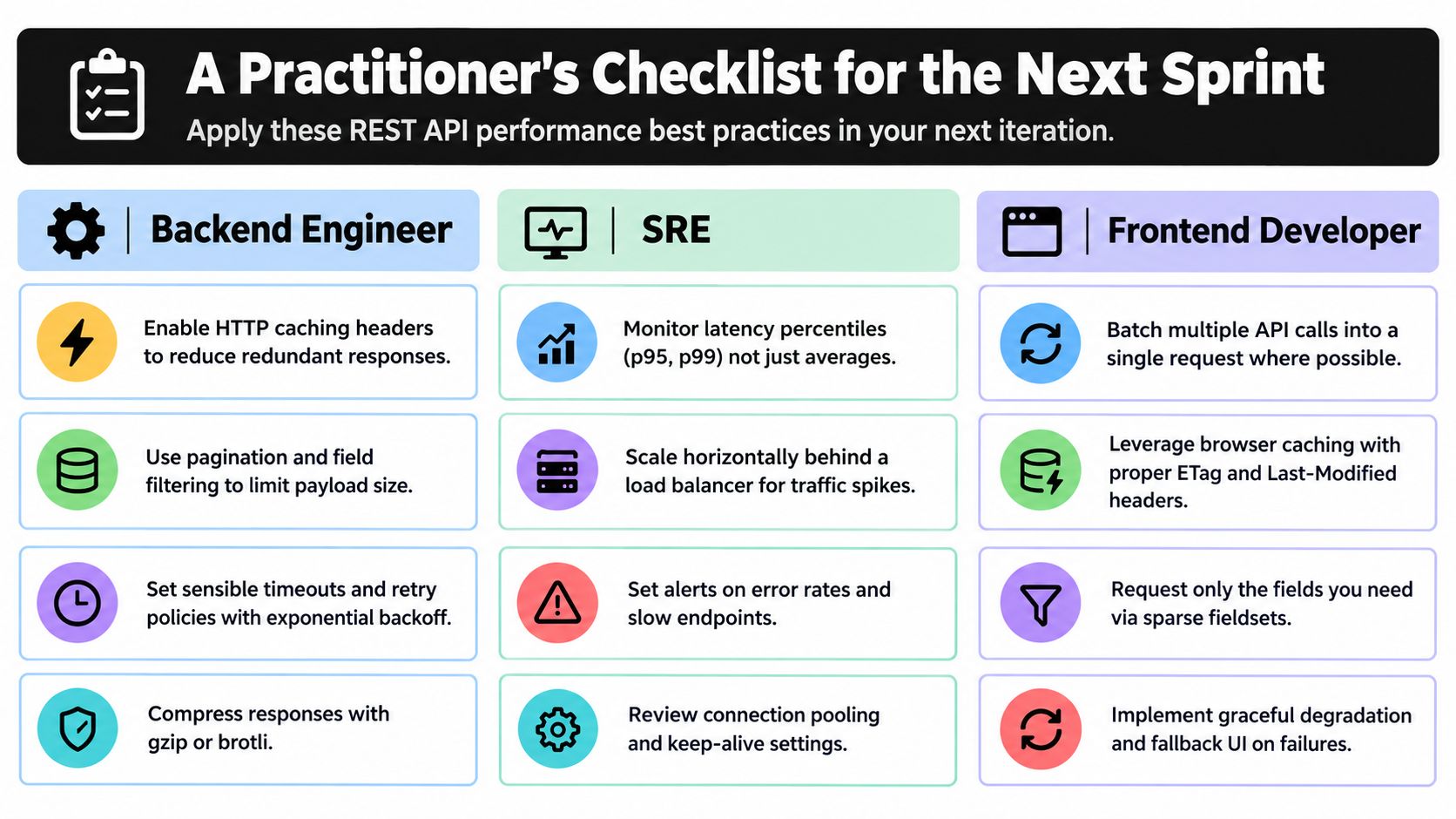
Pick one slow endpoint and identify whether distance, payload, round trips, or server work dominates. Then make the smallest change that targets that cost.
- Backend engineer: Set cache policies by data volatility, paginate large collections, support field selection, and compress suitable responses.
- SRE: Break latency out by endpoint and region, watch dependency saturation and retry amplification, and keep retries bounded by deadlines.
- Frontend developer: Request only needed fields, use pagination, and handle partial results or failures without blocking the whole screen.
Before rollout, test the endpoint under realistic load. A practical JMeter setup for API load tests can help teams plan their test approach, and the RealtyAPI API playground offers a place to explore request and response behavior.
| Technique | Main cost it targets | Key trade-off | Best for |
|---|---|---|---|
| HTTP caching | Repeated origin work and transfers | Freshness and cache-key correctness | Stable or revalidatable reads |
| Field selection | Payload size and parsing | More client and API complexity | Bandwidth-constrained clients |
| Compound responses | Round trips | Larger, more coupled responses | Latency-sensitive screens |
| Compression | Transfer size | CPU for encoding and decoding | Large, repetitive JSON |
| Bounded retries | Transient failures | Additional dependency load | Recoverable errors within a deadline |
Performance is a system of conscious trade-offs. Keep the change that improves the experience real users get in the regions and workflows you serve, not merely the metric that looks best in a dashboard.
RealtyAPI.io provides a unified real-estate data API for searching property listings and retrieving details, availability, reviews, and market signals. Explore RealtyAPI.io to test its API and see whether its response patterns fit your application's performance needs.