Rental Property Types Explained: A Guide for Developers
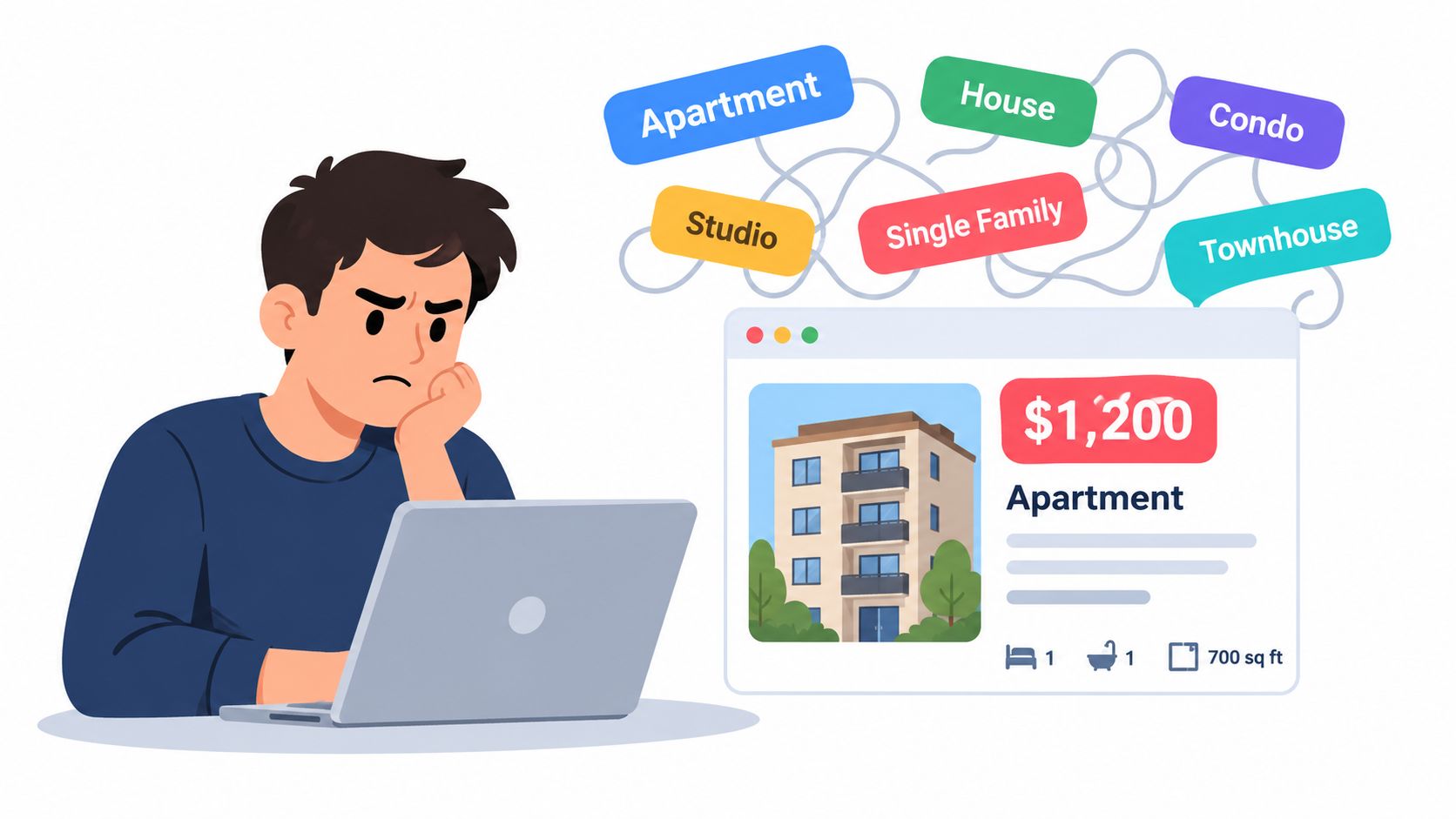
Your listing page looks correct until a user switches from “entire home” to “private room.” The price calculation still uses the full-property occupancy model, the search filter includes incompatible results, and the compliance service can't tell whether the host is offering a bedroom or the complete dwelling. One classification error has crossed the product boundary, from presentation to analytics and regulation.
Rental property types are data objects, not just labels. A detached house, a unit in a large apartment building, a social rental dwelling, and a short-term private room may all appear in a broad “residential rental” category. They don't share the same attributes, pricing logic, availability behavior, or user intent. A production system needs a taxonomy that reflects those differences without making every downstream service invent its own interpretation.
Why Rental Property Taxonomy Matters for Developers
A marketplace usually fails in subtle ways when its property taxonomy is too shallow. A listing may be tagged as an apartment because the source calls it that, even though the record represents an entire condominium. A duplex can be stored as a single-family home, while a unit inside the duplex is treated as a multifamily asset. Search still returns results, but users see the wrong amenities, bedroom assumptions, or availability fields.
The same problem reaches pricing. A nightly rate for a shared room can't be evaluated with the same revenue model as a full house. Long-term rent, short-term revenue, cleaning costs, minimum stays, lease duration, and vacancy all depend on what the user is renting. Regulatory rules also attach to the use and contract, not only to the building's physical form.
A useful product model
Treat classification as a set of dimensions rather than one enum:
- Structure: detached house, attached house, small multifamily, mid-sized multifamily, or large multifamily.
- Accommodation: entire place, private room, or shared room.
- Tenure and institution: private market, public, nonprofit, or social rental.
- Contract: short-term, mid-term, or long-term, with duration and termination rules.
- Use and compliance: residential, mixed-use, permitted short-term rental, or restricted use.
This approach lets a search service filter by physical form while an underwriting service calculates type-specific yield. It also preserves source detail instead of forcing an apartment, condo, and aparthotel into one irreversible label.
Practical rule: Store the source classification and your normalized classification separately. Normalization should improve interoperability, not erase evidence.
The right taxonomy supports better matching. A family may need a detached home with parking and three bedrooms, while a business traveler may want a furnished private room near a transit corridor. Both are searching for rental property, but they're expressing different constraints. Developers who model those constraints explicitly can build more reliable filters, analytics, and recommendations.
Understanding the Structural Rental Taxonomy Framework
A search endpoint that stores every rental as “house” or “apartment” will quickly lose information needed for pricing, filtering, and operations. The U.S. rental stock illustrates why a five-part structural framework works better. The 2016 rental stock contained 47.1 million rental units, equal to 35% of the national housing supply, with approximately 44 million occupied. Multifamily properties represented 61% of rental units, or 28.9 million homes. The remaining stock included detached and attached houses, mobile homes, and similar dwellings.
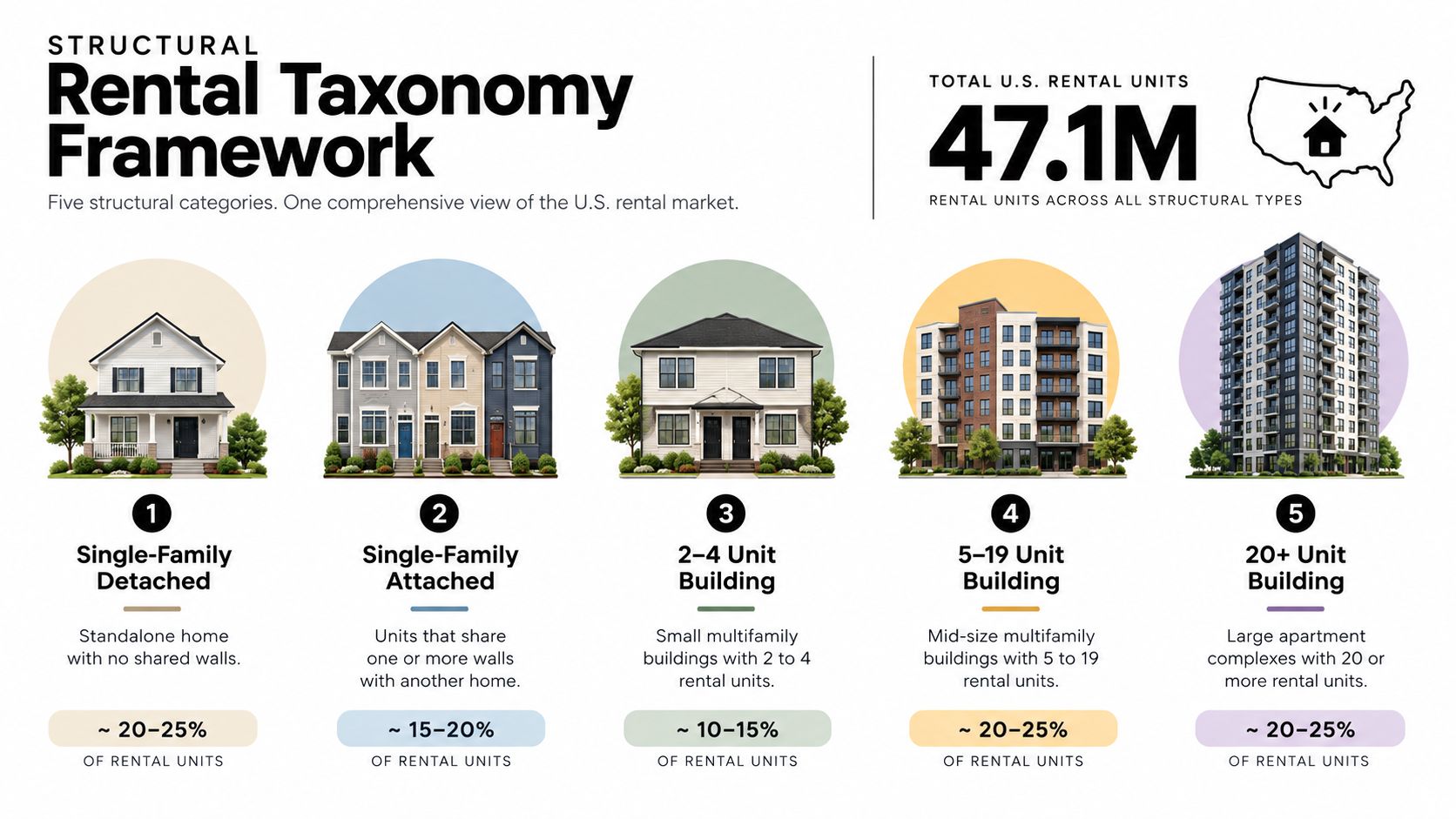
Use unit count as a structural dimension rather than collapsing every building into one multifamily value:
| Category | Units (millions) | Share of stock, national | Share of rentals, 100 largest metros | Primary geography |
|---|---|---|---|---|
| Single-family detached | 13.1 | Not separately stated | 24% | Suburbs and nonmetropolitan areas |
| Single-family attached | 2.9 | Not separately stated | 7% | Suburbs and metropolitan areas |
| 2–4 unit building | Not separately stated | Not separately stated | 17% | Mixed, often urban and older neighborhoods |
| 5–19 unit building | Not separately stated | Not separately stated | 24% | Urban and established metropolitan areas |
| 20+ unit building | Not separately stated | Not separately stated | 25% | Primarily urban areas |
The remaining stock included 2.1 million mobile homes, recreational vehicles, and similar dwellings. The metro figures show the distribution within the 100 largest U.S. metropolitan areas, while the national figures describe the broader rental stock. All figures in this section come from Redfin's rental housing analysis.
Why unit count belongs in the schema
A duplex and a high-rise may both satisfy a multifamily filter, yet their APIs need different fields. A two-unit building may have one owner, separate entrances, and no shared amenity system. A large apartment property typically requires building records, floor plans, unit-level availability, concessions, shared amenities, and property-wide services.
Geography should remain separate from structure. Urban inventory often needs filters for transit access, floor plan, furnished status, and building amenities. Suburban and nonmetropolitan single-family inventory may depend more on parking, outdoor space, pet policies, school proximity, and utility responsibility.
Store unit count, building type, unit type, and geography as distinct fields. This schema supports broad consumer queries while preserving the granularity required for pricing engines, availability feeds, analytics, and comparisons between similar properties.
Single-Family Versus Multifamily Rental Segments
Detached and attached homes and managed multifamily inventory diverge in how their records are structured, even when asking rents look similar. A single-family listing usually represents one complete dwelling. A multifamily property represents a container for multiple rentable units, often with shared services and building-level operations. That distinction should shape the taxonomy, search filters, and pricing logic.
For single-family supply, useful fields include lot or yard information, parking type, private outdoor space, pet restrictions, utility responsibility, school-area metadata, and whether the home is detached or attached. Search intent usually centers on household fit. Renters may care more about a yard, pets, parking, or utility obligations than about a building-wide amenity set.
Multifamily data is more hierarchical. The property contains buildings, floor plans, and units, and each unit can have its own rent, availability date, square footage, bedroom count, lease terms, and concessions. Building amenities such as a gym or package room should not be copied into every unit without a clear provenance model. Store the source level for each attribute so downstream systems can distinguish property features from unit features.
| Segment | High-value fields | Typical query intent |
|---|---|---|
| Single-family | Yard, parking, pets, utilities, private entrances, lot form | “Find a home that fits my household” |
| Multifamily | Building amenities, floor plans, unit availability, lease terms, services | “Find an available unit in a managed property” |
Schema decisions that survive production
Do not flatten a multifamily property into one listing when the source exposes unit inventory. Preserve the relationship between property, building, floor plan, and unit. For single-family supply, avoid manufacturing floor-plan entities when the source provides only a dwelling-level record.
Availability also follows different workflows. A multifamily provider may update inventory by unit or floor plan, while a single-family owner may update one listing manually. Preserve availability_date, unit_status, and last_seen_at rather than assuming every property follows the same lifecycle. These fields support stale-listing detection, pricing updates, and reliable availability filters.
Utility data needs similar care. A resource explaining how Axis Meter Solutions works can provide context for metering and consumption responsibility in residential rental workflows. The schema should still store the actual lease rule, billing arrangement, source value, and effective date instead of inferring responsibility from property type.
For apartment-focused inventory, RealtyAPI.io apartment data can map into the multifamily hierarchy when records include bedrooms, bathrooms, square footage, asking rent, availability dates, and floor-plan labels. Keep each attribute tied to the correct hierarchy level, because that choice affects deduplication, filtering, pricing, and unit-level comparisons.
Short-Term Rental Property Subtypes and Competitive Effects
Short-term rental inventory needs finer classification than a generic “vacation rental” field. A guest booking a private room shares a home with the host or other occupants. A shared room offers a sleeping space among guests. An entire place gives the guest control of the complete apartment or house. Those experiences compete with hotels in different ways.
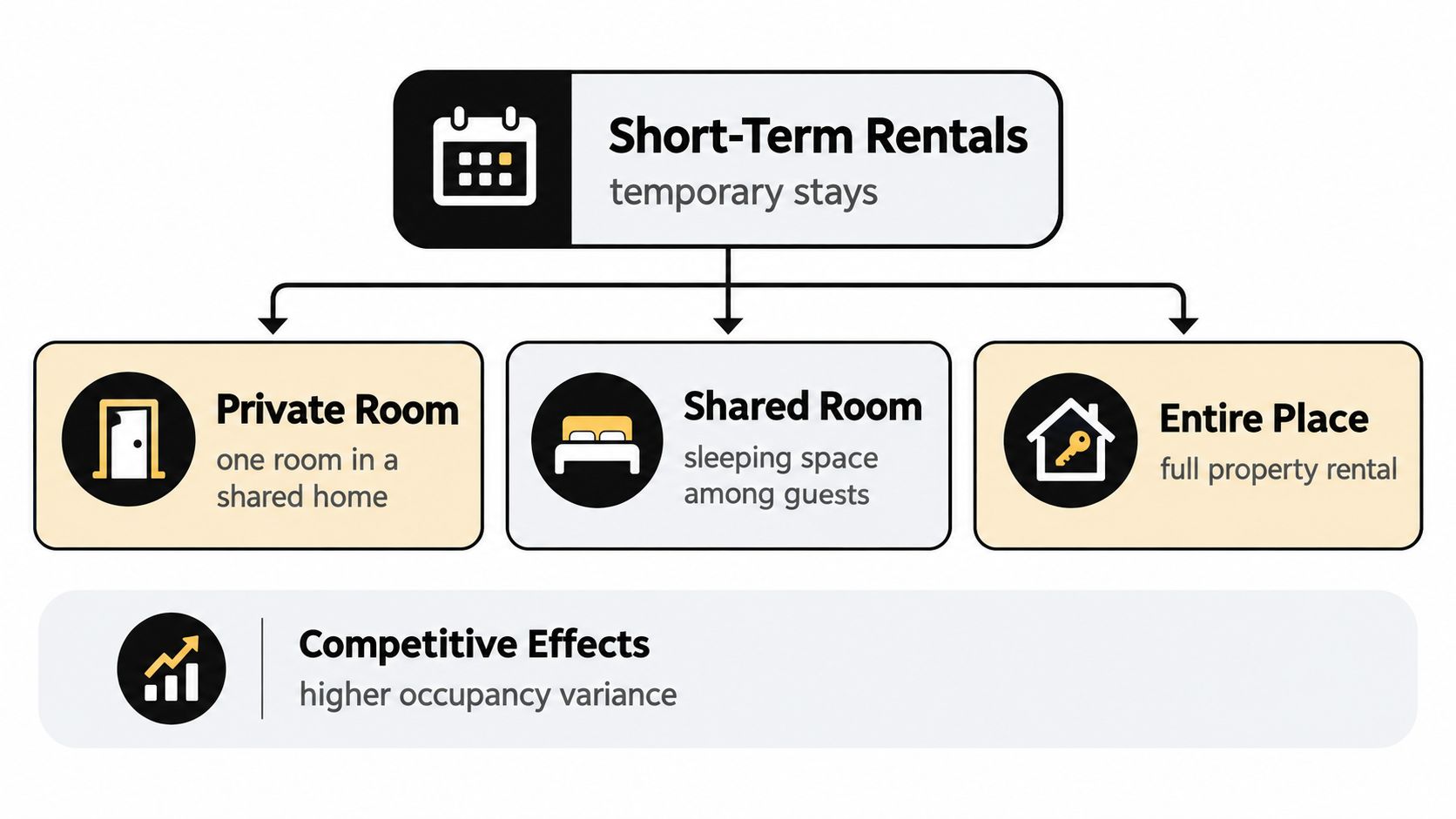
A peer-reviewed study of 10 major metropolitan areas in the United States and international markets found that a 1% increase in short-term-rental supply was associated with a 0.03% reduction in urban-hotel room demand and a $0.13 decrease in average monthly RevPAR, as reported in the study of short-term rentals and hotel demand. The result wasn't uniform across listing types. Private-room listings had the strongest and most consistent effects across hotel classes, while entire homes affected a narrower group of hotel segments and shared-room effects were weaker and less consistent.
Model the substitution, not just the inventory
Private rooms can substitute directly for hotel rooms because travelers compare one sleeping space, location, and price. Entire homes compete more directly for groups, families, kitchens, multiple bedrooms, and longer stays. A shared room may attract a different budget segment and shouldn't be treated as an equivalent supply increase.
Your STR schema should include:
- Accommodation subtype: shared room, private room, entire apartment, or entire house.
- Bedroom and bed structure: bedroom count, bed count, and sleeping arrangements.
- Access scope: private entrance, shared kitchen, shared bathroom, or full-property access.
- Stay economics: nightly price, cleaning cost, minimum stay, and stay length.
- Market controls: neighborhood, hotel class, season, and regulatory status.
A supply count without accommodation subtype is a demand-displacement estimate waiting to fail.
An aparthotel adds another complication. It may provide apartment-like space with hotel-style operations, front desk services, and standardized inventory. Developers evaluating investor benefits of aparthotels should keep aparthotel status separate from “entire apartment,” because the operating model affects fees, services, availability, and competitive sets.
A property-type filter should expose these distinctions rather than forcing users to reverse-engineer them from titles. For a practical implementation, RealtyAPI.io Airbnb property-type filters can sit behind a normalized accommodation taxonomy, provided the pipeline preserves the original source value.
Building Your Rental Property Data Schema
A useful rental schema starts with stable dimensions and adds type-specific extensions. The core record should identify the property, location, source, physical form, accommodation scope, and current market status. Don't encode every distinction in one expanding enum, because new source categories will eventually force migrations and ambiguous fallbacks.
A practical base record might contain:
- Identity: source ID, canonical property ID, source URL, and update timestamp.
- Physical attributes: structure type, unit count, bedrooms, bathrooms, unit size, and accessibility features.
- Commercial attributes: asking rent or nightly price, currency, fees, deposit, and included utilities.
- Availability: availability date, booking window, booked nights, minimum stay, and stay length.
- Compliance: registration status, permitted use, lease category, and regulatory flags.
Use a normalized core plus a typed extension object. A long-term unit might need lease_term, notice_rules, and income_eligibility. An STR might need accommodation_type, availability_windows, booked_nights, turnover_cost, and review_velocity. A mixed-use asset needs commercial-income context and dwelling-unit income rather than a generic residential flag.
Yield needs a denominator
Nightly ADR alone doesn't establish that a short-term rental outperforms a long-term lease. The break-even formula should compare annualized long-term rent with net STR revenue per booked night:
required booked nights = annualized long-term-rent benchmark / net STR revenue per booked night
Net revenue should subtract platform fees, turnover costs, utilities, property management, taxes, and compliance costs. The Australian Housing and Urban Research Institute analysis of Sydney rentals found that three-bedroom houses can exceed long-term rental returns when booked for more than 140 nights annually, while one-bedroom properties need slightly more than 180 booked nights.
That difference reflects fixed-cost dilution. Larger homes can command higher nightly rates and serve groups, but they also carry more cleaning, furnishing, maintenance, and vacancy exposure. Smaller units may be simpler to operate, yet they need higher utilization to overcome lower absolute nightly revenue.
For implementation, RealtyAPI.io's rental property calculator can be treated as a workflow reference, but your own pipeline should retain the raw inputs so analysts can change assumptions without recollecting listings.
Regulatory and Institutional Classifications Beyond Structure
A detached house can serve as private-market housing, social housing, or temporary accommodation. The physical form stays the same, while the eligibility rules, pricing engine, contract model, and search filters change. The OECD defines social rental housing as accommodation offered below market prices and allocated through specific eligibility rules rather than ordinary market mechanisms. Across OECD countries, the sector comprised close to 28 million dwellings and averaged 7% of total housing stock, with a European Union average of 8%, according to the OECD Affordable Housing Database. The OECD also found that the share of social housing declined during the previous decade in 18 of 25 countries with available historical data.

A social apartment and a privately priced apartment can share the same structure, bedroom count, and floor area. Their records still need different schemas. Social-rental data may include eligibility rules, provider type, application status, income thresholds, allocation method, and rent-setting mechanism. A private listing may instead expose asking rent, deposit, concessions, and current availability.
Historical state matters too. A database that stores only the latest listing cannot explain changes in housing composition or policy coverage. Preserve effective dates, source snapshots, and jurisdiction-level policy metadata when the product supports market analysis.
Contracts create another property type
Lease duration and possession rights define operational classifications. In England, an assured shorthold tenancy has specific term and possession mechanics, including a fixed term of not less than six months under the conditions set out in the Housing Act 1988 tenancy rules. A six-month residential tenancy therefore requires different availability, pricing, and compliance logic from a holiday booking.
Supply composition also belongs in institutional fields. Only about 18% of new Canadian housing units from 2010–2019 were intended for long-term rental occupation, according to the housing supply data reference. Use that figure for policy analysis, not as a default assumption about every Canadian listing.
Store tenure_type, provider_type, price_rule, eligibility, lease_duration, termination_rights, and regulatory_jurisdiction independently. Keep commercial and mixed-use filters, such as RealtyAPI.io LoopNet property types, separate from residential tenure classifications. That separation prevents a building category from being mistaken for a contract or eligibility rule.
Developer Takeaways and Implementation Roadmap
The most reliable taxonomy has two layers. The first describes the physical asset, from detached house to large multifamily building. The second describes the institutional and operational context, including private market or social rental, entire place or private room, lease duration, pricing rules, and regulatory permission.
Build the data model in this order:
- Normalize structural form. Adopt the five-category framework, but retain raw source labels, unit count, and building-level relationships.
- Separate property from accommodation. Store whether the user rents an entire place, private room, shared room, unit, or bed.
- Make inventory hierarchical. Connect buildings to floor plans and units where the source supports that detail. Keep single-family homes at the dwelling level when no unit inventory exists.
- Add institutional fields. Capture tenure, provider, eligibility, lease duration, termination rights, and regulatory jurisdiction.
- Calculate by type. Compare long-term rent with net STR revenue, and segment hotel substitution by accommodation subtype rather than total listing count.
- Design filters around outcomes. Support bedrooms, accessibility, parking, pets, utilities, deposits, minimum stays, and affordability, not only house versus apartment.
The contrarian product opportunity is often outside the most visible inventory. Canadian evidence described in the CMHC rental market research shows that only about 1%–2% of rental units affordable to lower-income households were vacant in 2025, while new supply concentrated in more expensive units, especially one- and two-bedroom mid-rise apartments. An Idaho housing survey found that 85% of respondents had difficulty finding units that met their needs and identified smaller homes, accessory dwelling units, townhomes, duplexes, senior housing, and workforce housing as needed types.
That means a useful marketplace shouldn't optimize only for listing volume. It should help users identify affordable three-bedroom homes, accessible units, ADUs, senior-friendly housing, and workforce rentals by combining price, availability, household fit, and upfront costs.
Property classification is a core product feature. If the taxonomy is wrong, search, pricing, compliance, and matching all inherit the error.
RealtyAPI.io provides a developer-first data layer for property searches, rental details, availability, reviews, amenities, and property-type filtering across public real estate and short-term rental sources. Visit RealtyAPI.io to test an API workflow and build rental-property data products around a normalized, production-ready schema.