Real Estate Listings Online Explained for 2026

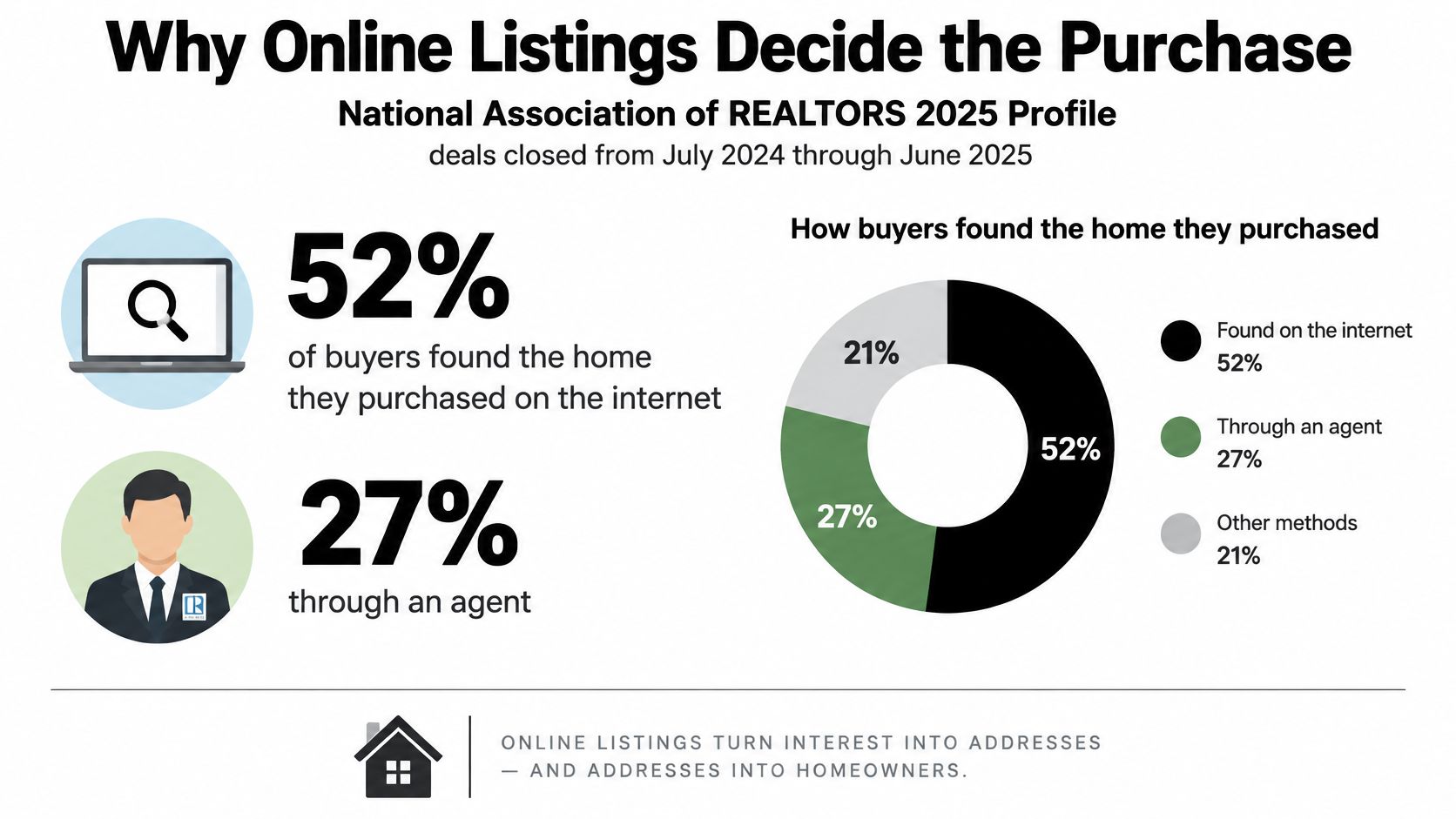
52% of buyers found the home they purchased on the internet, according to the National Association of REALTORS®’ 2025 Profile of Home Buyers and Sellers, covering transactions completed from July 2024 through June 2025. The same survey found that 27% discovered their home through an agent and 9% through a friend, relative, or neighbor. For anyone building with real estate listings online, that makes listing quality a purchase-decision problem, not just a search-interface problem.
Why Online Listings Decide the Purchase
The NAR profile also gives useful context for what happens between discovery and purchase: buyers typically searched for 10 weeks. Among internet users, 81% considered photographs useful, 77% valued detailed property information, 57% found floor plans useful, and 38% valued virtual tours.
Those preferences describe a comparison process. A buyer might save a house because its kitchen looks promising, return to check the floor plan, and later ask an agent whether the property is still available. Each visit asks something different of the same record.
Build for comparison, not just discovery
Say a buyer saves similar homes near their workplace. One listing has attractive photographs but no living-area measurement; another has complete dimensions but an unclear availability status. Neither record supports a confident decision, even if both appear neatly on a map.
For marketplaces, brokerages, and PropTech apps, the practical hierarchy is straightforward:
- Establish identity. Show the correct property, address, and asking price.
- Support comparison. Make room counts, area, property type, and fees consistent enough to filter.
- Resolve uncertainty. Provide useful media, current status, and a clear route to the responsible advertiser.
A correct address and price help earn the click. Structured facts and usable media help buyers decide whether a viewing is worth arranging.
Product standard: A useful listing answers a buyer's next question, rather than forcing them to reopen the search.
Understanding online inventory means following the record from its source through distribution, field mapping, platform differences, and verification. The measure of success isn't how many homes a feed returns. It's whether you can explain where each result came from and what a buyer can reasonably conclude from it.
How a Listing Moves from the MLS to the Open Web
A listing is a permissioned record, not merely a web page. In a typical for-sale workflow, a listing agent enters property information into a local multiple listing service, or MLS, under the listing broker's participation.
The public doesn't necessarily see that original member record. Other businesses display authorized versions, sometimes with fewer fields or different presentation rules.
Permission comes before distribution
Under the National Association of REALTORS®’ MLS model rules, Internet Data Exchange, or IDX, allows participants to authorize other participants to display listings through websites, mobile applications, and audio devices. Display includes both showing and delivering information, and seller-directed restrictions on internet display or address display must be preserved.
That last point matters when building an API. Removing an address from a property card while continuing to deliver it in the response isn't the same as withholding it from electronic distribution.
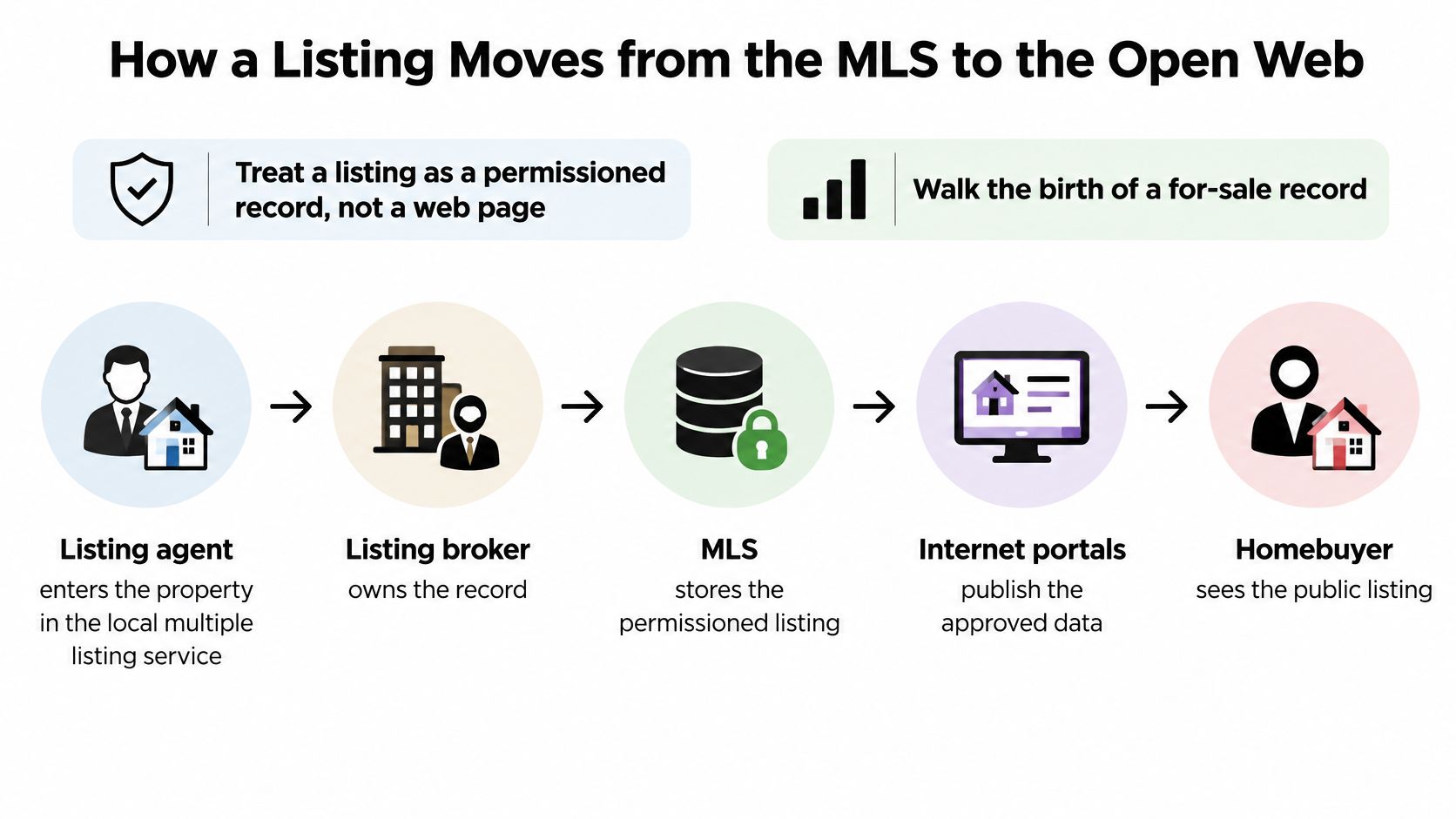
NAR's IDX policy doesn't require an MLS to operate a publicly accessible listing website. It generally permits presumed listing-broker consent unless the broker refuses display, subject to state-law requirements, and requires IDX operators to notify the MLS and provide access for compliance monitoring.
Think of the MLS as a member-maintained library catalog. Public listing services display selected catalog entries, but each service's access and publication permissions still matter.
Where an online listing lives
| Layer | Who creates it | How the public sees it | What can be withheld |
|---|---|---|---|
| Local MLS | Listing broker and agent | Member access and licensed feeds | Seller-directed internet or address opt-out |
| IDX sites and apps | Other MLS participants | Authorized display of another broker's listing | Address or entire listing when the seller directs |
| National portals | MLS feeds plus agent or owner posts | Portal search, maps, and alerts | Whatever the feed contract and portal policy allow |
| Classifieds and social ads | Anyone with an account | Public posts | Fields omitted by the poster; don't assume systematic identity checks |
| Short-term rental sites | Host | Listing page and calendar | Host-controlled dates, price, and house rules |
| Developer data APIs | Nobody new; they read licensed or public data | Search and detail endpoints | Only fields the source exposes |
Trace the record, not just the address
An MLS identifier is useful for finding the originating record, but don't assume identifiers are globally unique across systems. Store the source system alongside the identifier.
When evaluating a search-by-MLS endpoint, check whether the returned identifier belongs to the originating MLS, the portal, or the API provider's own index. Those are different namespaces, even when they refer to the same home.
Before calling an integration complete, name the source system, the permitted use, and the mechanism for honoring withdrawal or display restrictions. If those answers are missing, you have a collection of records, not an accountable distribution pipeline.
Fields Price and Availability Signals That Matter
A listing record should answer three separate questions: which property is this, can someone still pursue it, and what does the quoted price mean? A misplaced map pin or stale status can make the rest of the record misleading.
Start with identity and actionable status
An address alone may not distinguish two units or duplicate advertisements. Keep coordinates, unit number, source-specific listing ID, and source URL together.
Status should retain both a normalized value and the wording used by the source. Keep active, pending, contingent, rented, and off-market distinct when the source provides those values. Store the source's update time separately from your retrieval time: a recent fetch confirms when your system saw the page, not when the advertiser last confirmed availability.
Listing fields and the decision each one supports
| Field group | Example attributes | Decision it supports |
|---|---|---|
| Identity | Address, coordinates, listing ID, source URL | Map pin and duplicate detection |
| Status | Active, pending, contingent, off-market, last seen | Whether the home can still be pursued |
| Price | List price, cuts, rent, HOA, nightly rate | Compare the ask and recurring costs |
| Structure | Beds, baths, area, lot, year, type | Whether filters match the building |
| Media | Ordered image URLs, dimensions, room labels, floor plan, tour | Image presentation and property interpretation |
| People | Agent, brokerage, or host | Who to contact about the listing |
| Rules | Display allowed, eligibility, how to apply | How the home may be presented and pursued |
Store price as amount, currency, and billing period. A nightly rate is not monthly rent, and neither necessarily includes fees. For a Zillow listing price lookup, save each result as a dated observation instead of overwriting the prior value. That history helps distinguish an actual price change from a parsing error.
Treat media as inventory
Photos and descriptions shape how a property is understood, but they cannot establish that a listing is current or that its asking price is sound. Keep ordered image URLs, dimensions, orientation, room labels, accessibility text, floor-plan files, and freshness timestamps so the product can display and assess media consistently.
For federally assisted rentals, HUD's fair-housing guidance calls for clear, consistent marketing information covering amenities, eligibility, application logistics, and applicant selection. Store those details as structured text rather than expecting applicants to infer them from photographs.
Before publication, flag missing hero images, duplicate photographs, unreadable assets, and price-status combinations that conflict. Route contradictions for review. A longer result list does not resolve gaps in coverage, stale records, or disagreement between sources; show the source and observation time so users can judge what each signal supports.
How Listing Platforms Differ in Practice
Two sites can show the same house and still disagree. Their records may arrive through different channels, represent different transactions, or reflect updates retrieved at different times.
The important comparison isn't which platform looks more complete. It's what kind of inventory each platform represents and what its fields mean.
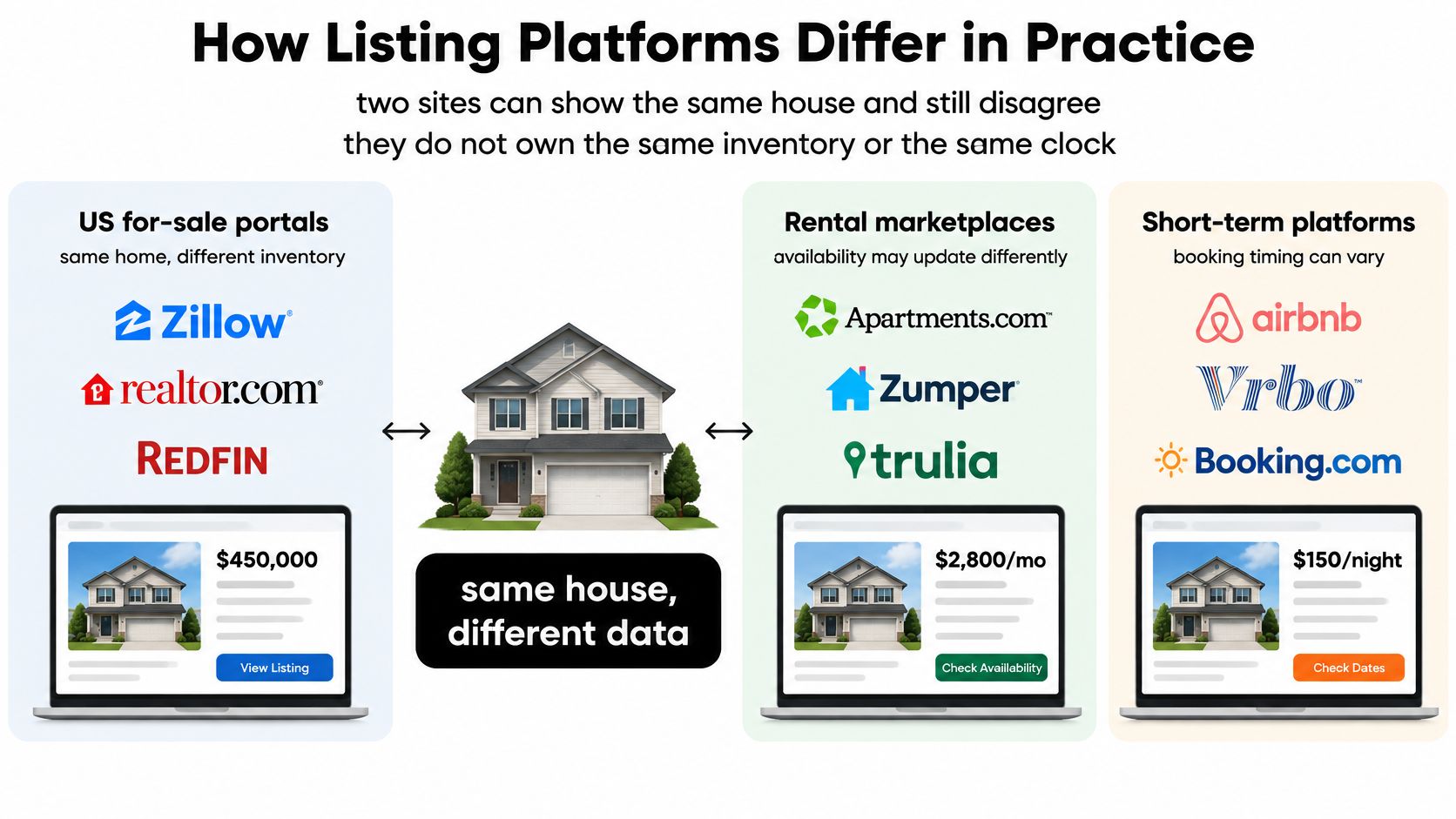
Match the signal to the transaction
On Zillow-style portals, distinguish the seller's list price from an automated value estimate. An estimate is a modeled opinion of value, not an offer to sell.
Realtor.com's participant-fed listings make status wording important. Redfin combines a search portal with a brokerage, so users may encounter both feed-derived records and properties represented by its agents.
What each listing platform is showing
| Platform type | Main inventory | Who updates it | Signal to trust |
|---|---|---|---|
| Zillow-style US portals | For-sale plus some rentals and FSBO | MLS feeds and direct posts | List price, not the automated estimate |
| Realtor.com | Participant for-sale listings | Brokers via MLS-style feeds | Status words such as active or pending |
| Redfin | Portal plus its own brokerage | MLS data and Redfin agents | Price history and days on market |
| Apartments.com | Long-term rentals | Property managers | Which units are free and which concessions apply |
| Airbnb and Vrbo | Short stays | Hosts | Nightly rate plus the calendar |
| Rightmove and Zoopla | UK sales and lettings | Estate agents | Asking price, and sold prices where Zoopla shows them |
| Idealista and similar country portals | Local sales and rentals | Local agents | Local currency, tenure, and energy fields |
For Apartments.com, a building-level advertisement isn't necessarily confirmation that a particular unit is available. Retain unit-level availability and concession conditions rather than displaying the lowest advertised rent as universally obtainable.
Airbnb and Vrbo require date-aware interpretation. A visible property page doesn't establish that a traveler's chosen nights are bookable, and a displayed nightly rate shouldn't become a monthly-rent estimate without explaining the assumptions.
Preserve local meaning
A global application needs more than currency conversion. Rightmove and Zoopla records may require tenure information, while Idealista and other country portals expose local property and energy attributes that a US-only schema may omit.
Keep local fields in an extension object when they don't fit your shared model. Dropping them makes normalization easier for developers but less useful for the person deciding whether the property suits them.
For brokerages managing publication workflows, RealEstateCRM's guide to listing automation tools for brokers is a useful companion when comparing operational tooling with downstream search requirements. Publishing a record and interpreting a returned record are different jobs.
A familiar portal name identifies a presentation layer. It doesn't establish your right to redistribute everything displayed there.
Don't assume a consumer-facing Zillow page implies an openly available listing API. Confirm access and redistribution rights for the integration you intend to use, then choose platforms by transaction type: sale, long-term rental, or short stay.
APIs and Integrations for Listing Products
Choose an integration route based on how much control you need over authorization, updates, and field definitions. An endpoint that returns JSON solves transport; it doesn't automatically solve rights, meaning, or reliability.
Choose the access route deliberately
- Licensed MLS or RESO Web API feed. For an eligible brokerage, this can provide a direct, governed relationship with the inventory source. RESO describes an interoperability standard, not automatic permission to access every MLS.
- Direct portal or partner agreement. This can define supported fields and approved uses explicitly. Build around the actual agreement, not assumptions based on the portal's consumer website.
- Do-it-yourself scraping. Your team owns extraction, markup changes, status mapping, and operational recovery. Review applicable terms and permissions before implementation.
- Unified public-source API. A shared schema can reduce adapter work across sites. It doesn't turn public pages into official MLS records or remove your verification obligations.
The distinction matters most when something goes wrong. If a status changes unexpectedly, you need to know whether the source changed, the extractor failed, or your mapping logic interpreted a new value incorrectly.
Use a traceable read pattern
A workable integration follows this sequence:
- Search narrowly. Query a city, coordinates, or known listing URL, keeping transaction type explicit.
- Fetch the detail record. Use the source listing identifier and retain its source namespace.
- Map without erasing. Normalize status, price, and media while preserving raw values for diagnosis.
- Attach provenance. Store the source name and retrieval time with every observation.
- Monitor changes. Subscribe to price, status, and open-house events where supported, rather than repeatedly rebuilding the entire dataset.
Keep search summaries separate from detail responses. A missing attribute in a summary doesn't necessarily mean the source lacks it, and an omitted field shouldn't automatically erase a previously confirmed value.
The integration documentation is a starting point for checking request patterns and supported interfaces. Validate the particular provider and endpoint you intend to use instead of assuming every source exposes identical capabilities.
Design around the question being asked
A marketplace asks what's listed near a place. A brokerage compares a known address with other asking prices, while a travel application needs availability for particular stay dates.
Those products can share ingestion infrastructure, but they shouldn't share an undifferentiated definition of availability. A pending sale, an occupied apartment, and a blocked booking calendar require different user-facing explanations.
For production, add pagination, bounded retries, request logging, and explicit handling for source maintenance. Distinguish an empty successful search from a failed retrieval so an upstream outage doesn't remove an entire neighborhood from your application.
Test recovery as well as success. A useful acceptance test deliberately interrupts a source and checks that previously retrieved records become visibly aged rather than falsely current.
How to Tell a Real Listing from a Copy
A bigger result set can lower trust. From January 2020 through June 2025, consumers reported nearly 65,000 rental scams and approximately $65 million in losses to the Federal Trade Commission, which cautions that the true total is likely higher; in the twelve months ending June 2025, about half of reported rental scams began with fake Facebook advertisements and another 16% with Craigslist.
A copied advertisement can contain a real address and convincing photographs. The scammer replaces the contact details and tries to collect money before the prospective renter can verify the advertiser's authority.
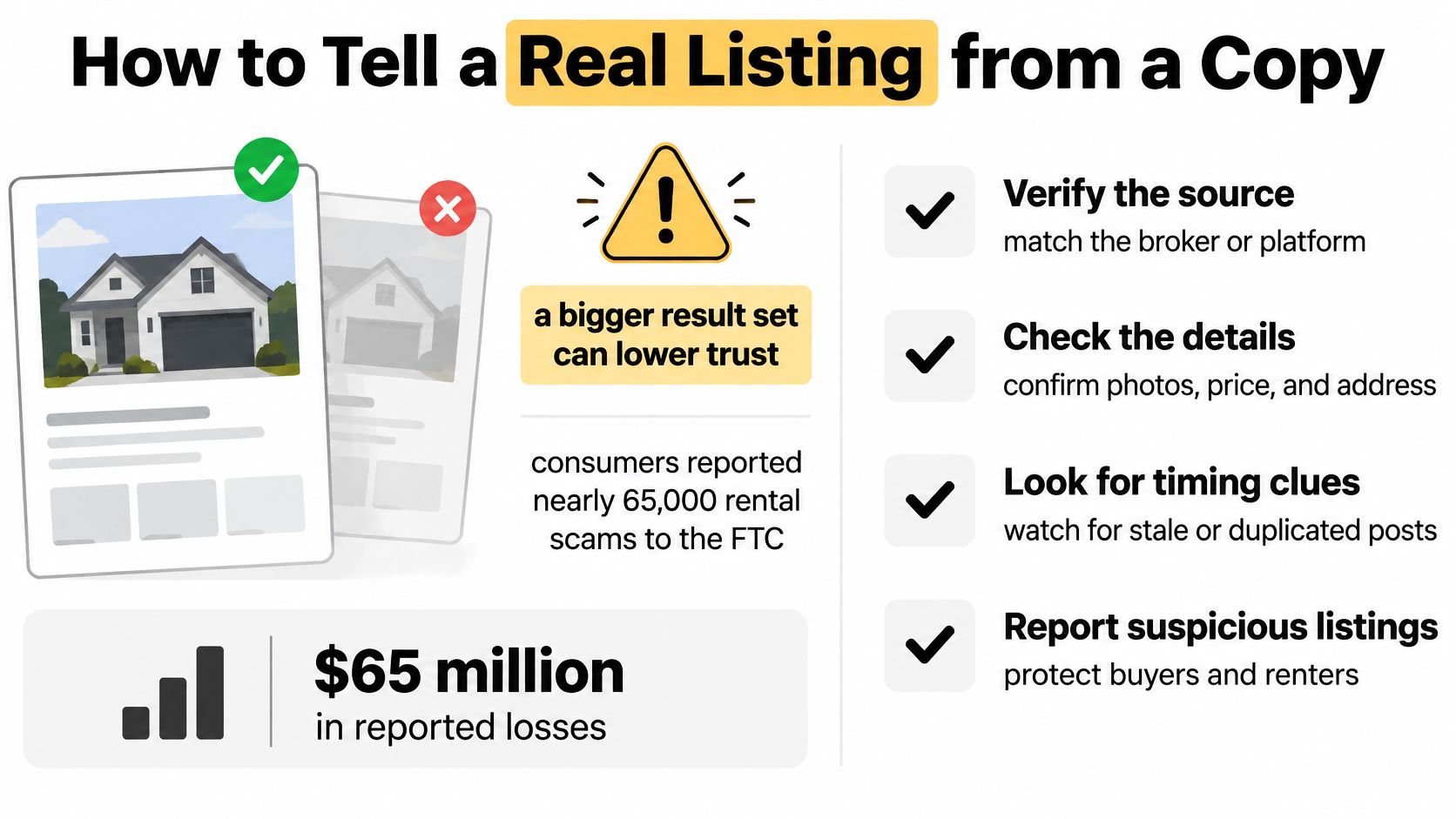
Compare the relationship between fields
Matching photographs alone doesn't establish legitimacy. Compare the property, advertiser, price, and timing together.
Cross-source check before you trust a listing
| Check | Genuine signal | Stop sign |
|---|---|---|
| Address and coordinates | Same pin and unit across sources | Pin moved or unit number missing |
| Image set | Original photos match the listing's own history | Same photos reposted under a new contact |
| Price | Within the normal range of recent asks or rents | Far below local market with a request for upfront payment |
| Contact or agent | Known brokerage or host matches the MLS or platform record | New contact on an old listing |
| Last seen and status | Recent timestamp with agreeing status | Old timestamp or sold home still shown as active |
An owner and listing-agent information lookup can support comparison, but independently confirm the contact through the brokerage or original platform. Don't treat the telephone number inside a suspicious advertisement as its own verification channel.
Verification boundary: A conflict is a reason to pause and investigate, not proof of either a bargain or a scam.
Missing inventory needs scrutiny too
Not every gap is fraud. Public feeds can omit withheld listings, and distribution delays can produce mismatched availability.
A report on the Chicago MLS's response to Zillow describes a 2025 Zillow analysis finding private listings more than twice as common in majority-white neighborhoods, while also reporting the MLS's methodological objections. Treat that disagreement as a reason to measure coverage transparently, not to declare a portal's results a complete market census.
HUD's digital housing advertising guidance explains that the Fair Housing Act prohibits advertisements indicating preferences or discrimination based on race, color, religion, sex, disability, familial status, or national origin, and recommends auditing audience or source lists for unjustified restrictions.
Expose source, update age, missing-field flags, and cross-source disagreements. Review both advertising language and delivery settings so a clean-looking search interface doesn't conceal exclusion.
Ship One Feed You Can Explain
Pick a specific job before adding another source: find homes near a location, open a known listing, or alert a user when an asking price changes. That choice determines the minimum fields your application needs and the failures it must handle.
For an initial build, refuse to publish records without a source name and retrieval time. Keep incomplete records in a review queue rather than filling gaps with invented defaults.
Give the first release an acceptance test
Use a small, inspectable market and check the output manually:
- Marketplace test. Confirm that filters select the intended property types and that map pins resolve to the correct units.
- Brokerage test. Place dated asking-price observations beside the current ask without presenting them as completed sale prices.
- Analytics test. Sample neighborhoods for missing attributes and source availability instead of treating a national record count as proof of coverage.
Write down what happens when a record disappears. Your application should distinguish source removal, retrieval failure, and confirmed transaction closure rather than assigning the same off-market label to all of them.
RealtyAPI.io offers a developer-first way to test this integration shape: one API key and one integration provide property, rental, and market data across 27 listing platforms, including Redfin, Realtor, Airbnb, Apartments.com, Rightmove, Zoopla, and Idealista, with 300+ endpoints spanning search, property details, market data, agents, and rentals.
This is public-source data, not an official MLS feed. We don't guarantee accuracy, completeness, or timeliness, and customers are responsible for verifying information used in their decisions.
Set a concrete first milestone: request a key, run a location search and a detail call in a chosen city, and inspect the returned source labels. Expand only after you can explain the response, its gaps, and its update behavior to someone who didn't build the integration.
RealtyAPI.io brings property, rental, and market information into a shared API for building search, comparison, and monitoring tools. Visit RealtyAPI.io to request a key and test a location search followed by a property-detail request, keeping the originating site visible in your application.