Python API Gateway Example: Build a Simple Proxy
You've copied a Python API gateway tutorial, deployed the handler, and watched one request reach the backend. Then real requirements arrive. A second service needs a different path, clients send malformed payloads, an upstream API slows down, and nobody can explain which route is generating errors. A useful Python API gateway example has to address those conditions, not just demonstrate forwarding.
Python is a practical choice for gateway-adjacent control layers. In the 2024 Stack Overflow Developer Survey, 51.0% of respondents reported using Python, placing it among the most popular languages overall. The language is familiar to application teams, has mature HTTP tooling, and works well for policy, validation, and orchestration code around managed gateway services.
Why Most Python API Gateway Examples Miss Production Reality
A tutorial can prove that a request reaches an upstream service while leaving the decisions that determine whether the gateway survives production. AWS's Python API Gateway code examples show how to create resources, deploy APIs, and connect Lambda-backed REST endpoints. They are useful service references, but they do not define your routing policy, validation boundary, authentication model, or failure behavior.
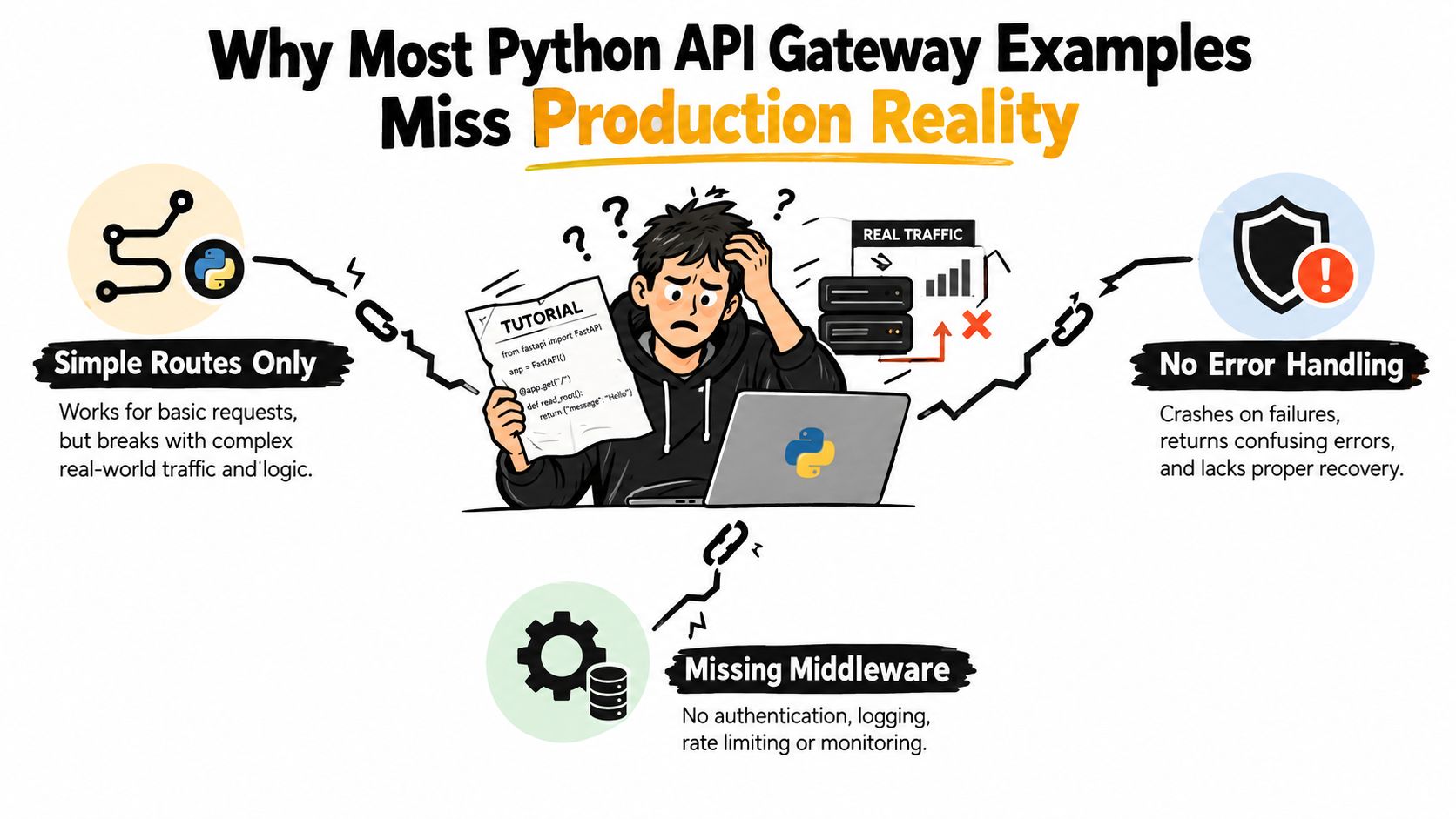
A production gateway sets those boundaries explicitly. It decides where identity is verified, which payloads are rejected, how errors are shaped, and what happens when an upstream dependency slows down or fails. Without that contract, authorization spreads across backends, validation differs between routes, and retries from clients can intensify an outage.
The missing operational contract
Define the expected behavior for every route:
- Routing: Which path and method call which upstream operation?
- Validation: Which query parameters, headers, and body fields must pass before forwarding?
- Identity: Which token, API key, or service identity does the gateway verify?
- Failure behavior: Which failures are safe to retry, and which should return immediately?
- Telemetry: Which request, latency, and error fields will help operators isolate the fault?
The handler is only one part of the design. AWS API Gateway metrics documentation describes request count, latency, and errors as core signals. AWS stores API Gateway metrics in CloudWatch for 15 months, with default one-minute granularity, according to the same AWS documentation. Route-level visibility then helps distinguish a failing dependency from a broader API problem.
Practical rule: If an example does not show how operators will observe failures, it demonstrates request forwarding, not a production gateway design.
Start with a small but complete baseline: clear route ownership, strict validation, a defined authentication boundary, bounded retries, and structured logs. Choose deployment and scaling mechanisms that fit the workload and the team. Python can implement the policy layer effectively, but convenience should not become a reason to build an unnecessary custom proxy.
Building a Practical Python API Gateway with FastAPI
FastAPI works well when the gateway needs application-level decisions, such as request validation, tenant-aware authorization, or transformation between a public contract and an internal service. Keep the entrypoint thin. Put route declarations, upstream clients, policies, and schemas in separate modules so a growing API doesn't become one large handler.
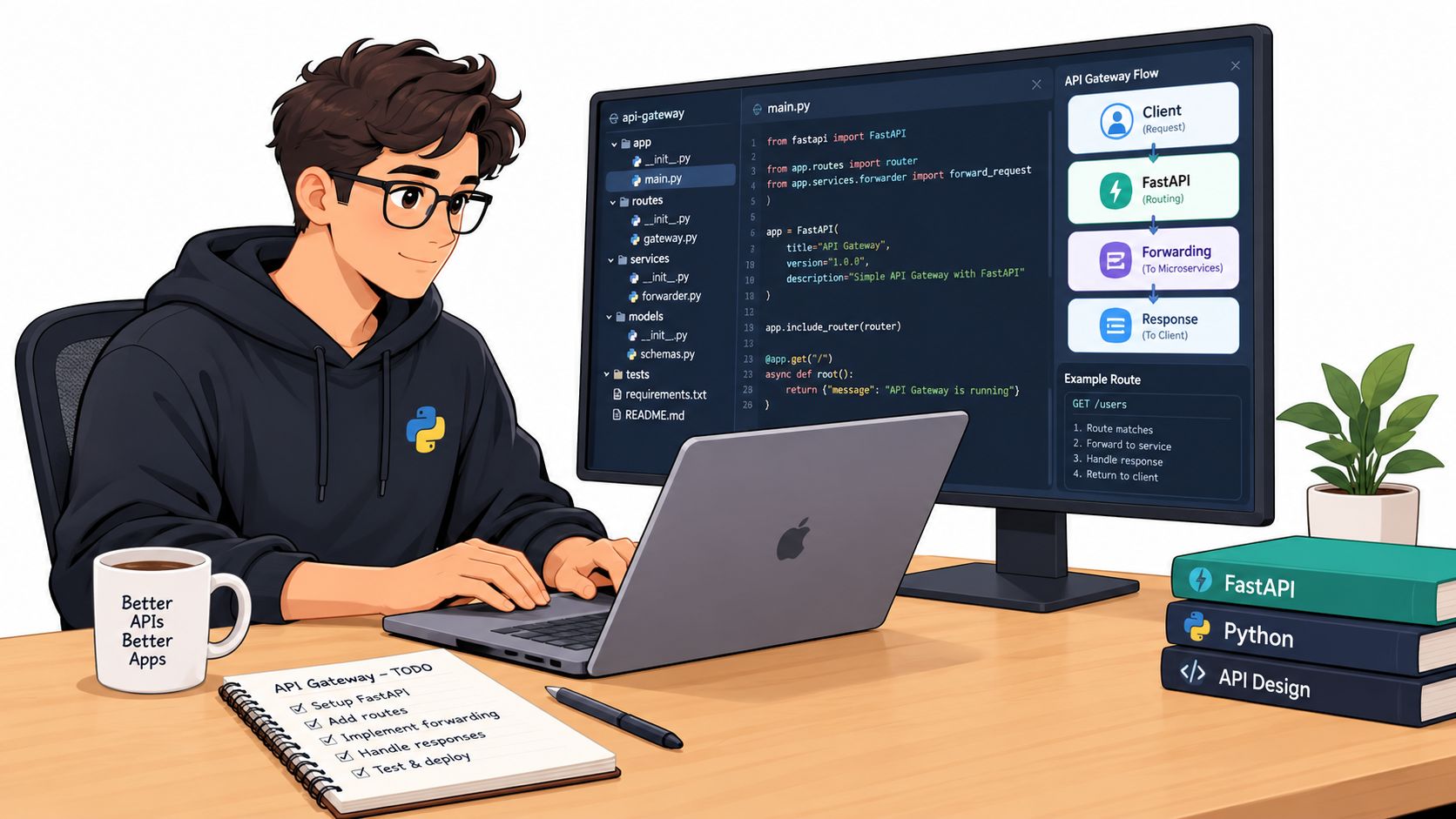
A maintainable layout can look like this:
app/main.pycreates the FastAPI application.app/routes/contains public route definitions.app/clients/owns outbound HTTP clients and timeouts.app/schemas.pydefines request and response models.app/policies.pyhandles authentication and authorization decisions.app/settings.pyloads environment-specific configuration.
The route should validate first, authenticate before calling the upstream, and pass only the data the backend needs. An illustrative pattern is:
from fastapi import Depends, FastAPI, Header, HTTPException
from pydantic import BaseModel
import httpx

app = FastAPI()
UPSTREAM_URL = "https://service.internal"

class PropertyQuery(BaseModel):
    destination: str
    guests: int

async def require_token(authorization: str | None = Header(default=None)):
    if not authorization or not authorization.startswith("Bearer "):
        raise HTTPException(status_code=401, detail="Authentication required")
    return authorization.removeprefix("Bearer ")

@app.post("/v1/search")
async def search(
    query: PropertyQuery,
    token: str = Depends(require_token),
):
    headers = {"Authorization": f"Bearer {token}"}

    async with httpx.AsyncClient(timeout=5.0) as client:
        response = await client.post(
            f"{UPSTREAM_URL}/search",
            json=query.model_dump(),
            headers=headers,
        )

    return response.json()
This is a useful starting shape, not a complete production policy. In a real service, validate the token against a trusted issuer, map upstream status codes deliberately, and avoid forwarding every incoming header. A dedicated client module should own connection pooling, timeouts, correlation headers, and response decoding.
Route matching and response handling
Use explicit routes when each operation has distinct validation or authorization rules. A catch-all proxy can reduce initial code, but it also makes policy review harder and increases the risk of forwarding an unintended path or method. For endpoints that return large results or progressive output, use streaming responses rather than buffering the entire upstream body in memory. The response streaming overview for AWS serverless applications explains the difference between buffered and incremental delivery and the need to handle slow clients and mid-stream failures.
Keep public responses stable even when internal services change. A gateway that mirrors every backend field couples clients to internal implementation details. Define response models, redact sensitive fields, and return consistent error envelopes. You can test the public contract interactively with a real estate API playground, then reproduce the same request in automated integration tests.
For AWS Lambda deployments, AWS Lambda Powertools provides an ApiGatewayResolver decorator pattern that matches both path and HTTP method. Its documentation also notes that proxy_type can be configured when the function is fronted by API Gateway HTTP APIs, which can simplify event handling without hiding the route contract.
Run the gateway locally with representative upstream failures, not just successful responses. Test malformed JSON, missing credentials, slow dependencies, unexpected content types, and cancellation while a response is streaming. Those tests reveal whether your gateway is enforcing its contract.
Choosing the Right Framework and Architecture for Your Gateway
FastAPI is a strong fit when Python must make decisions on the request path. It gives teams typed validation, asynchronous handlers, and a straightforward structure for middleware and dependency injection. It isn't automatically the right choice for every gateway. If the main requirement is TLS termination, path forwarding, and connection management, a dedicated reverse proxy may be simpler to operate.
| Approach | Best for | Complexity | Operational control |
|---|---|---|---|
| FastAPI service | Validation, transformation, custom policy, Python-owned orchestration | Medium | High |
| Lightweight reverse proxy | Stable forwarding with minimal business logic | Low | Medium |
| Managed API gateway with a Python integration | Cloud-native routing, quotas, identity, and managed operations | Low to medium | Medium |
| Serverless function proxy | Infrequent or event-driven integrations with limited runtime state | Medium | Medium |
| Custom gateway platform | Specialized routing, multi-tenant policy, or unusual protocols | High | High |
A managed gateway is usually preferable when identity integration, throttling, deployment stages, and infrastructure ownership matter more than custom request logic. Google's Python API Gateway client documentation describes the setup sequence around a Cloud Platform project, billing, API enablement, and client operations such as create_api and create_gateway. That model keeps much of the gateway lifecycle outside application code.
Match the architecture to the boundary
Use a Python gateway when it owns meaningful behavior. Examples include translating a public search request into several internal calls, applying tenant-specific policy, or normalizing inconsistent upstream responses. Don't place arbitrary domain logic there merely because the gateway is convenient. Business rules that belong to a service become difficult to version when hidden inside shared middleware.
A reverse proxy is the better boundary for simple forwarding. It avoids creating a Python process whose only job is to relay bytes, and it typically provides mature connection handling. A managed service is attractive when your team doesn't want to own availability, patching, gateway configuration, and deployment coordination.
Teams designing multiple independently deployed services should first define service ownership and contracts. A practical resource on building microservices end to end can help frame those broader boundaries. For API contracts, publish an OpenAPI document and validate it in CI. A documented OpenAPI integration workflow is useful when the gateway must expose a stable schema to client teams.
The decision should follow constraints, not fashion. Ask who owns the runtime, whether the gateway needs custom Python behavior, how much policy should be centralized, and whether the team can operate another service. Keep the first version narrow, but leave clear seams for authentication, metrics, and upstream clients.
Adding Authentication, Rate Limiting, and Retry Logic
A gateway becomes useful when it protects the services behind it. Authentication, rate limiting, and retries should be separate controls with separate failure behavior. Combining them into one large middleware function makes it difficult to reason about whether a rejected request was unauthenticated, throttled, or failed upstream.
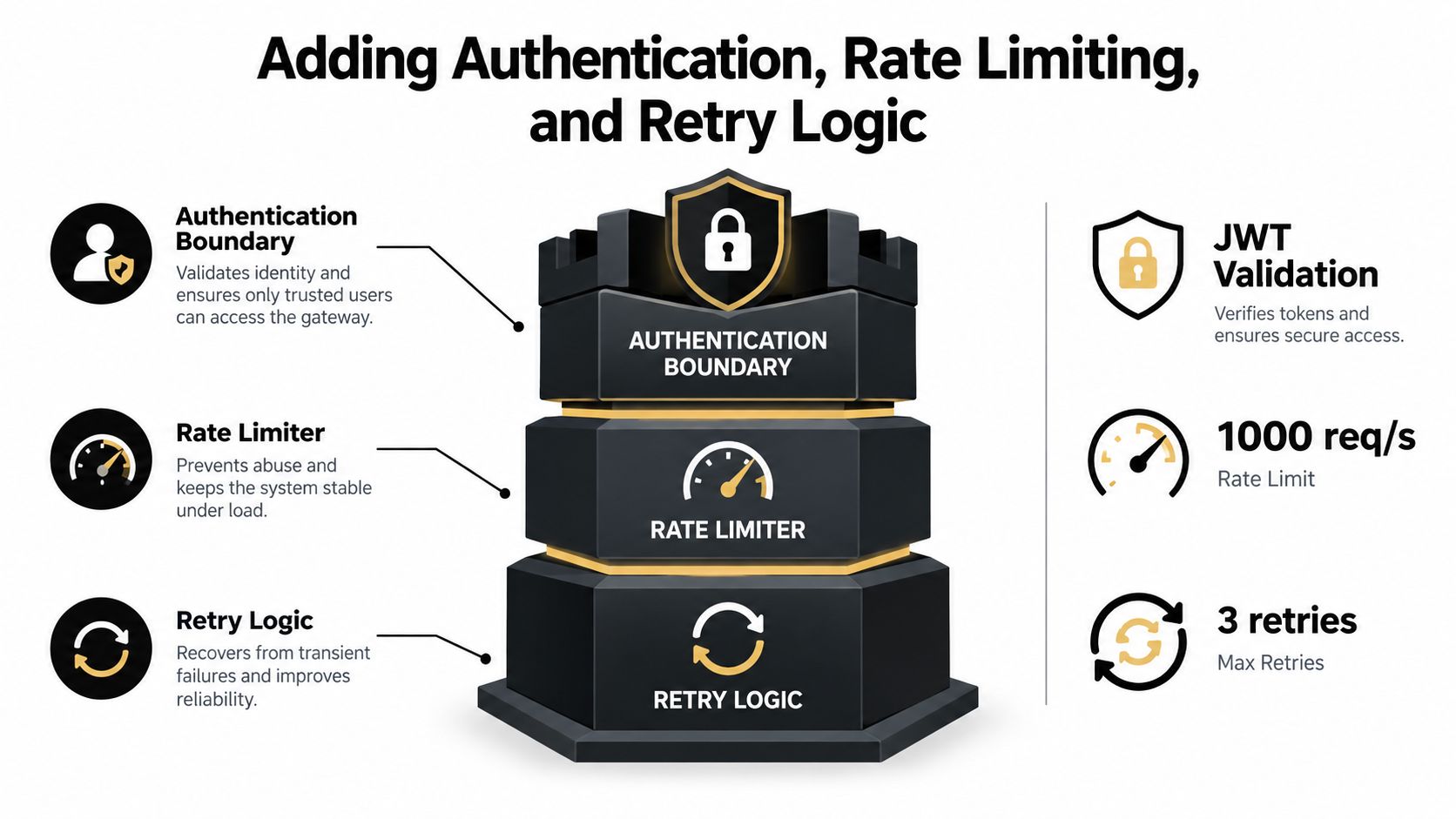
Authentication should happen before expensive downstream work. Parse the Authorization header, verify the token signature and claims through a trusted library or identity provider, and attach a small principal object to the request context. Don't treat a decoded JWT payload as proof of identity, and don't forward client-controlled identity headers to internal services.
Rate limiting needs a defined key. Depending on the product, that might be a tenant, user, API key, or carefully handled client address. Store counters in a shared system when the gateway runs across multiple instances. An in-memory counter can be useful for local testing, but it won't enforce a consistent policy once requests reach different workers.
The rate-limit guidance for API integrations provides a useful reference point for thinking about quotas and client behavior. Your gateway should return a clear throttling response, include enough information for a client to back off, and prevent one tenant from consuming capacity intended for others.
Retry only failures that can recover
Retries belong around the outbound call, not around the entire incoming request without limits. A safe policy normally considers the HTTP method, the error class, and whether the operation is idempotent. A read request that receives a transient network failure may be retryable, while a payment or mutation request requires an idempotency key and explicit upstream support.
Use exponential backoff with jitter and a strict deadline. Don't retry authentication failures, validation failures, or every server error indiscriminately. Each retry consumes connection capacity and can worsen an already overloaded dependency.
Resilience rule: A retry policy without a total time budget is an outage multiplier.
The gateway also needs backpressure. Set connection and response timeouts, cap request body sizes, and fail quickly when the upstream has exceeded its budget. If the client disconnects, cancel work where the framework and client library allow it. For a broader treatment of logical access control for apps, review how authorization decisions should align with application resources rather than stopping at token presence.
Finally, make errors predictable. Return a consistent structure with a request identifier, expose safe messages to clients, and keep internal exception details in logs. A client that can distinguish 401, 403, 429, and upstream availability failures can respond intelligently instead of repeating the same request blindly.
Observability, Deployment, and Scaling Considerations
A route can pass every functional test and still fail in production because nobody can explain a timeout, rejected request, or bad upstream response. Instrument each request with a correlation identifier, route name, method, status, duration, and upstream outcome. Keep credentials, raw authorization headers, and sensitive request bodies out of logs.
Track request volume, latency, errors, and dependency health together. AWS API Gateway retains metrics in CloudWatch for 15 months at one-minute granularity, according to its CloudWatch metrics documentation. Cloudflare's API Gateway Python resources expose usage history and HTTP request time-series endpoints through their API documentation. HAProxy's statistics page documents more than 100 unique metrics. These references point to the same operational requirement: a gateway needs monitoring data that helps engineers isolate route, dependency, and capacity failures.
Return a consistent error structure with a request identifier and safe client messages, while keeping exception details in logs. A client that distinguishes 401, 403, 429, and upstream availability failures can choose an appropriate response instead of repeating the same request blindly. The status code reference documents the exact codes your gateway should map.
Deploy with failure boundaries
Containerize a FastAPI gateway when predictable dependencies, long-lived connection pools, and standard service deployment matter. Serverless integrations reduce infrastructure management for event-driven traffic, but introduce platform-specific limits, cold starts, and different streaming behavior. Oracle's Python Functions and API Gateway tutorial covers creating an application and function, deploying and testing it, exposing the function through an API Gateway, and calling it from the internet.
Use versioned routes or stages for contract changes. Release a new upstream gradually, watch route-level errors and latency, and make rollback a deployment action rather than a manual code edit. Define degradation behavior before an incident. If a secondary enrichment service fails, decide whether to return partial data or reject the response, then document that contract for clients.
For application teams, application performance monitoring best practices such as those outlined by Cloudvara connect traces, logs, and service-level signals. RealtyAPI.io can sit behind this pattern when a PropTech application needs a unified real estate API. The gateway then handles authentication, request shaping, and client-facing policy, while the data provider handles data access. Keeping those responsibilities separate makes scaling and incident diagnosis easier.
Practical Tips and Next Steps for Building Production Gateways
Start with one route and write down its contract before adding abstractions. Define the accepted input, authentication requirement, upstream timeout, retry eligibility, response schema, and error mapping. Then test the route against slow, invalid, unauthorized, and unavailable conditions.
A short checklist prevents most avoidable mistakes:
- Validate early: Reject malformed parameters before opening an upstream connection.
- Name routes explicitly: Prefer readable route ownership over an unrestricted catch-all proxy.
- Bound every dependency: Set connection, response, and total request deadlines.
- Measure outcomes: Record route-level latency and status without exposing secrets.
- Roll out safely: Version public contracts and keep a tested rollback path.
Consider a PropTech search product that accepts a destination and filters from a web client. Its Python gateway can authenticate the tenant, validate the query, apply a quota, call a real estate data provider, normalize the response, and expose one stable schema to the frontend. RealtyAPI.io offers a unified API layer for publicly available real estate data, with REST, GraphQL, and webhooks, so the gateway can focus on application policy instead of implementing separate client integrations for each source.
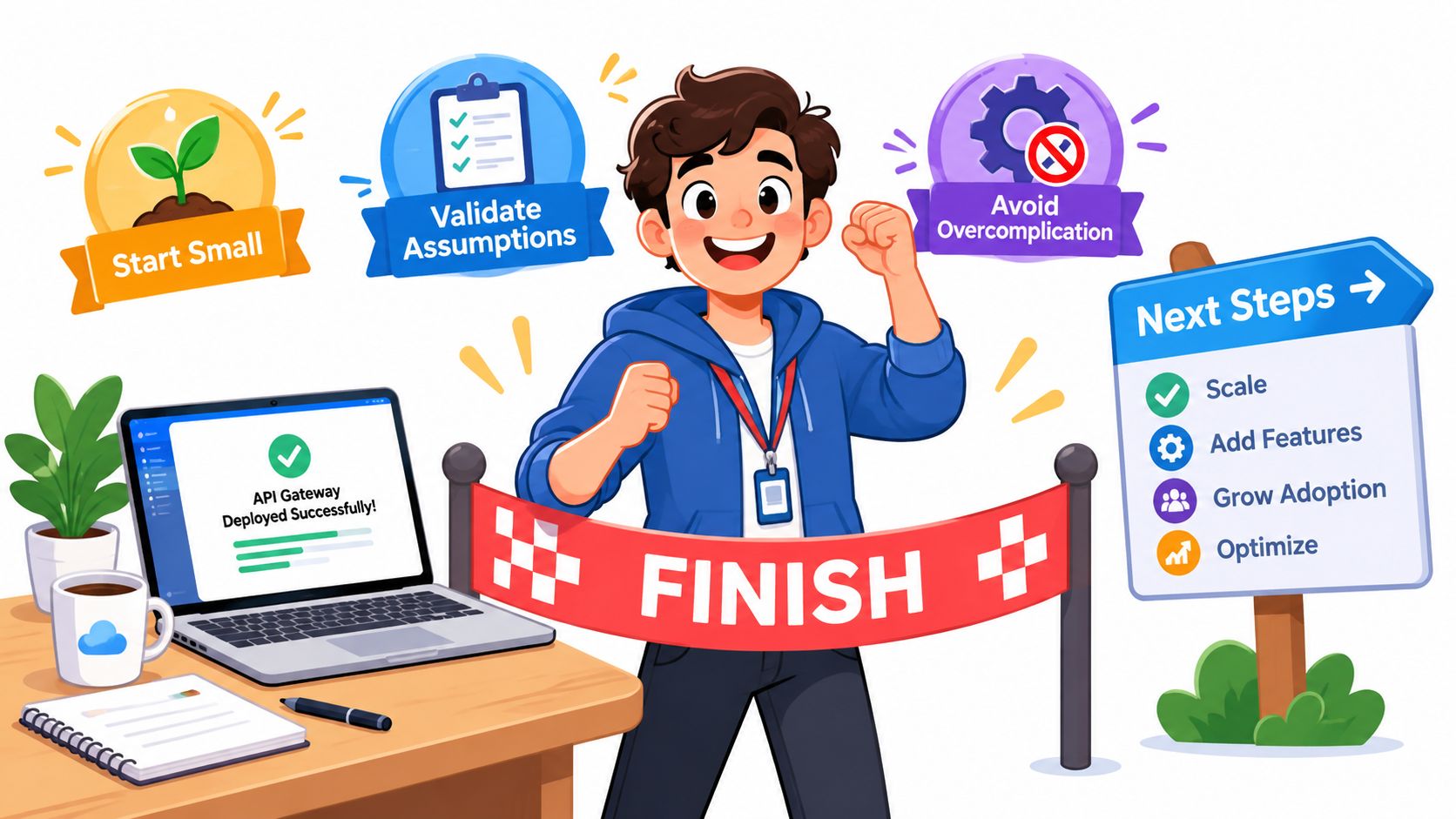
Run the smallest useful version locally, add contract and failure tests, and deploy it with metrics enabled from the beginning. Expand only when a real requirement appears, such as tenant isolation, response streaming, or a second upstream with different reliability characteristics.
RealtyAPI.io provides a unified real estate data API with REST, GraphQL, and webhooks, giving Python gateway teams a consistent upstream for property search, listings, pricing trends, availability, and related market data. Connect your gateway to the data layer, apply your own validation and access policies, and visit RealtyAPI.io to explore the API and get started.