Build a Fast Property Search Tool with RealtyAPI

You're probably looking at a familiar failure right now: the search page loads quickly, but the results are stale, duplicated, missing important fees, or impossible to compare. A listing says “available,” yet the property was taken yesterday. Another looks affordable until mandatory charges appear at checkout. A third ranks highly for reasons the user can't understand.
A production-grade property search tool isn't just a form connected to a listings endpoint. It's a data system that translates messy intent into structured queries, merges inconsistent sources, enriches listings with decision-ready context, and keeps freshness under control. The hard work sits behind the search box, in caching, normalization, attribution, privacy rules, and measurement.
Designing the Property Search User Experience
Online discovery is now the starting point for virtually every U.S. home search. The National Association of REALTORS® 2025 Profile of Home Buyers and Sellers reports that all home buyers used the internet to search for a home in 2024, and 43% said looking for properties online was their first step. Buyers spent a median of 10 weeks searching, typically viewed seven homes, and viewed two homes online only. Photos, detailed property information, and floor plans were the most valuable website content, valued by 41%, 39%, and 31% of buyers respectively.
That behavior changes the engineering target. Search shouldn't optimize only for the number of returned records. It needs to move a user from vague intent to a qualified action, such as saving a property, opening a detail page, sending an inquiry, requesting a tour, or making an offer.
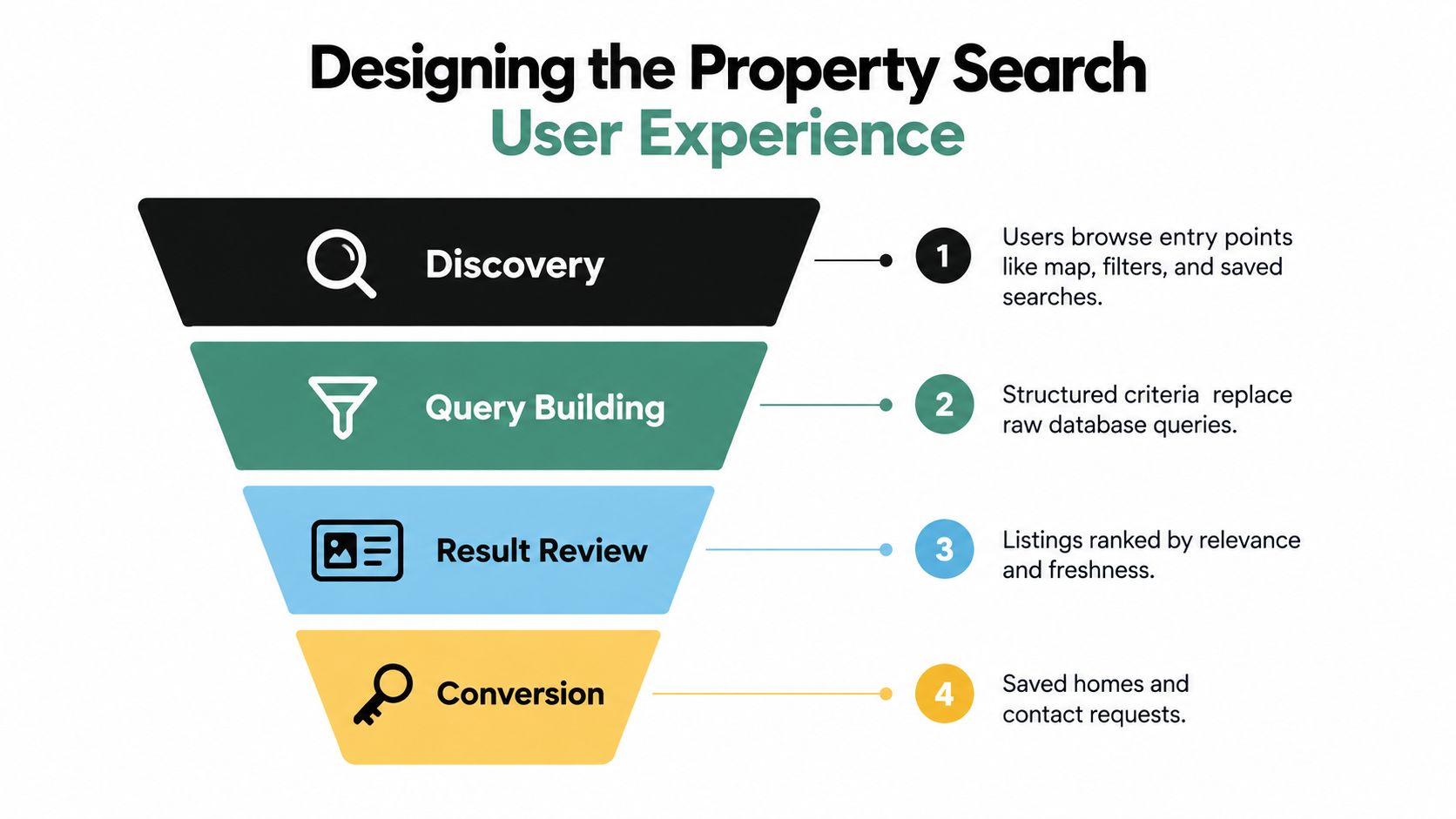
Model the funnel, not just the query
A reliable request pipeline usually has six stages:
- Normalize intent. Convert free text and UI controls into geography, price, property type, bedrooms, amenities, and timing requirements. “Near central Brussels, under my budget, with an elevator” should become explicit fields, not a string passed directly to a database.
- Resolve geography. Accept destinations, coordinates, place identifiers, postcodes, and direct URLs. Store the canonical place alongside the original input so the interface can explain what it searched.
- Retrieve broadly. Fetch a candidate set large enough to support later ranking and filtering. Retrieval and filtering are different jobs.
- Apply hard constraints. Remove listings that fail essential requirements, such as property type or maximum price. Keep unknown values separate from confirmed failures.
- Rank intelligently. Combine preference matches, freshness, data completeness, and source reliability. Don't let a highly relevant but stale record outrank a current listing without making that trade-off visible.
- Measure outcomes. Track result views, detail views, saves, inquiries, tours, and completed transactions independently.
A large NBER field study found that households viewed approximately 34 properties on average, while an intervention that improved access to school-quality information increased inquiries by 0.80 from a control average of 2.3 inquiries. The same study found that households observed roughly one off-platform property per week, so a single source never represents the full feasible choice set. That makes deduplication, coverage reporting, and recall measurement essential.
Practical rule: A successful search is a session that produces a qualified action, not an API request that returns HTTP 200.
Instrument each stage with a request ID and query snapshot. Record the normalized filters, candidate count, hard-filter exclusions, rank scores, and final actions. This lets you distinguish a poor inventory problem from a poor ranking problem or a frontend problem. Teams that only monitor latency and response success will miss the more damaging failure, users receiving plausible results that don't help them decide.
For teams working on conversion, measuring and A/B testing friction provides useful context for evaluating where users abandon a flow. In practice, test one friction point at a time, such as overly aggressive filters, unclear map behavior, or a result card that hides key property attributes.
Fetching Listings with RealtyAPI Endpoints
The cleanest integration starts with a stable internal search contract. Your frontend should send a normalized request to your backend, and the backend should translate it into the source-specific RealtyAPI call. That separation prevents provider details from leaking into UI code and gives you room to change sources without rewriting the product.
A typical request needs a source, location input, transaction mode, filters, sorting, and pagination. Coordinate searches should include latitude and longitude plus a radius or bounding strategy supported by the endpoint. Place-ID searches should preserve the identifier returned by your geocoder, rather than repeatedly converting a human-readable label into coordinates.
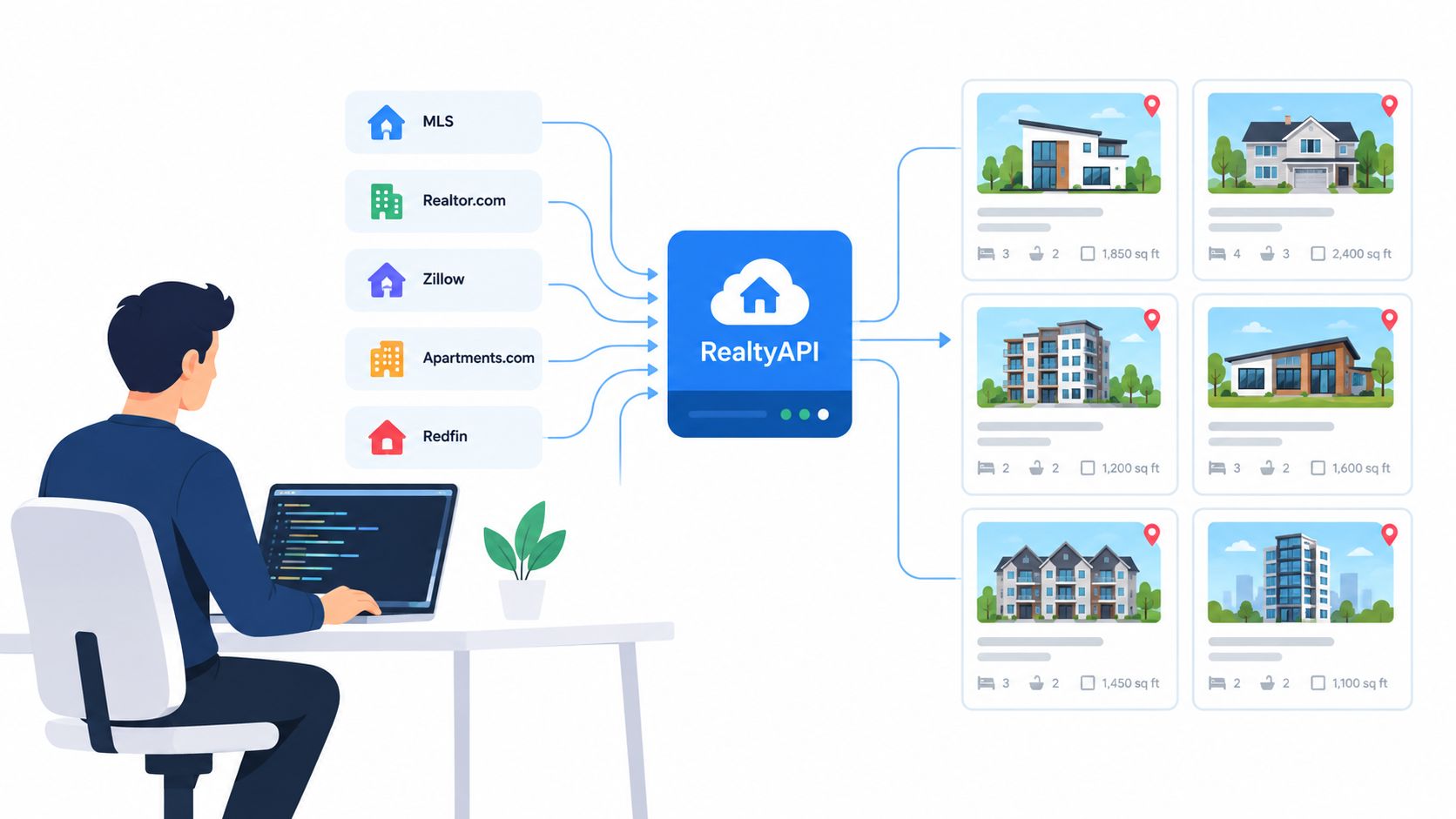
Keep provider calls behind one adapter
For each source, define an adapter with four responsibilities:
- Input mapping. Translate your canonical fields into the provider's parameter names and accepted values.
- Response mapping. Convert source-specific cards, details, images, availability, amenities, and prices into your own schema.
- Pagination control. Preserve the provider cursor, page number, total indicator, and source-specific continuation state.
- Failure classification. Separate validation errors, authentication failures, rate-limit responses, timeouts, empty results, and upstream outages.
RealtyAPI supports searches by destination, coordinates, place ID, and direct URL, with coverage that includes platforms such as Redfin, Realtor, Airbnb, and Zoopla. The relevant RealtyAPI introduction documentation should be your starting point for authentication, request structure, and response handling. A practical overview of API planning and delivery is also available in Digital Souls Studios on MVP development, particularly when you're deciding which search capabilities belong in the first release.
Pagination is where otherwise reliable integrations often lose inventory. Never assume a fixed page size or that a missing field means there are no more results. Follow the continuation token or page metadata until the source indicates completion, impose a server-side maximum for cost control, and expose an honest “more results available” state when you stop early.
Retry carefully and cache deliberately
Use exponential backoff for transient failures, with jitter so concurrent workers don't retry together. Retry timeouts and temporary upstream errors, but don't retry malformed requests or authorization failures. Put a request budget around every user search so one slow source can't hold the entire response open indefinitely.
Cache geography resolution and stable metadata aggressively. Cache search responses for a short, explicitly documented period, keyed by a canonicalized query that includes source, location, filters, sort order, and page state. Don't cache personalized ranking decisions under a shared key. Detail pages can use a separate policy from search results because availability, price, and status often change at different rates.
Enriching Results with Contextual Attributes
A listing can match the bedroom count and price filters yet still fail the household's real needs. Flood exposure, energy efficiency, transit access, neighborhood context, price history, and data quality all affect the decision. A property search tool should surface those factors without making an external estimate look like a listing fact.
Build enrichment as a separate layer around the source record. Store each attribute with its value, source, retrieval time, geographic resolution, and methodology version when applicable. If a risk provider covers a neighborhood rather than a parcel, label the coverage clearly. That distinction prevents stale or broad-area data from appearing more precise than it is.
Put context where decisions happen
Result cards should show signals that affect initial selection. Keep more detailed explanations on the property page, where users can inspect definitions and limitations. Flood risk belongs early in the experience, provided the interface displays its source and update time.
A randomized housing-platform field experiment involving roughly 964,000 registered users found that displaying flood-risk information led users who had been browsing high-risk homes to shift toward properties with 12.4% less flood risk by week nine. Their eventual offers had 57% less flood exposure than those of control users. The finding is relevant to search design because disclosure changed the homes users pursued, not only their clicks. The research is described in research on flood-risk disclosure.
Ranking logic should separate requirements from preferences:
- Hard exclusions remove properties outside an explicit threshold, such as a selected flood-risk limit.
- Soft signals influence ordering for preferences such as transit distance or energy efficiency.
- Visible unknown states distinguish missing values from favorable values.
- Explanations identify whether an attribute came from the listing, an external dataset, or a derived estimate.
Transport context can be fetched through a dedicated walk, transit, and bike endpoint. Keep its response in a separate enrichment record rather than overwriting the original listing. This makes refreshes safer and preserves the source data when an upstream provider changes coverage or returns stale results.
Make provenance part of the data model
A model-generated neighborhood summary should not share the same field as an observed listing fact. Use separate fields for raw values, normalized values, confidence, and explanation. Retain historical snapshots when users need to understand price changes or when an attribute's methodology changes.
This structure also protects ranking quality. Treating missing flood-risk data as low risk creates false reassurance. Treating every missing value as negative suppresses homes in areas with weaker coverage. Expose uncertainty, record freshness, and geographic scope so users can judge how much weight each attribute deserves.
Handling Accessibility and Total Cost Filters
A listing priced below nearby homes can still cost more after mandatory fees, deposits, utilities, and application charges are included. Accessibility claims need the same scrutiny. The word “accessible” does not confirm a step-free entrance, elevator access to the correct floor, or a bathroom that fits a resident's needs.
The 2025 National Renter Survey reported that 76.9% of renters leasing from property-management companies and 59.5% renting from public housing authorities had encountered at least one landlord-imposed junk fee. The release also reported that 65.0% of renter households needing mobility features and 77.1% needing sensory features lacked those features, while 43.7% said landlords were typically unwilling to add requested accessibility features. See the 2025 National Renter Survey release for the reported figures.
Represent cost as data, not display text. Keep recurring charges separate from one-time move-in costs. A comparable monthly total might include base rent, mandatory service charges, parking, utilities, and recurring management fees. Deposits and application charges belong in a separate move-in view. An uncertain fee should remain unknown rather than becoming zero without notice.
Use distinct fields for:
- Required recurring charges, which affect monthly comparison.
- Required one-time charges, which affect move-in affordability.
- Optional charges, which should not inflate the mandatory total.
- Unknown charges, which need a visible warning.
- Evidence and timestamp, identifying whether the value came from structured data, listing text, or an estimate.
Accessibility requires the same field-level treatment. Store step-free entry, elevator access, bathroom layout, visual alarms, and transit proximity independently. Each capability should support states such as verified, reported, contradicted, and unknown. That prevents one broad label from hiding a missing or conflicting detail.
Filtering logic must distinguish rejection from ranking. Remove a property only when available evidence confirms that it fails the requirement. An unknown elevator field is not proof that no elevator exists. Let users hide unknown results, place them after verified matches, or include them with a clear uncertainty label.
A structured query can use the RealtyAPI accessibility filtering endpoint, while the interface explains why each result matched. A checkbox marked “accessible” remains too vague for a household with a specific mobility or sensory need.
Negative information often has greater practical value than a larger result count. An unverified entrance or undisclosed mandatory fee can prevent an application, a wasted viewing, and a later cancellation. Reliable rejection reasons make a property search tool safer to use.
Scaling with Webhooks and Edge Caching
A buyer opens a search from Singapore while a seller changes the price in Chicago. The result page must respond quickly, yet it cannot show a home that is already under contract. Real estate feeds change quickly, so production search needs a freshness model that varies by field and by cache layer.
Webhooks should trigger targeted invalidation. Validate each signature, store the raw event, deduplicate deliveries, and place accepted events on a queue. A worker can update the canonical listing, mark affected search keys stale, and purge or revalidate only the relevant edge objects.
Make the consumer idempotent. Providers can retry events or deliver them out of order, while a delayed message must not replace newer information. Store the provider event ID when available, compare source timestamps, and retain an audit trail showing why the current value won.
Different data types need different cache policies:
- Search pages can use short lifetimes with targeted invalidation.
- Listing details need prompt revalidation for price, status, and availability.
- Static assets, including image transformations, can usually remain cached longer.
- Geographic metadata can outlive live listing state.
NAR's IDX policy requires electronic IDX listing displays to update automatically at least once every 12 hours, according to the IDX policy guidance. That cadence does not protect users from an interim price, status, or availability change. Webhooks and freshness checks still determine whether a result is trustworthy.
Edge performance depends on disciplined keys. Normalize query-parameter order, quantize map viewports carefully, and avoid creating a new key for every minor pointer movement. Return compact card fields for result pages, then fetch heavier detail content separately. Purge by listing ID and by affected geographic or filter partitions when an update arrives.
Stale-while-revalidate can keep global responses fast, but show the last-updated time and define which fields may remain briefly stale. For volatile status fields, a short cache lifetime or synchronous freshness check is safer than displaying an attractive home that is no longer available. This edge strategy is what makes sub-second responses practical without treating stale MLS data as current.
Scraping-based systems also need a realistic budget for residential proxy and browser cost models. A unified data layer can reduce browser sessions, proxy rotation, and source-specific retries, but it does not remove the need for request budgets or backpressure.
Put the RealtyAPI rate-limit documentation in the capacity plan. Coalesce identical requests, cap concurrency, and return a controlled fallback when several users request the same uncached query. Those safeguards protect the origin and keep a cache miss from becoming a traffic spike.
Testing and Deploying Your Search Application
A 200 response proves almost nothing about search quality. Production testing must challenge the cases that damage trust: stale off-market records, duplicate listings, missing regional certificates, conflicting prices, incomplete accessibility fields, and privacy-restricted properties.
Start with fixture data that captures these contradictions. Include two source records for the same home, a listing with an updated price but an older detail payload, a property with missing energy information, and a seller who has withheld the address from internet display. Assert not only that the API returns data, but that the user sees the correct status, attribution, uncertainty, and exclusion reason.
Test compliance as a product behavior
In the United States, NAR's IDX policy permits MLS participants to display other participants' listings on websites, mobile apps, and audio devices, but the display must remain under the participant's actual and apparent control. The site must identify the operating brokerage, use listing data for IDX display, and avoid exposing the wider MLS database to unrelated entities. Seller privacy instructions can also prevent a listing or property address from appearing in an IDX display. These requirements are set out in the NAR IDX policy.
Clear Cooperation creates another timing edge case. After publicly marketing a property, a listing broker must submit it to the MLS within one business day, according to the NAR Clear Cooperation Policy. Public marketing includes channels such as brokerage websites, IDX and VOW displays, email campaigns, and publicly available applications. Preserve source timestamps and status history so your system can distinguish a newly marketed property from a record that has merely failed to synchronize.
For UK searches, treat certificates as structured data. In England and Wales, an EPC must be ordered before a property is marketed for sale or rent, and the government provides a service to check certificate validity and download the document through its Energy Performance Certificate guidance. Missing or outdated EPC data should produce an explicit unknown state, not an assumed rating.
Measure qualified outcomes after launch
Monitor the full funnel:
- Coverage: How many eligible source records reach the canonical index?
- Recall: How many relevant properties survive normalization and filtering?
- Freshness: How old are the source timestamp and last successful update?
- Deduplication: How many records were merged, and why?
- Ranking: Which signals placed each result where it appears?
- Conversion: How often do sessions produce saves, inquiries, tours, or offers?
Run load tests against realistic query distributions, including map pans, repeated popular locations, deep pagination, and concurrent detail requests. Test cache stampedes by expiring a hot key while many clients request it simultaneously. Test webhook replay and out-of-order delivery. Test graceful degradation when one source times out, because returning partial results with clear attribution is often better than blocking the entire page.
A property search tool is ready for production when it can explain both its results and its omissions. Fast pages matter, but users trust the system only when it handles uncertainty, freshness, privacy, fees, and context with candor.
RealtyAPI.io provides a unified API for querying publicly available property and rental data by destination, coordinates, place ID, or URL, with structured details, webhooks, retries, and edge delivery for production search applications. Use RealtyAPI.io to request an API key, test the endpoints, and build a property search experience that treats freshness and data quality as core product features.