How to Get Real Estate Listings with APIs

Your property-search prototype returns listings, the map looks convincing, and the first demo goes well. Then you add another city, see the same apartment twice, and discover that a withdrawn property is still accepting inquiries. The endpoint works, but the product isn't reliable yet.
For developers, how to get real estate listings is really a question about building a dependable acquisition pipeline. You need authorized access, explicit geographic coverage, predictable requests, and a way to explain what each record represents. Getting JSON back is just the beginning.
Why Real Estate Listing APIs Fail in Practice
A familiar debugging session starts with a mismatch: a consumer portal displays properties that your integration doesn't return. It's tempting to change filters until the counts look closer. Before doing that, establish whether you're comparing the same inventory, statuses, geographic boundaries, and display permissions.
A portal-shaped response isn't evidence of complete or authorized access. A useful integration must distinguish listing discovery, lawful access, source coverage, freshness, and normalized delivery.
API access and complete inventory are not interchangeable promises. A successful request proves that a service answered, not that your application can retrieve or republish every property in a market.
Separate discovery from inventory access
In NAR's 2024 buyer research, 51% of buyers found their purchased home through an internet search, while 88% purchased through an agent or broker. Digital discovery and brokerage-connected transactions serve different parts of the process, so a developer shouldn't treat a public search interface as a substitute for inventory agreements.
The same distinction matters operationally. A source might permit interactive display without permitting bulk redistribution, historical storage, or unrestricted exports. Those constraints belong in the architecture before anyone builds a warehouse around the response.
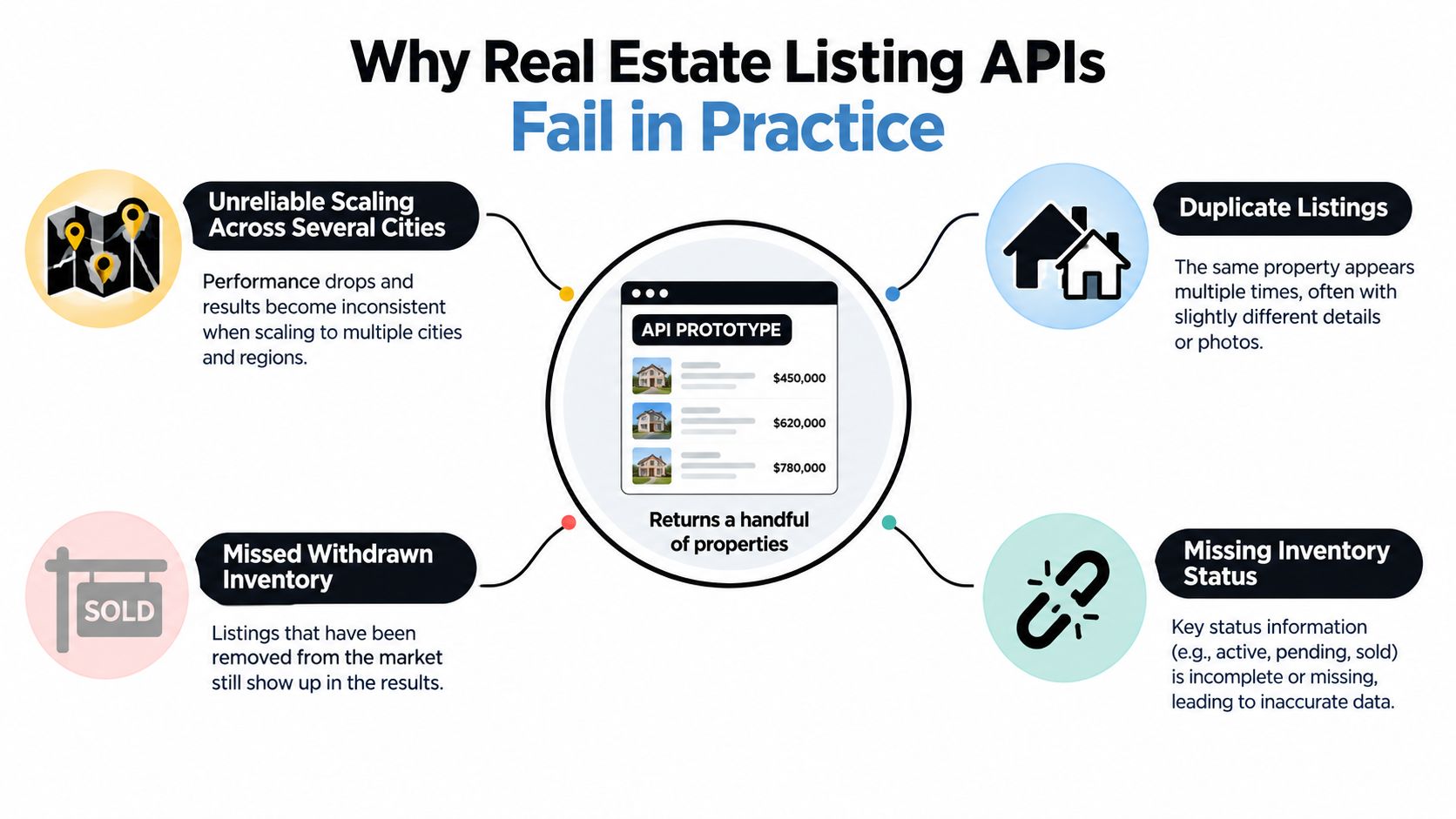
Diagnose the failure before changing the request
Use separate checks rather than a single success metric:
- Access: Does the agreement authorize your application, audience, and intended use?
- Coverage: Which markets, property categories, and listing statuses can the source supply?
- Freshness: When did the source last confirm the record, rather than when did your server download it?
- Identity: Are repeated records separate listings, syndicated copies, or different units?
- Delivery: Can the application distinguish unavailable inventory from an upstream failure?
Keep these answers attached to the integration's operating documentation. Otherwise, a frontend engineer may interpret an empty response as no homes available, while the ingestion team knows the market isn't supported.
The practical trade-off is straightforward: an API can reduce retrieval work, but it doesn't eliminate responsibility for permissions, interpretation, and maintenance. Build those responsibilities into the product instead of treating them as cleanup after launch.
Choose a Source and Register for API Access
Choose the source around rights and coverage, not the attractiveness of its sample response. A direct brokerage feed, an approved RESO-compatible service, and a unified public-listing provider solve different access problems.
For a U.S. IDX application, the NAR IDX policy supports a workflow involving relevant local MLS identification, participant or authorized sponsorship, application review, and display controls. It also requires IDX downloads to refresh at least every 12 hours and restricts redistribution. Don't design an unrestricted permanent mirror before confirming what your agreement allows.
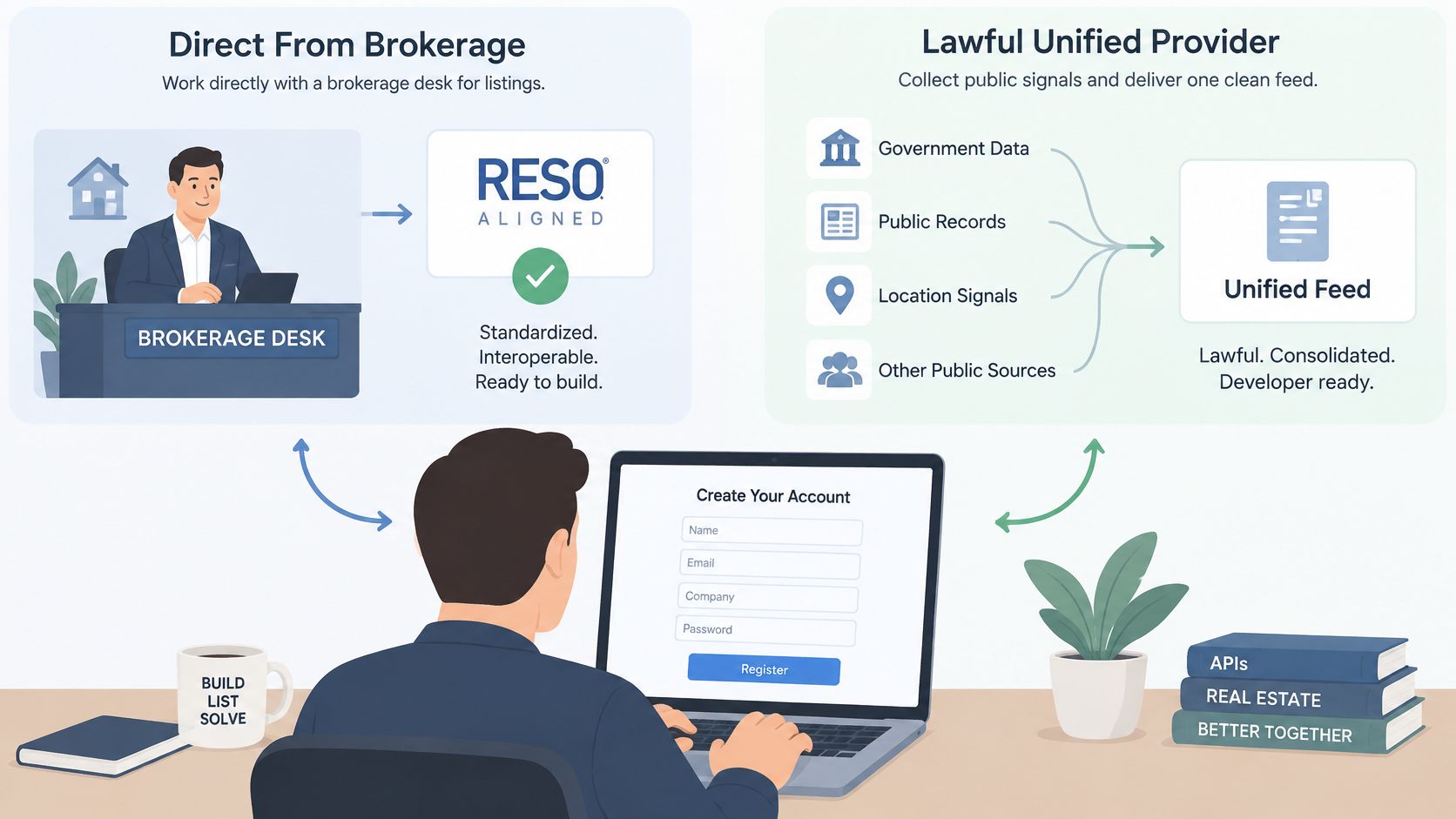
Compare access models before registering
A brokerage-connected source is appropriate when your product needs authorized MLS display and clearly defined local inventory. A unified provider may be useful when your application needs consistent retrieval across public listing platforms or countries. Neither arrangement automatically grants unlimited downstream rights.
When evaluating alternatives to a portal-specific integration, BatchData's discussion of developer-friendly Realtor.com alternatives is a useful comparison resource. Treat vendor comparisons as a shortlist, then inspect each candidate's actual contract, documentation, and market support.
RealtyAPI.io is one unified option offering REST, GraphQL, webhooks, global coverage, and ready-made language snippets. Its developer introduction provides a starting point for evaluating the interface, but broad platform coverage shouldn't be interpreted as identical fields or permissions in every market.
Keep the first request deliberately narrow
Register an account, create a development credential, and store it in an environment variable or secrets manager. Keep credentials out of browser bundles, repositories, screenshots, and request logs. Use a separate production credential where the provider supports it.
Make the initial request against a supported location with a minimal field selection and a small result limit. Inspect the raw response before building UI components around assumptions about prices, statuses, or pagination.
Before approving production access, verify:
- Credentials: Authentication succeeds from the intended server environment, and rotation is documented.
- Target markets: The provider confirms the relevant geography and inventory categories.
- Permitted fields: Storage, analytics, media use, and redistribution are explicitly understood.
- Display responsibilities: Attribution, opt-outs, removal handling, and audit requirements have owners.
- Access boundaries: Testing credentials and sample data don't get mistaken for production authorization.
Where direct MLS access isn't available, use documented feeds, publisher permission, or explicitly permitted public-page access. Don't substitute authentication bypasses or evasive extraction for an access agreement.
Query Listings by Location with Confidence
A user typing a neighborhood name and a background worker processing a canonical place aren't performing the same location operation. Keep the application-level search contract stable, but choose a location mode that matches the task.
Geographic coverage also needs its own validation. NAR's MLS overview describes hundreds of local MLSs operating under distinct rules. Launch market by market instead of assuming that a national-looking interface provides uniform inventory.
Choosing a Listing Location Strategy
| Location Input | Best Fit | Validation Focus | Common Failure |
|---|---|---|---|
| Destination | User-entered city or neighborhood search | Country, region, ambiguity, resolved boundary | Selecting the wrong place with the same name |
| Latitude and longitude | Nearby search or map interaction | Coordinate order, valid ranges, supported radius or bounds | Searching outside coverage or swapping coordinates |
| Place ID | Repeated queries for an already resolved place | Issuer, namespace, supported geography | Passing an identifier from an incompatible service |
| URL | Supported page-to-data workflows | Scheme, hostname, page type, provider support | Treating an arbitrary page as a supported listing source |
A destination is convenient for discovery but requires disambiguation. Coordinates are precise inputs, yet the provider still needs a documented geographic search rule. A place ID is stable only within its defined namespace, and a URL is an input reference, not permission to extract a page.
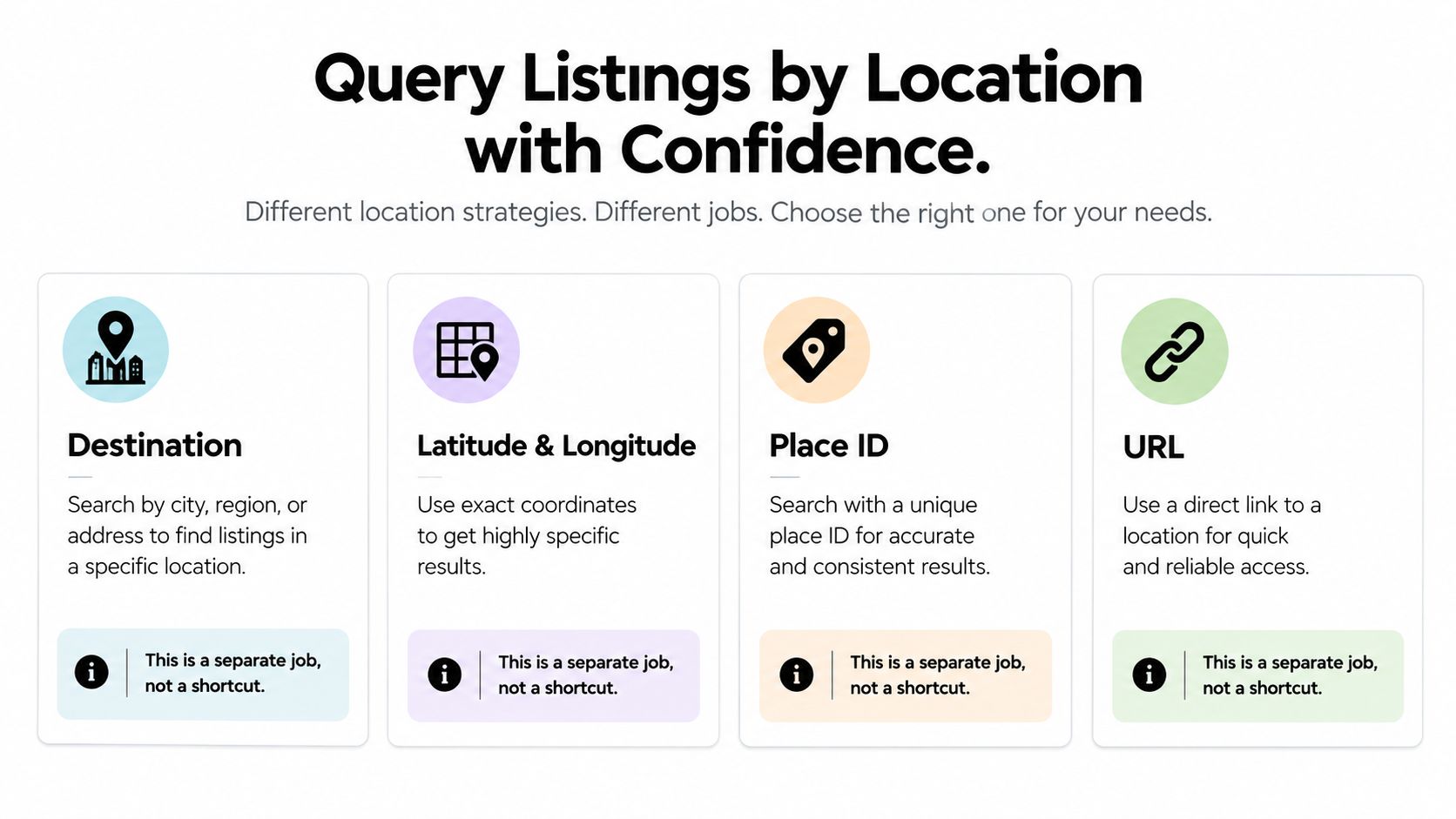
Preserve a predictable request contract
Define an internal request model, then translate it into each provider's documented syntax. The following is application pseudocode, not a vendor endpoint or schema:
search(resource=LISTINGS, location=destination(query), filters=filters)
search(resource=LISTINGS, location=coordinates(lat, lon), filters=filters)
search(resource=LISTINGS, location=place_id(namespace, id), filters=filters)
search(resource=LISTINGS, location=source_url(url), filters=filters)
Only the location expression changes. Keep filters, ordering, pagination, and result normalization consistent so switching inputs doesn't create unrelated search behavior.
For ambiguous destinations, return candidate places and ask the user to choose. For unsupported places, return a coverage outcome rather than an empty success response. Reject malformed URLs before making an upstream request, and allow only provider-supported hosts and page types.
Practical rule: Never silently broaden a failed neighborhood search into an entire region. Return the resolved area so the caller can decide whether the fallback is acceptable.
Preserve both the requested location and the resolved geography. That makes support investigations possible when a user says the results are nearby but outside the neighborhood they selected. It also avoids hard-coding a portal's internal routing or page behavior into your public application contract.
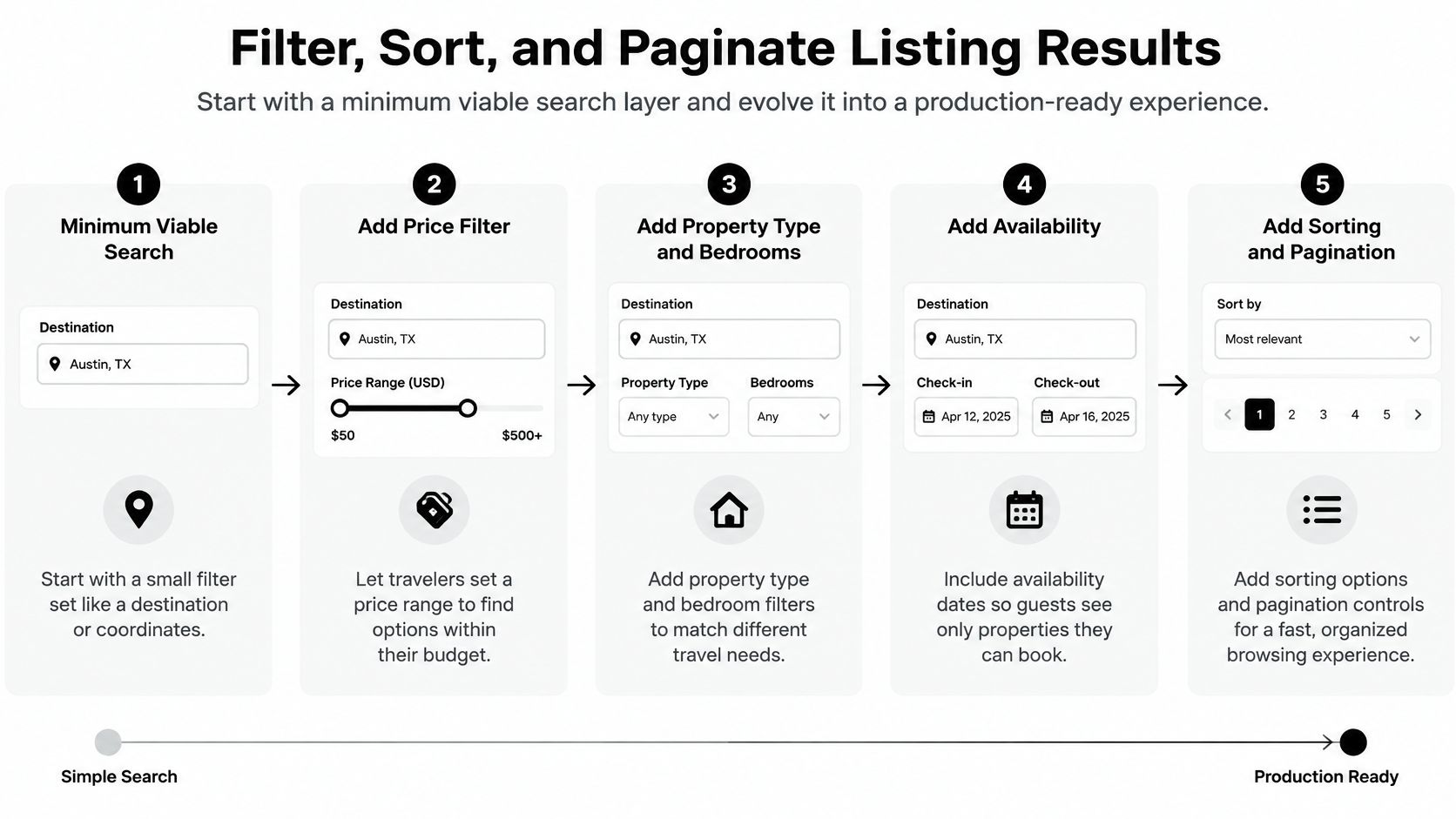
Filter, Sort, and Paginate Listing Results
Start with the filters needed to answer the current user action. A location and availability constraint may be enough for an initial search; an investment workflow may also require price, property type, and bedrooms. Don't forward every frontend parameter upstream just because it exists.
Use typed inputs and explicit semantics. A missing bedroom filter should mean no bedroom constraint, not a default value that accidentally excludes properties. Price filters need a currency context, and property-type values need mapping to the source's supported vocabulary.
Make sorting part of the contract
Choose documented sort options and preserve their meaning through pagination. If the provider supports a stable tie-breaker, use it; otherwise, assume that changing inventory may affect page boundaries.
For example, a map interface could request 20 results per view as a product-design choice, while a background reconciliation job traverses the fuller authorized result set. The map should optimize for interaction, whereas the background job needs checkpoints, completeness tracking, and a clear stopping policy.
Don't reuse the map query blindly for ingestion. Viewport clipping, aggressive limits, and user-facing defaults can make an interactive search unsuitable for reconciliation.
Bound every traversal
A production pagination loop should maintain explicit state:
- Query identity: Freeze the normalized location, filters, and sort for the traversal.
- Continuation: Treat cursors as opaque values and follow documented page-token behavior.
- Termination: Stop at documented exhaustion, a repeated continuation token, cancellation, or a configured work budget.
- Duplicate detection: Track source listing identifiers across pages without assuming duplicate suppression proves completeness.
- Checkpointing: Save progress only after the page has been validated and persisted successfully.
Don't assume a short page means the search is complete unless the provider documents that behavior. Likewise, an empty page with a continuation token may require different handling from an empty terminal page.
Persist records without losing their history
Use idempotent upserts keyed by source namespace and source listing ID. Preserve the originating MLS where supplied, source timestamps, observation timestamps, media permissions, and field-level provenance when merging records.
Keep listing identity separate from property identity. The same physical home may have different listing records over time, while separate apartments may share a street address. For cross-source matching, prefer identifiers, then normalized address and unit information, with geographic and content similarity as supporting evidence.
A deduplicated search index and an auditable source archive serve different purposes. Merge the display entity without discarding the records that explain it.
Apply confirmed withdrawal or sold-status events through soft deletion from active search, subject to retention permissions. Preserve authorized status history separately so current availability changes don't rewrite historical analytics. When sources disagree, resolve conflicts by authority and recency rather than whichever request finished last.
Write Working Code in Four Languages
Keep provider-specific syntax inside a small adapter. The examples below are executable adapter-loop patterns, not undocumented vendor SDK calls: each expects your project to implement a listing_adapter module or equivalent using the provider's actual contract.
That adapter owns authentication headers, endpoint selection, filter translation, and response validation. Its fetch operation accepts a key, location, filters, and cursor, then returns a locally normalized items collection and next continuation value. Those names belong to your application, not an assumed upstream schema.
Use the same behavior across stacks
First verify the actual request and response in the API playground. Implement the adapter against that verified contract, including request timeouts and visible exceptions for malformed responses.
Python suits ingestion scripts and data-processing jobs. This loop reads configuration explicitly and rejects repeated cursors rather than risking an endless traversal.
import os
from listing_adapter import fetch

key = os.environ["LISTING_API_KEY"]
location = os.environ["LISTING_LOCATION"]
cursor, seen = None, set()
try:
    while True:
        page = fetch(key=key, location=location,
                     filters={"availability": "active"}, cursor=cursor)
        for item in page["items"]:
            print(item)
        cursor = page["next"]
        if cursor is None:
            break
        if cursor in seen:
            raise RuntimeError("Repeated pagination cursor")
        seen.add(cursor)
except Exception as error:
    raise RuntimeError("Listing traversal failed") from error
JavaScript fits an existing server-side application. Keep the credential on the server, and let the adapter expose cancellation so requests can stop when a user abandons a search.
import { fetchPage } from "./listing-adapter.js";

const key = process.env.LISTING_API_KEY;
const location = process.env.LISTING_LOCATION;
if (!key || !location) throw new Error("Missing configuration");
let cursor = null;
const seen = new Set();
try {
  while (true) {
    const page = await fetchPage({
      key, location, filters: { availability: "active" }, cursor
    });
    for (const item of page.items) console.log(item);
    cursor = page.next;
    if (cursor === null) break;
    if (seen.has(cursor)) throw new Error("Repeated pagination cursor");
    seen.add(cursor);
  }
} catch (error) {
  throw new Error("Listing traversal failed", { cause: error });
}
Go makes cancellation and typed response handling explicit. Here, FetchPage and Page are project-owned adapter definitions, with a nullable string continuation.
func Walk(ctx context.Context, emit func(Item) error) error {
    key, location := os.Getenv("LISTING_API_KEY"), os.Getenv("LISTING_LOCATION")
    if key == "" || location == "" {
        return fmt.Errorf("missing configuration")
    }
    var cursor *string
    seen := map[string]bool{}
    for {
        page, err := FetchPage(ctx, key, location,
            map[string]string{"availability": "active"}, cursor)
        if err != nil { return fmt.Errorf("listing traversal: %w", err) }
        for _, item := range page.Items {
            if err := emit(item); err != nil { return err }
        }
        cursor = page.Next
        if cursor == nil { return nil }
        if seen[*cursor] { return fmt.Errorf("repeated pagination cursor") }
        seen[*cursor] = true
    }
}
PHP works well inside an existing backend or scheduled worker. Configure the HTTP client inside the adapter rather than duplicating authentication logic in controllers.
require 'listing_adapter.php';

$key = getenv('LISTING_API_KEY');
$location = getenv('LISTING_LOCATION');
if (!$key || !$location) {
    throw new RuntimeException('Missing configuration');
}
$cursor = null;
$seen = [];
try {
    while (true) {
        $page = fetch_page($key, $location,
            ['availability' => 'active'], $cursor);
        foreach ($page['items'] as $item) {
            echo json_encode($item, JSON_THROW_ON_ERROR), PHP_EOL;
        }
        $cursor = $page['next'];
        if ($cursor === null) break;
        if (isset($seen[$cursor])) {
            throw new RuntimeException('Repeated pagination cursor');
        }
        $seen[$cursor] = true;
    }
} catch (Throwable $error) {
    throw new RuntimeException('Listing traversal failed', previous: $error);
}
Choose for maintainability, not syntax
Python minimizes friction around analysis workflows; JavaScript integrates naturally with asynchronous application services. Go offers explicit types and cancellation, while PHP avoids adding another runtime to an established PHP product.
Whichever you choose, test the adapter with captured, permitted response fixtures. Cover valid JSON, missing fields, unexpected types, and continuation behavior before testing the loop against live inventory. Add the configured work budget and checkpoint mechanism to these minimal examples before scheduling unattended jobs.
Handle Rate Limits and Recoverable Errors
A failed request doesn't automatically deserve a retry. Authentication failures need credential correction, invalid filters need request correction, and a valid empty response may need no action at all. Malformed responses, temporary server failures, and throttling require separate handling based on the provider's documented behavior.
Inspect response metadata before classifying the failure. Don't assume every provider uses the same status codes, error envelope, or retry-delay header. Consult the rate-limit documentation for the chosen interface rather than embedding guessed limits in shared infrastructure.
Retry only when another attempt can help
For retryable failures, use bounded exponential backoff with jitter. Honor a documented server-provided delay, cap the elapsed retry budget, and stop when the job's deadline expires. A deterministic validation error shouldn't consume that budget.
Coordinate workers with a lease keyed to the normalized query and continuation token. That prevents several workers from repeatedly fetching the same page during an outage. Release or expire the lease safely when a worker crashes.
- Authentication failure: Stop the affected job and alert the credential owner.
- Invalid request: Surface the rejected field or location without logging sensitive request content.
- Temporary outage: Retain the checkpoint and retry within the configured budget.
- Unexpected response: Quarantine the payload securely and raise a schema-validation event.
- Confirmed empty result: Record a successful empty search separately from transport failure.
Make recovery observable
Log a stable query fingerprint, provider, outcome category, latency, retry count, and final result. Exclude API keys and unnecessary personal information. For broader architectural considerations around dependencies and failure boundaries, Rite NRG on integration challenges provides a useful companion perspective.
A temporarily unavailable page shouldn't immediately remove a property from search. Mark the observation as uncertain, schedule confirmation, and distinguish retrieval failure from an explicit listing-status change.
After recovery, resume from the last durable checkpoint and run reconciliation for the affected scope. Do not label a partially completed traversal as a complete inventory snapshot. Expose that distinction to downstream analytics so an outage does not look like a sudden change in market supply.
Verify and Productionize Your Listing Integration
Compare representative records against their sources, exercise every supported location mode, and test empty and malformed responses. Measure freshness, status lag, duplicate rate, and removal handling; document actual market and field coverage. Missing records aren't proof that homes are absent from the market.
Use the status-code reference to finalize error classification, and consult Croft's take on monitoring platforms when selecting operational tooling.
Launch checklist
- Rights and display: Confirm attribution, retention, and takedown behavior.
- Data quality: Verify identity mapping, timestamps, and coverage boundaries.
- Operations: Test alerts, checkpoints, and recovery.
- Fair housing: Review listing pages and advertising against HUD's guidance, which prohibits protected-characteristic preferences and calls for an Equal Housing Opportunity logo, statement, or slogan in traditional sale or rental advertisements.
Choose a source, register a key, verify a request, add pagination, and instrument the integration before expanding coverage.
For a unified interface to public real estate listing data, visit RealtyAPI.io to evaluate its location-search options and developer tools. Start with a supported market, verify the response against your intended use, and build the monitoring and pagination controls before widening your integration.