How to Calculate Home Equity Loan Payments (Formula + Example)
Type a number into any bank's home equity calculator and it hands you a payment: $1,433 a month. No explanation, no working, just a number you're supposed to trust with your house attached to it. Here's the thing: to calculate home equity loan payments you need one formula, three inputs, and about four minutes of arithmetic. Once you can run it yourself, you can check any lender's quote, see exactly what a longer term really costs, and catch the gap between the rate on the flyer and the APR you'll actually pay.
This guide works the whole thing by hand: the amortization formula, a full worked example on $150,000, the loan-to-value math that decides how much you can borrow in the first place, and how home equity loan payments differ from HELOC payments. If you just want the number, our free home equity loan calculator runs this exact math with charts and an amortization schedule. Stay here if you want to know what it's doing.
The formula that sets your payment
A home equity loan is a fixed-rate installment loan secured by your house. You get a lump sum, and you repay it in equal monthly payments until the balance hits zero. The payment comes from the standard amortization formula:
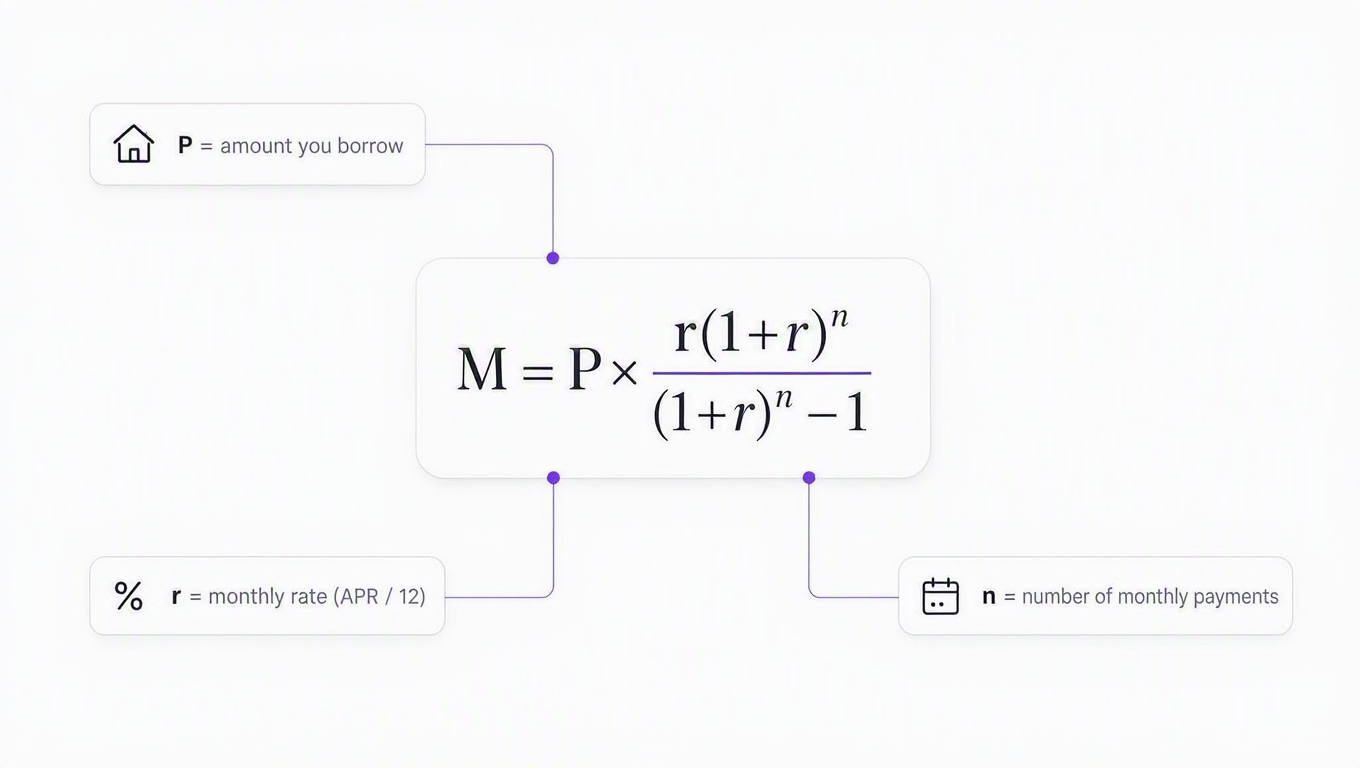
M = P × [ r(1 + r)^n ] / [ (1 + r)^n − 1 ]

M = monthly payment
P = principal (the amount you borrow)
r = monthly interest rate (annual rate ÷ 12, as a decimal)
n = number of monthly payments (years × 12)
Why this formula and not something simpler? Because every month, interest accrues on whatever balance is left. A fixed payment has to do two jobs at once: cover that month's interest, and chip away enough principal that the balance reaches exactly zero on the final payment. The formula is just the algebra that finds the one payment amount that does both over n months. Early on, the balance is large, so most of your payment goes to interest. Late in the loan the balance is small, so most of it goes to principal. Same payment, shifting split.
Your payment is determined by three numbers: what you borrow, the rate, and the term. Everything else on the quote sheet is decoration. Keep that in mind when a lender leads with a "low monthly payment" instead of a rate.
Step 1: how much can you actually borrow (LTV and CLTV)
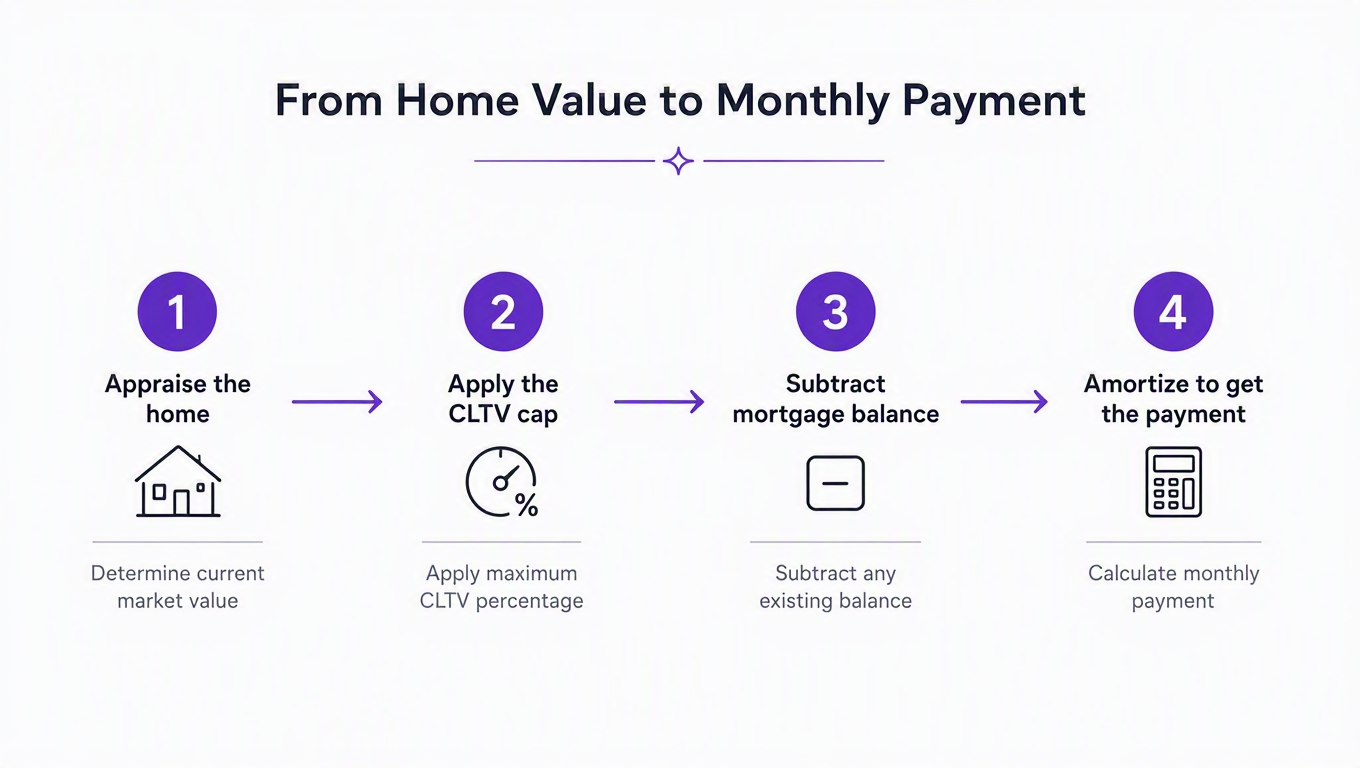
Before the payment math matters, a lender decides your ceiling, and it's not your credit score that sets it. It's your home's appraised value. Lenders cap your combined loan-to-value ratio (CLTV): your existing mortgage balance plus the new home equity loan, divided by the home's value. Most stop at 80%; some go to 85% or 90% at higher rates.
The math is one line:
Maximum loan = (Home value × CLTV limit) − current mortgage balanceSay your home appraises at $500,000 and you owe $250,000 on your first mortgage:
| CLTV limit | Max total debt allowed | Minus your mortgage | Max home equity loan |
|---|---|---|---|
| 80% | $400,000 | −$250,000 | $150,000 |
| 85% | $425,000 | −$250,000 | $175,000 |
| 90% | $450,000 | −$250,000 | $200,000 |
Why do lenders stop short of 100%? Because a home equity lender is second in line. If the house is ever sold in foreclosure, the first mortgage gets paid off before they see a cent, and homes in distress rarely sell at full appraised value. That 10–20% cushion is their margin of safety, which is also why 90% CLTV loans carry higher rates than 80% ones. The appraisal, not your Zillow estimate, is the number that counts here; if you're curious how appraisers actually get there, we've written up the main property valuation methods separately.
Step 2: run the numbers on $150,000 at 8% for 15 years
Let's borrow that $150,000 at 8.00% for 15 years and work every step. (8% is a realistic figure right now: the average 15-year home equity loan was 8.413% in Mortgage Research Center data from August 7, 2026, so a strong borrower quoting around 8% is plausible, and it keeps the arithmetic honest.)
1. Monthly rate: r = 0.08 ÷ 12 = 0.0066667
2. Number of payments: n = 15 × 12 = 180
3. Compound factor: (1 + r)^n = 1.0066667^180 = 3.3069
4. Plug in:
M = 150,000 × [ 0.0066667 × 3.3069 ] / [ 3.3069 − 1 ]
  = 150,000 × 0.022046 / 2.3069
  = 150,000 × 0.0095565
  = $1,433.48 per month
That's the whole trick. Over 180 payments you'll hand the bank $258,026 in total, of which $108,026 is interest, on a $150,000 loan. Nobody puts that second number in the ad.
What does the very first payment look like? Interest for month one is 150,000 × 0.0066667 = $1,000.00, so of your $1,433.48, only $433.48 touches the principal. Five years in, having paid about $86,000, you'll still owe $118,149. Oof. That's not the bank cheating you; it's just what interest on a large balance does. The split flips in the back half of the loan, which is exactly why paying extra principal early is so effective, and why our amortization calculator shows the month-by-month table rather than just the payment.
What changes when you change one number
All payments below use the same formula at 8.00%. Monthly payment first, lifetime interest in parentheses:
| Amount borrowed | 10 years | 15 years | 20 years |
|---|---|---|---|
| $50,000 | $607 ($22,797) | $478 ($36,009) | $418 ($50,373) |
| $100,000 | $1,213 ($45,593) | $956 ($72,017) | $836 ($100,746) |
| $150,000 | $1,820 ($68,390) | $1,433 ($108,026) | $1,255 ($151,118) |
Read the $150,000 row again. Stretching from 10 years to 20 cuts the payment by $565 a month and more than doubles the interest, from $68,390 to $151,118. A longer term doesn't make a loan cheaper. It makes it quieter.
Rate moves matter too, though less dramatically than people expect on a 15-year term:
| Rate | Monthly payment | Total interest |
|---|---|---|
| 7.50% | $1,390.52 | $100,293 |
| 8.00% | $1,433.48 | $108,026 |
| 8.50% | $1,477.11 | $115,880 |
| 9.00% | $1,521.40 | $123,852 |
Half a point is worth about $44 a month and $7,900 over the life of this loan. That's the number to remember when you're deciding whether shopping a third lender is worth the afternoon. (It is.)
The rate is not the price: APR and closing costs
Home equity loans come with closing costs, typically 2–5% of the loan amount, covering the appraisal, origination, title search, and recording. On $150,000, that's $3,000 to $7,500. Here's why it matters: if $7,500 in costs is taken out of your proceeds, you make payments on $150,000 but only $142,500 lands in your account.
Why is the APR higher than the rate you were quoted? Because APR re-solves the payment equation against what you actually received. Same $1,433.48 payment, same 180 months, but measured against $142,500 of real proceeds, the effective annual rate works out to 8.86%, not 8%. That 0.86-point gap is the closing costs, spread over the loan's life. Compare lenders on APR and the "low rate, high fees" trick stops working. Some lenders offer "no closing cost" loans in exchange for a higher rate, which is the same trade in the other direction; run both through the math before choosing.
Home equity loan vs. HELOC: same house, different payment math
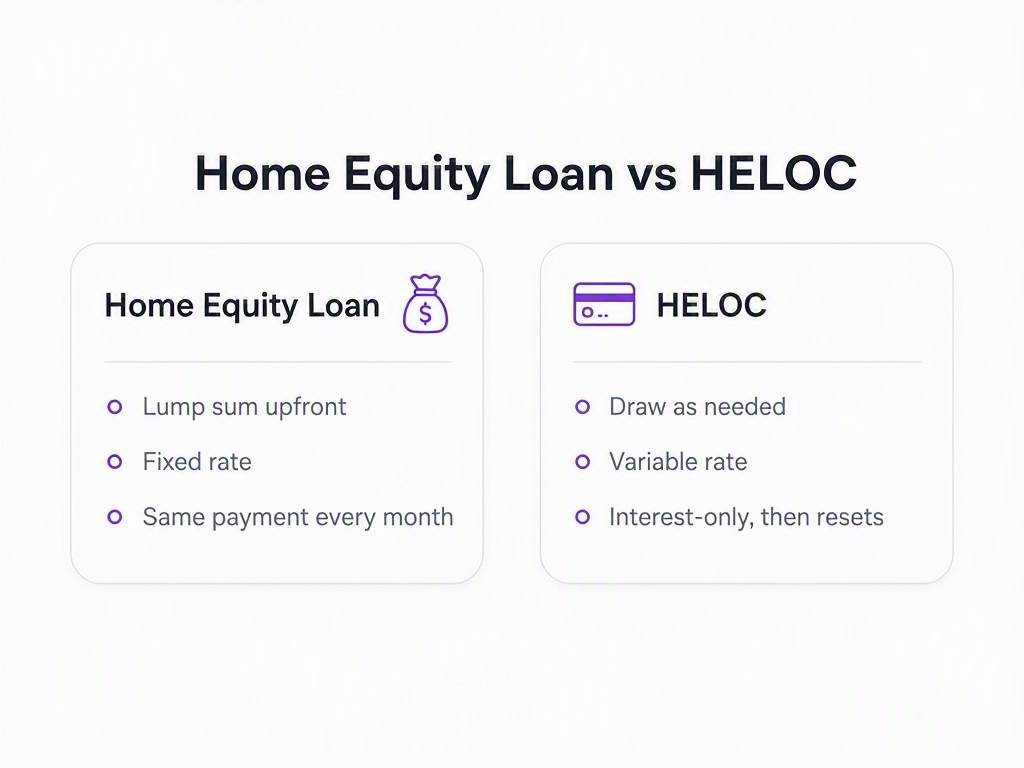
A HELOC (home equity line of credit) borrows against the same equity but behaves differently, and the payment math is where people get surprised. Current averages from the same August 2026 Mortgage Research Center data:
| Home equity loan | HELOC | |
|---|---|---|
| Average rate | 8.248% (10-yr) / 8.413% (15-yr), fixed | 8.295%, variable |
| How you receive money | Lump sum upfront | Draw as needed during draw period |
| Payment structure | Fixed, fully amortizing from month one | Often interest-only during the draw period, then amortizing |
| Payment predictability | Same to the penny for the whole term | Moves with rates; jumps when the draw period ends |
| Main limitation | No flexibility: you pay interest on the full amount from day one, even if you needed less | Payment shock at repayment phase; variable rate risk; discipline required |
Is the HELOC's lower payment actually cheaper? Usually not, and here's the arithmetic. During the draw period, many lenders require only interest as the minimum payment. On a $150,000 balance at the 8.295% average, that's 150,000 × 0.08295 ÷ 12 = $1,036.88 a month, which looks friendlier than the loan's $1,433.48. But after years of those payments you still owe the entire $150,000. When the draw period ends (the CFPB's explainer uses 10 years as its example), you stop being able to borrow and enter a repayment period, often ten or twenty years, with what the CFPB calls "significantly higher" monthly payments, at whatever the variable rate is by then. The low payment wasn't a discount; it was a deferral. Choose a HELOC for flexibility on an unknown, staged expense, and a home equity loan for a known, one-time cost where you want the payment locked. If your real goal is a lower rate on your whole mortgage, a cash-out refinance is the third option worth pricing.
Prefer a video walkthrough of the mechanics? This one covers how a home equity loan works and how it compares to a HELOC:

Check it yourself in code or a spreadsheet
The formula is five lines in any language. Here it is in JavaScript, with the edge case that trips people up (a 0% promotional rate divides by zero unless you handle it):
function monthlyPayment(principal, annualRatePct, years) {
  const n = years * 12;
  if (principal <= 0 || n <= 0) return 0;
  const r = annualRatePct / 100 / 12;
  if (r === 0) return principal / n;        // 0% APR: straight division
  return principal * (r * Math.pow(1 + r, n)) / (Math.pow(1 + r, n) - 1);
}

console.log(monthlyPayment(150000, 8, 15).toFixed(2));
// Expected output: 1433.48
In Excel or Google Sheets, the built-in PMT function does the same thing: =PMT(0.08/12, 180, -150000) returns $1,433.48. If your spreadsheet, this code, and your lender's quote all agree, the quote is clean. If they don't, ask the lender what's baked into their number; the answer is usually fees.
What the payment number doesn't tell you
- Your house is the collateral. A home equity loan is a lien. Miss enough payments and the lender can foreclose, which is a materially worse outcome than defaulting on a credit card. Price the payment against your worst month, not your best one; our debt-to-income calculator is the honest way to check, and it's the same ratio your lender will run.
- It stacks on top of your first mortgage. The $1,433 doesn't replace your existing payment; it joins it.
- The tax deduction is narrower than people think. Interest is deductible only if the money buys, builds, or substantially improves the home securing the loan, and only within the $750,000 combined-debt limit (IRS Publication 936). Debt consolidation and tuition don't qualify.
- The quoted averages assume a strong file. Published average rates skew toward high credit scores and low CLTVs. Your quote is the only rate that matters, which is one more reason to be able to check the math behind it.
Key takeaways
- Three inputs set the payment: principal, rate, term. M = P × r(1+r)^n / ((1+r)^n − 1). Everything a lender shows you should reconcile to this, and now you can check.
- Borrowing power is CLTV math, not vibes. (Home value × CLTV limit) − mortgage balance. At the common 80% cap, a $500k home with a $250k mortgage supports a $150k loan.
- The term is the biggest lever on total cost. $150k at 8% costs $68k in interest over 10 years and $151k over 20. Pick the shortest term whose payment survives your worst month.
- Compare APR, not rate. $7,500 in closing costs quietly turns an 8% rate into an 8.86% APR. APR is the number that catches it.
- A HELOC's low draw-period payment is a deferral, not a discount. Interest-only means the balance never shrinks; budget for the reset before you sign.
Every number in this article came out of the same formula, and you can poke at all of it interactively: the home equity loan calculator runs this exact amortization math and adds the parts that are tedious by hand: APR with your actual closing costs, the borrowing-limit calculation at any CLTV, and a full month-by-month schedule with charts. Free, no signup, and now you know exactly what it's doing under the hood.