Free Real Estate APIs: What You Actually Get Without Paying
Search for a free real estate API and most of what you get is articles written by companies that sell one, cheerfully ranking themselves first. This post is written by a company that sells one too. The difference: we are going to be unusually specific about what "free" actually buys you, because the word means at least three different things in this market, and two of them cost money.
Everything below was verified while writing this article, in August 2026. We ran the API calls, downloaded the files, and read the pricing pages. Where a quota has a number, it is the number we saw, not the number a 2023 blog post remembers.
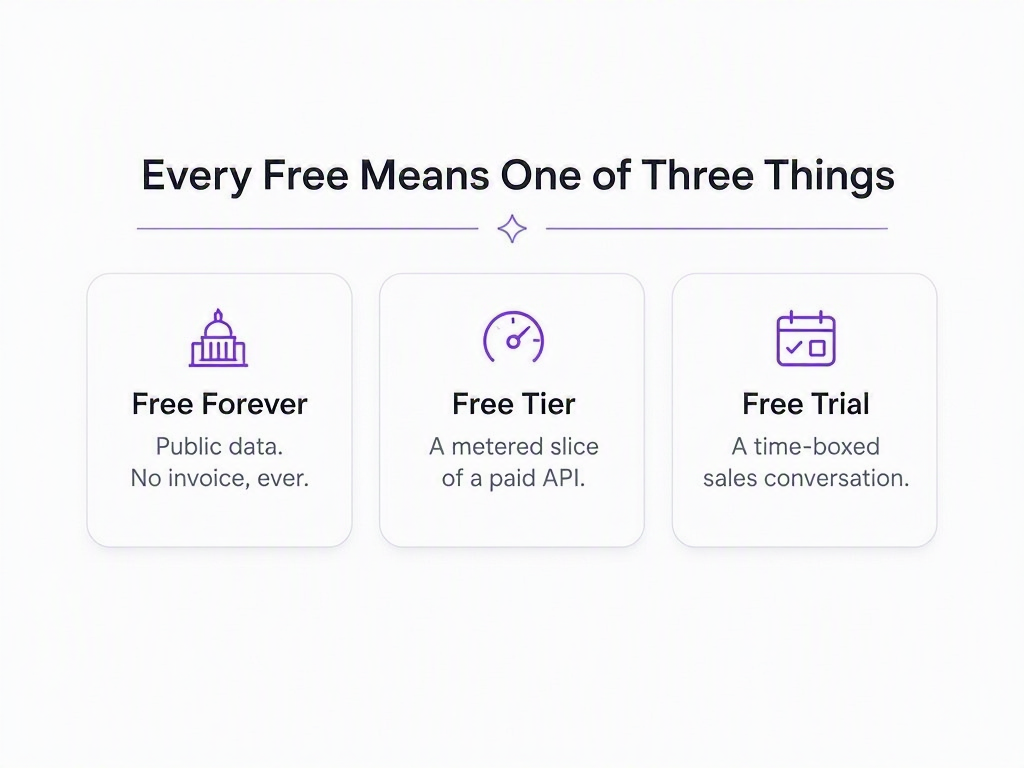
Every "free" means one of three things
Before comparing anything, sort every source you find into one of these buckets:
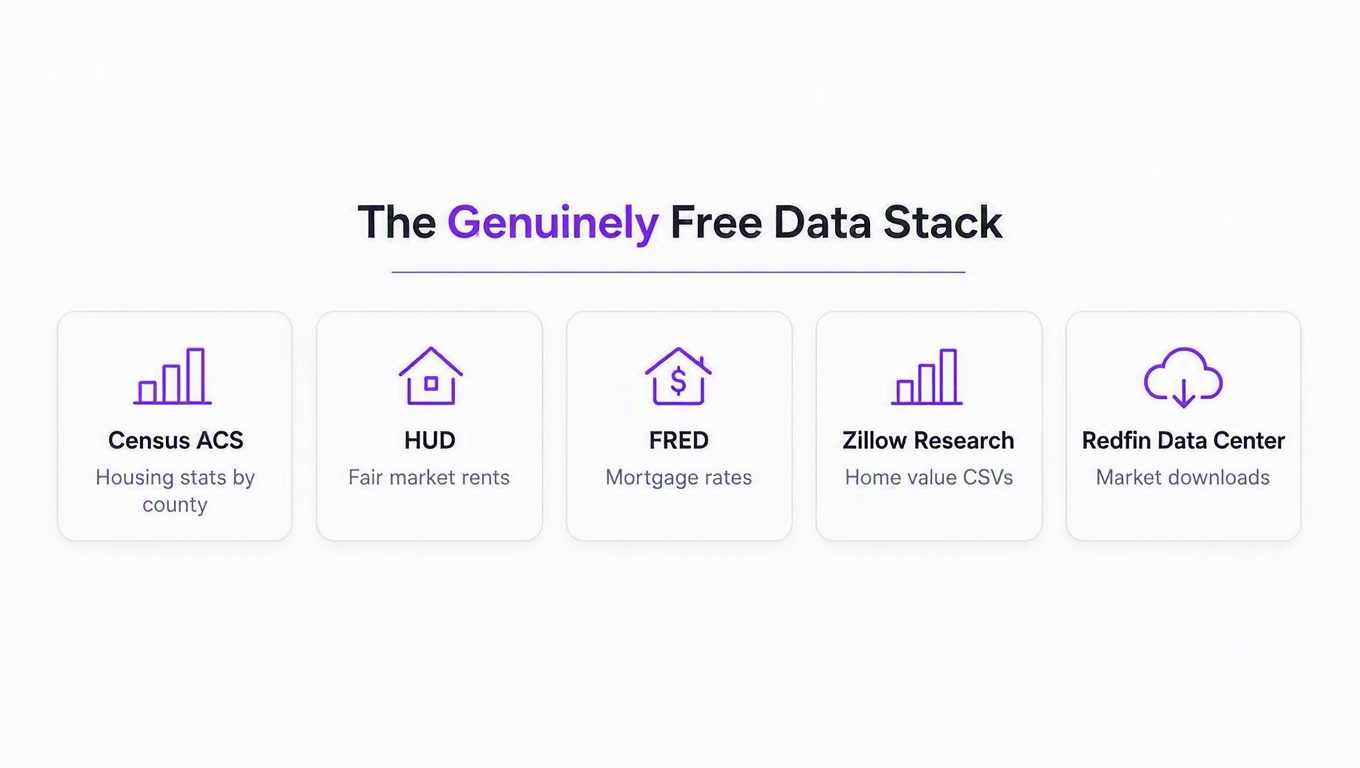
- Free forever. Government and research data: the U.S. Census Bureau, HUD, FRED, Zillow Research downloads, Redfin's Data Center. No invoice will ever arrive. The trade-off is that this data is aggregated and periodic, not live.
- Free tier. A metered slice of a paid API. Real requests, real endpoints, a hard monthly cap. Good for finding out whether the data answers your question before you pay.
- Free trial. A time-boxed key that exists to start a sales conversation. Nothing wrong with that, but it is not free data; it is a scheduled meeting.
The best real estate data in America is genuinely free, because your taxes already paid for it. That is not a throwaway line. Median home values for every county, fair market rents for every metro, thirty years of mortgage rates: all public, all documented, all a curl away. The catch is where that data stops, and that boundary is the whole reason the paid market exists.
The genuinely free layer: government and research data
If your product needs market-level numbers rather than individual live listings, you may not need to pay anyone at all.
U.S. Census Bureau (ACS)
The American Community Survey API covers housing in absurd depth: median home value, median gross rent, occupancy, heating fuel, year built, all of it down to county and tract level. One field note, though. While writing this we called the API without a key and got a polite "Missing Key" page back: as of 2026, every request requires an API key. Half the tutorials online still claim you can make 500 keyless queries a day. That era is over. The key is free and self-serve, so this changes your setup time by about two minutes, but bring a key.
curl "https://api.census.gov/data/2023/acs/acs5?get=NAME,B25077_001E,B25064_001E&for=county:453&in=state:48&key=YOUR_KEY"B25077_001E is median home value, B25064_001E is median gross rent, and state:48&county:453 is Travis County, Texas. The response is JSON as an array of arrays, header row first. The Census Bureau's own walkthrough of pulling a housing table is worth twenty minutes:

HUD, FRED, and the research downloads
Three more sources that cost nothing and show up in more production systems than their owners probably realize:
- HUD's free API serves Fair Market Rents, Income Limits, and the USPS ZIP-to-tract crosswalk with a free bearer token, rate limited to 60 queries a minute. If you are building anything involving rent benchmarks or affordability, this is the reference dataset the industry is quietly comparing against.
- FRED, from the St. Louis Fed, gives you a free key and 120 requests a minute against hundreds of thousands of economic series, including the 30-year mortgage rate (
MORTGAGE30US) and housing starts. It even mirrors Zillow's home value index, so one key covers macro and housing in a single API. - Zillow Research and Redfin's Data Center publish market-level CSVs: home value indexes, rents, inventory, sale-to-list ratios. No account, no key.
That last one deserves a demonstration, because "no key" means you can have real data before you finish this paragraph:
curl -sL "https://files.zillowstatic.com/research/public_csvs/zhvi/Metro_zhvi_uc_sfrcondo_tier_0.33_0.67_sm_sa_month.csv" | head -3Output at the time of writing (columns trimmed for width):
RegionID,SizeRank,RegionName,RegionType,StateName,...,2026-06-30
102001,0,United States,country,,...,372995.19
394913,1,"New York, NY",msa,...,735003.13
That is a 4.4 MB file with every U.S. metro's typical home value, monthly, back to 2000. Free, current through June 2026, and you just watched it download.
So what is missing? Everything in this layer is aggregated and delayed. It will tell you Austin condos softened; it will not tell you a specific 2-bed on Ohlen Road listed yesterday at $275,000. The moment your product needs an actual property, an actual price, or an actual listing photo, the free-forever layer ends.
Free real estate API tiers, compared
A free tier is a sample, not a plan. Its job is to let you verify coverage and data quality on your actual use case before money moves. Judged on that basis, here is what the commercial side actually offers, with numbers from each vendor's pricing page as of August 2026:
| Provider | Free tier | First paid tier | Overage | Limitations to know |
|---|---|---|---|---|
| RentCast | 50 requests/month | $74/mo for 1,000 requests | $0.20 per extra request on free | Property records, valuations, and rent estimates; 50 calls disappear fast once you paginate, and the jump to $74 is steep |
| ATTOM | Trial API key | No public pricing; talk to sales | n/a | Deep parcel and assessor data, but the trial is a sales funnel, not a tier; budget for a contract |
| RealtyAPI (us) | 250 requests/month, no card | $20/mo for 20,000 requests, or pay-as-you-go credits at $0.003 that never expire | $0.004 per extra request on PRO | Listing-portal data, not an MLS feed; a few premium platforms need a paid plan; no bulk exports on free |
Why does no MLS appear in this table? Because there is no free MLS API. The RESO Web API standardized how MLS data is served, but access still requires MLS membership and a data license agreement, negotiated per MLS. Anyone advertising "free MLS data" is either reselling something with strings attached or describing a trial.
The part nobody gives away: listings
Listings are the moat. Zillow, Redfin, and Realtor.com monetize attention on their own pages, so none of them offers a public API for their live listings. This is the gap every "free real estate API" search eventually crashes into, and you have three ways across it.
Option one: scrape the portals yourself. Free in the sense that a second job is free. Markup changes break your parsers, anti-bot systems escalate monthly, and the legal footing depends on what you collect and how; we wrote honestly about that in is website scraping legal and the trade-offs in web scraping vs API. Ask me how I know the maintenance estimate is always wrong.
Option two: become a partner. Portal partner programs and MLS licensing are real paths for established companies with legal teams and patience. For a prototype, they are a quarter of calendar time before the first JSON arrives.
Option three: a gateway that has already done the work. This is the product category we are in, so calibrate accordingly. RealtyAPI fronts 35 listing platforms at last count (Zillow, Redfin, Realtor, StreetEasy, Airbnb, Rightmove, Zoopla, Idealista, and so on) behind one key, and the free tier's 250 monthly requests exist precisely so you can test coverage on your market before paying. (What to validate beyond price is its own topic; our API for real estate guide covers the production side.) Here is a real call and its real response from this week:
import requests

resp = requests.get(
    "https://redfin.realtyapi.io/search/bylocation",
    params={"locationName": "Austin", "locationSubName": "TX",
            "searchType": "For_Sale"},
    headers={"x-realtyapi-key": "YOUR_API_KEY"},
    timeout=30,
)
resp.raise_for_status()
for home in resp.json()["searchResults"]:
    info = home["homeData"]
    print(info["addressInfo"]["formattedStreetLine"],
          info["priceInfo"]["amount"])
The JSON underneath, trimmed to the fields you would actually use:
{
  "message": "Success",
  "nextPage": true,
  "searchResults": [
    {
      "homeData": {
        "propertyId": "30972107",
        "mlsId": "7492744",
        "beds": 2,
        "baths": 2,
        "priceInfo": { "amount": "275000" },
        "sqftInfo": { "amount": "1194" },
        "yearBuilt": { "yearBuilt": 1981 },
        "daysOnMarket": { "daysOnMarket": "1" },
        "hoaDues": { "amount": "375" },
        "addressInfo": {
          "formattedStreetLine": "1748 Ohlen Rd #42",
          "city": "Austin",
          "state": "TX",
          "zip": "78757"
        }
      }
    }
  ]
}
That listing was one day old when we pulled it. This is the difference between the layers: the free government data above told you about Austin in June; this tells you about one condo yesterday, with its HOA dues. If you want the same thing from Zillow's side of the street, the walkthrough is in our Zillow API guide.
How to choose without wasting a week
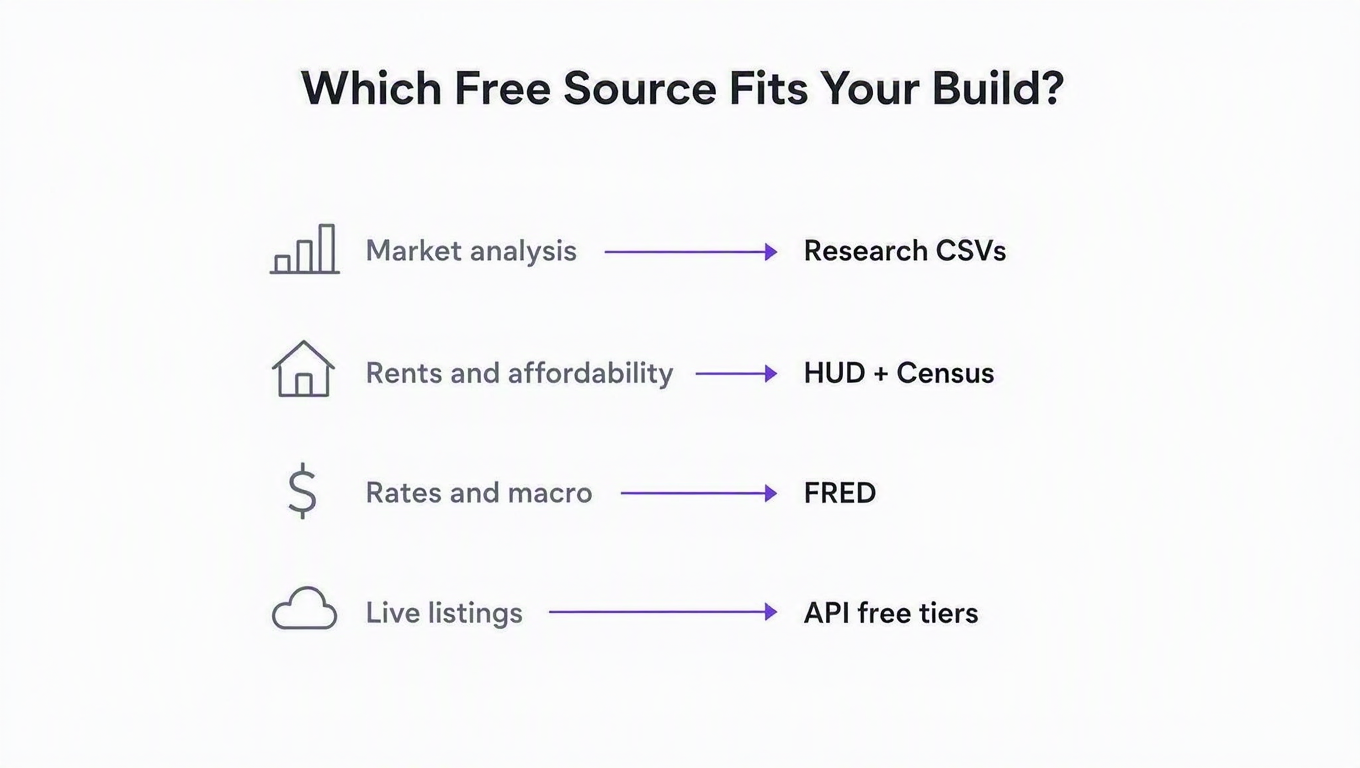
- Market analysis, dashboards, research? Start with Zillow Research and Redfin CSVs. You may be done, and the price is zero.
- Rents, affordability, or anything underwriting-adjacent? HUD plus Census ACS. These are the benchmarks regulators and lenders already use.
- Rates and macro context? FRED, one free key, done.
- Live listings, property details, photos, agent data? This layer is never free at scale. Use free tiers to test data quality on your actual market, then compare the paid math: 20,000 requests costs $20 with us and would cost $74 for 1,000 at RentCast's first tier, but their records data and ours solve different problems. Test both against your use case; opinions are cheaper than migrations.
Key takeaways
- Sort every source into free-forever, free tier, or free trial before comparing features. The buckets have different jobs: research, evaluation, and sales, in that order.
- Government and research data covers more than most developers assume. Census, HUD, FRED, and the portal research downloads are production-grade and permanently free; if you only need market-level numbers, stop paying for them.
- The Census API now requires a key on every request. Free and instant, but the old keyless-500-a-day advice you will find in tutorials is dead. We checked.
- No live-listings source is free at scale, from anyone. Listings fund the portals; every path to them costs engineering, lawyers, or money. Pick the cost you can afford to pay twice.
- Use free tiers as tests, not infrastructure. Verify coverage on your market and fields you actually need, then do the per-request math on the first paid tier before you commit.
If the thing you need is the listings layer, this whole article is testable for free: the free tier is 250 requests a month with no card, the docs include a playground so you can try endpoints before writing a line of code, and if 250 is not enough to convince you, credits are $0.003 each and never expire. Run your market through it; the data will argue better than we can.