Edge Delivery Services: The 2026 Developer's Guide

You ship a property search page and watch it load instantly in Texas. Then a user in Tokyo opens the same screen and waits while the spinner turns. The code is identical, the database is healthy, and the API hasn't changed. The difference is the distance between the user and the server doing the work.
That distance becomes more visible in real-estate products because users search from everywhere. Renters compare neighborhoods, investors monitor foreign markets, and travelers browse short-term inventory from another continent. A centralized origin can serve every request, but each request still pays for geography, connection setup, serialization, and upstream processing. Edge delivery services address that structure by placing routing, cached responses, and selected application logic closer to users.
The important question isn't whether an edge network sounds fast. It's whether your cache keys, freshness rules, protocols, retries, and observability make the system faster without returning the wrong listing or hiding an origin failure. This guide follows those decisions from first principles.
Why a Fast Real Estate Search Can Feel Slow in Some Cities
A product team in Austin tests a new property search. Destination autocomplete responds immediately, filters feel smooth, and listing cards appear before anyone can complain. The team then shares the release with a user in São Paulo, where the same interaction takes several seconds. Later, a tester in Tokyo reports similar friction.
That doesn't automatically mean the frontend is poorly written. The browser may be sending each request to a single origin located far from the person using it. Every trip carries the cost of distance, connection establishment, encryption, request processing, and response transfer. If the search triggers several dependent requests, those costs can accumulate before the user sees a useful result.
A centralized origin can be reliable and still feel slow to users who live far away.
Real estate also creates a geographically broad workload. A local rental site may have a concentrated audience, but a platform combining residential listings, travel inventory, maps, market aggregates, and analytics serves users across regions. The same API may receive requests for different destinations, currencies, languages, and availability windows.
This is why edge delivery is a structural response, not merely a cosmetic optimization. An edge location can accept a request near the user, reuse a response that is safe to reuse, and forward only the requests that need the origin. It can't eliminate database work or make volatile data static, but it can avoid repeating the same long journey for every visitor.
The same principle applies after someone chooses a property. A real-estate workflow may continue into document preparation, identity checks, and signing. Teams that need practical guidance on that handoff can use this guide to e-signatures for realtors to connect the search experience with the transaction stage.
What Edge Delivery Services Actually Do
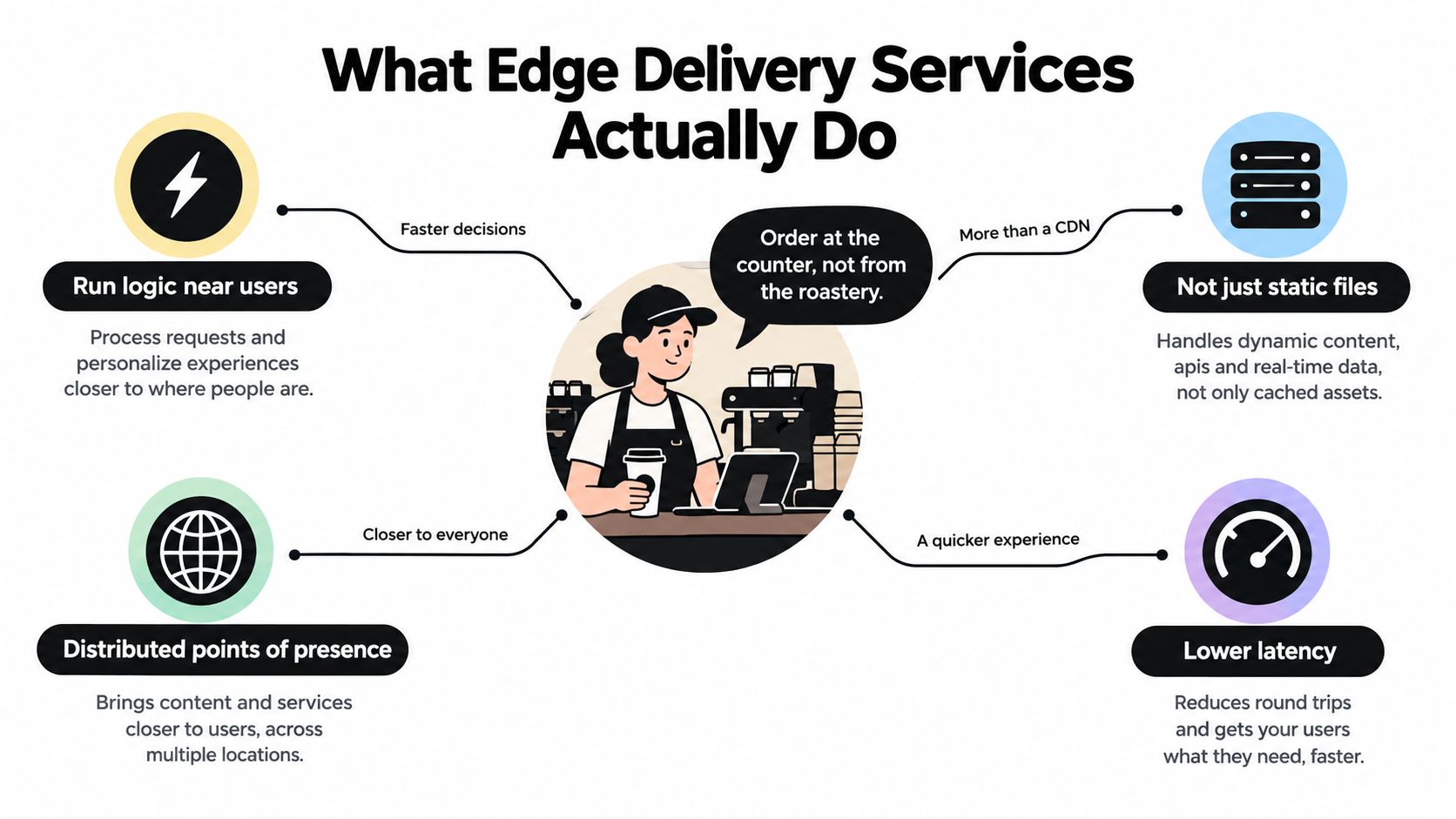
Think of a coffee chain with one kitchen in the center of a country. Every customer, regardless of neighborhood, sends an order to that kitchen. A distributed chain instead keeps small preparation stations near customers. Each station handles common drinks locally and asks the central kitchen for unusual ingredients.
Edge delivery services use a similar pattern for web and API traffic. They operate a distributed network of locations, often called points of presence, that can receive requests, cache responses, route traffic, and run selected application code near users. The origin remains the authoritative backend, but it no longer has to handle every repeated request directly.
Here are the terms in plain English:
- Point of presence: A nearby network location where the service accepts traffic.
- Edge node: The server or group of servers handling requests at that location.
- Origin: Your primary API, application, database, or service of record.
- Origin shield: An additional shared layer that reduces the number of edge locations contacting the origin.
- Cache key: The identity used to decide whether two requests can share a stored response.
- TTL: The time a cached response may remain fresh before the service must revalidate or fetch it again.
The flow is straightforward. A user searches for properties, routing sends the request to a nearby point of presence, and the edge checks whether it already has a valid response. If it does, the edge returns that response. If it doesn't, the edge forwards the request to the origin, receives the result, and may store it according to the response's caching policy.
An early academic analysis of Internet traffic at the University of Washington examined a community of more than 60,000 users and separated traffic into four delivery classes, including CDNs and peer-to-peer systems. The analysis established the core rationale for edge delivery, distribute work across intermediary servers rather than force every request to travel to a single origin. The original analysis also connected delivery behavior to client, object, and server characteristics.
For example, an autocomplete request such as a property destination lookup may be reusable for many users. A personalized result containing private authorization scope or rapidly changing availability needs stricter handling. For a shorter introduction to the infrastructure itself, what is an edge network offers useful background.
How Edge Delivery Differs from a Traditional CDN
A traditional CDN and an edge delivery platform may share the same network vocabulary, but they don't necessarily do the same job. The useful distinction is where the system applies logic and what it can cache.
A traditional CDN commonly sits in front of an origin to cache files such as images, stylesheets, JavaScript bundles, and property thumbnails. When the browser requests a thumbnail, the CDN can return the stored file. When the browser sends a search request with filters, the CDN may forward that dynamic request to the origin.
An edge delivery service adds programmable behavior at the network location. It may transform a request, apply routing rules, run authorization checks, personalize a response, combine upstream calls, or execute application logic before sending the result back. The distinction isn't that a CDN can never handle dynamic content. Modern CDNs can do much more than their original role. The practical question is how thoroughly the vendor supports compute and response handling at the edge.
| Capability | Traditional CDN | Edge delivery service |
|---|---|---|
| Typical cache unit | Static file | API or application response |
| Dynamic request | Usually forwarded to origin | Can be processed near the user |
| Application logic | Primarily at origin | Origin plus edge workers or functions |
| Invalidation | URL or asset oriented | URL, tag, surrogate, or policy based |
| Example | Cached property thumbnail | Filtered search response with edge logic |
Suppose a visitor opens a listing page. The image may be a straightforward file-level cache hit. The search results, however, can vary by destination, coordinates, filters, locale, currency, and authorization scope. An edge platform can evaluate those inputs close to the visitor, but only if the cache key and privacy rules are designed correctly.
The scale of this work is not limited to static media. In December 2018, Akamai reported that traffic across its network exceeded 72 terabits per second, while the same event involved hundreds of billions of API requests, hundreds of millions of dollars in e-commerce transactions, and trillions of Internet interactions. Akamai's account of that milestone illustrates why edge infrastructure now handles dynamic API traffic as well as files.
A vendor calling itself a CDN may already offer edge functions. A vendor calling itself an edge platform may still rely heavily on centralized services. Ask where the request is transformed, where the response is cached, and where a failed upstream call is handled. Those answers matter more than the label.
The Metrics That Actually Matter at the Edge
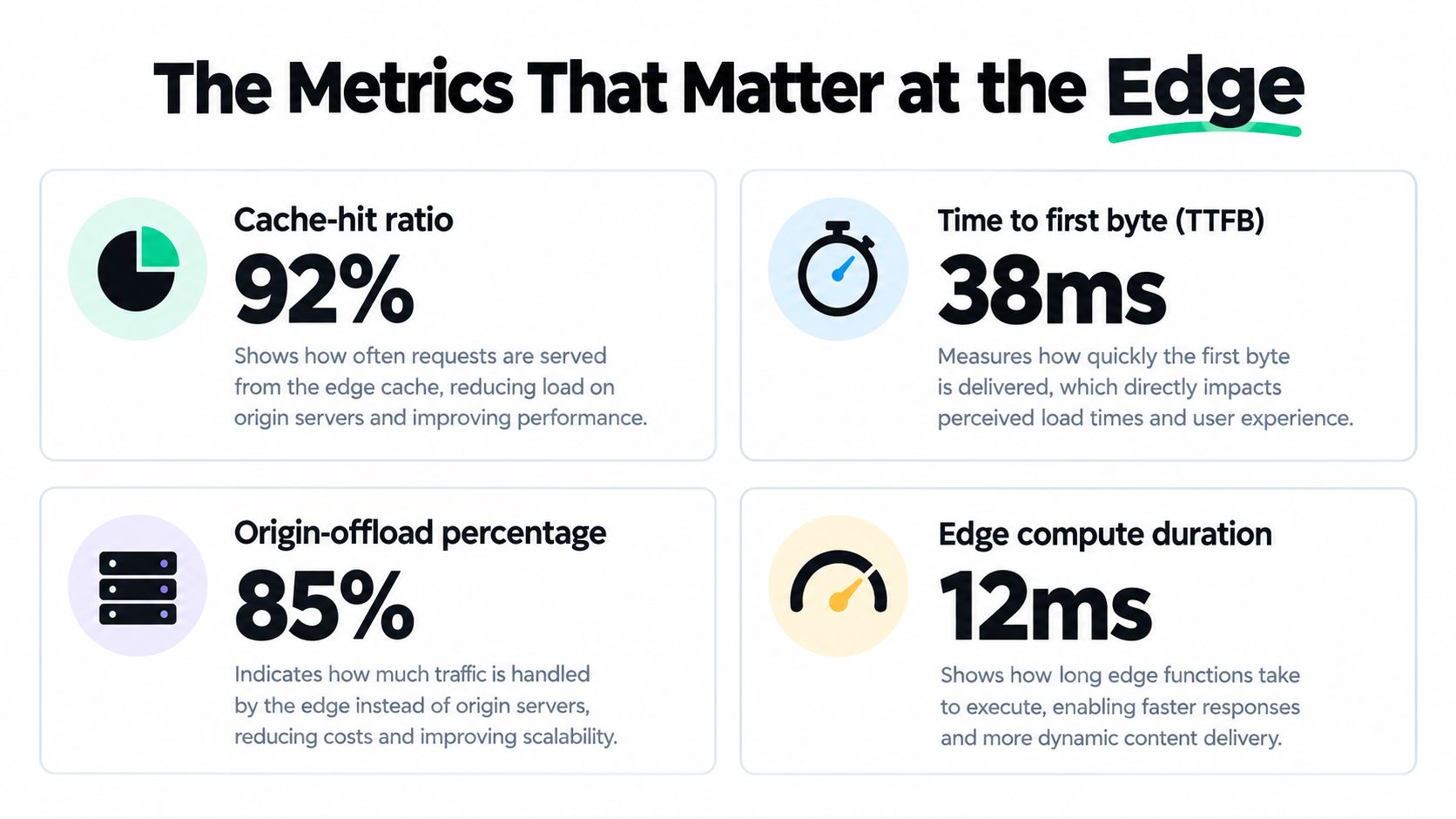
A dashboard full of green availability checks can still hide a slow search experience. Four measurements reveal whether an edge layer is doing useful work: cache-hit ratio, time to first byte, origin-offload percentage, and error rate.
Cache-hit ratio
The cache-hit ratio tells you how often the edge can answer without contacting the origin. A high ratio usually lowers origin load, but a high number isn't automatically good. If the service caches the wrong response or serves stale availability, the metric is hiding a correctness problem.
Web objects commonly follow a Zipf-like popularity distribution, where a small number of frequently requested objects generate a disproportionate share of traffic. That pattern favors caching stable responses such as normalized property metadata, amenity dictionaries, geocoding results, and market aggregates. Volatile availability and pricing fields need short freshness periods or cache bypass rules. IEEE's overview of content distribution networks describes the workload pattern behind that decision.
TTFB and origin offload
Time to first byte, or TTFB, measures how long the client waits before receiving the first part of the response. Track it at p50 and p95, and segment it by endpoint, geography, device type, and network. A fast median can conceal a poor experience for users on mobile networks or in regions with limited nearby capacity.
Origin-offload percentage shows how much work the edge absorbs. Compare it with request volume and response type, not in isolation. A search endpoint may have a modest hit ratio by design because its filters produce many unique combinations, while a metadata endpoint may offload substantial traffic.
Error rate
Measure errors at the edge and origin separately. An edge error increase can indicate a malformed cache key, failed worker, invalidation issue, or upstream timeout. A rising origin error rate with stable edge errors may point to backend capacity or dependency failures.
Use the RealtyAPI rate-limit documentation when interpreting rejected requests. A client response caused by policy isn't the same as a failed edge computation or an unavailable origin, and your monitoring should distinguish them.
Designing Cache Keys and Picking the Right Protocol
Cache design starts with a simple question: which inputs can change the response? Every response-varying input belongs in the cache key. For a real-estate search, that can include destination, coordinates, filters, locale, currency, and authorization scope.
Leave one out and the edge may return a valid response for the wrong request. A result cached for Paris shouldn't answer a request for Madrid. A response in euros shouldn't serve, without any signal to the user, someone who selected another currency. Authorization scope deserves special care because a shared cache must never cross a boundary that changes what a user is allowed to see.
The opposite mistake is adding unnecessary variation. Different parameter order, inconsistent capitalization, tracking values, or redundant query strings can split identical searches into separate cache entries. The edge then stores many versions of the same response and contacts the origin more often.
Freshness is a policy
HTTP caching gives you measurable controls. The Age value estimates how many seconds have passed since the origin generated or validated a response. max-age=N tells a client that the response is preferred while it is no older than N seconds. Once the response is stale, a cache generally can't reuse it unless the request or response directives permit stale content. RFC 9111 defines these rules.
| Header or directive | What it controls | Edge vs browser |
|---|---|---|
Age |
Estimated response age | Reported by a cache |
max-age=N |
Freshness duration | Commonly understood by clients and caches |
cdn-cache-control |
CDN-specific freshness | Lets edge policy differ from browser policy |
stale-if-error |
Reuse during an origin failure | Useful for non-critical responses |
stale-while-revalidate |
Serve while refreshing | Reduces waiting during revalidation |
An edge-only directive can separate browser behavior from CDN behavior. For instance, a listing response might remain available at edge locations longer while browsers receive a shorter caching period. Cloudflare's cache configuration documentation explains this pattern through cdn-cache-control and equivalent controls.
Why HTTP/3 helps
HTTP/3 uses QUIC over UDP and avoids TCP's connection-level head-of-line blocking. Its integrated cryptographic handshake can reduce connection establishment to approximately one round trip, compared with roughly three round trips for the TCP, TLS, and protocol negotiation sequence commonly associated with HTTP/2. HTTP/3 still needs HTTP/2 fallback because clients and networks vary.
HTTP Archive measurements report median TLS negotiation times of 57 ms for CDN-served traffic versus 177 ms for origin-served traffic. The HTTP Archive CDN analysis shows why terminating secure connections near users can matter.
Small autocomplete and metadata requests benefit most from connection setup improvements. Large JSON responses remain constrained by bandwidth, serialization, and client parsing, so test representative payloads rather than assuming protocol choice solves every latency problem. You can use an API playground for request testing while comparing p50 and p95 behavior by region.
How a Global Real Estate API Puts It All Together
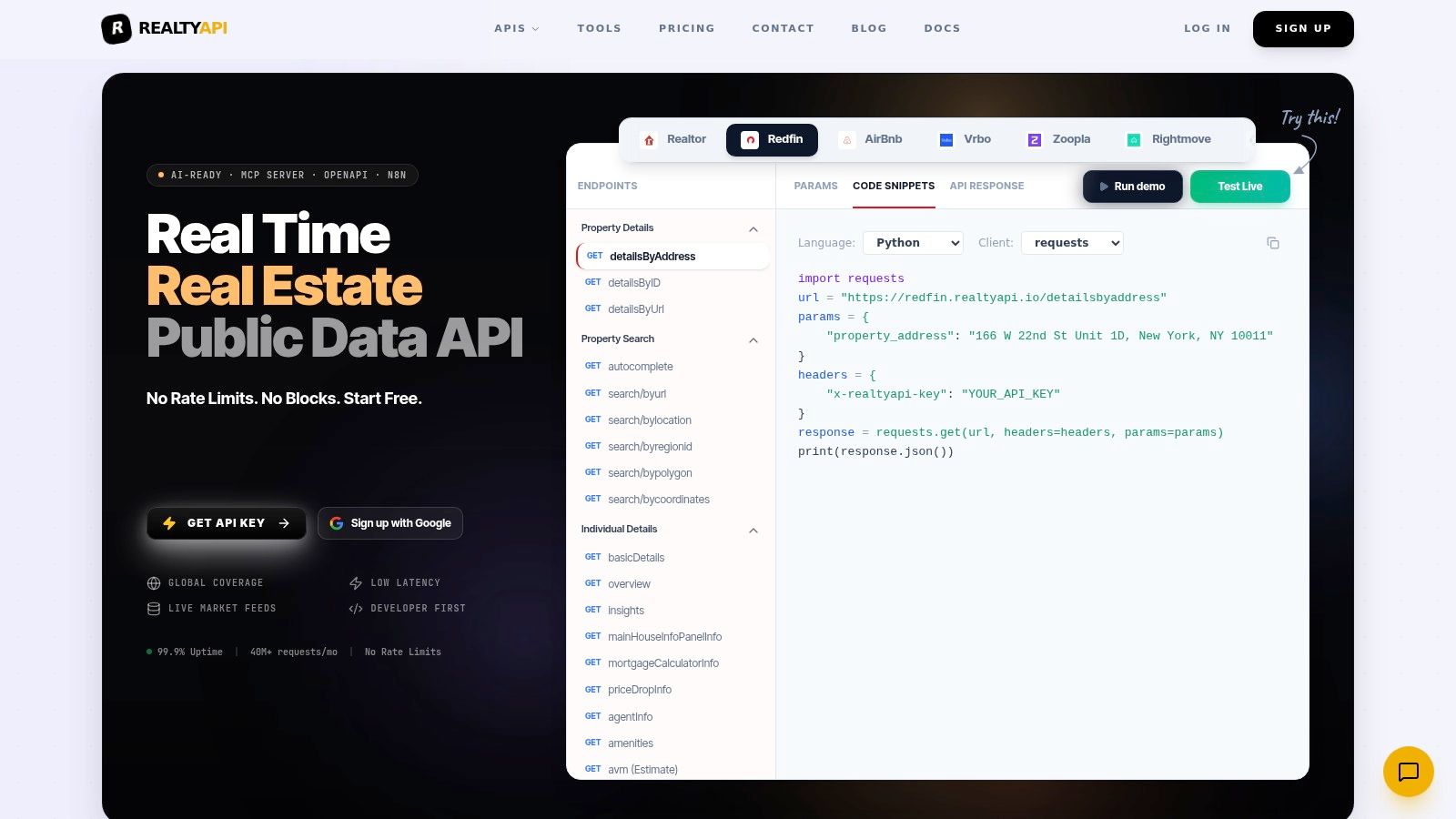
Consider a data layer that combines publicly available property information from Redfin, Realtor, Airbnb, Zoopla, Bayut, Apartments.com, and Idealista. A consumer might search by destination, coordinates, place ID, or URL, then request listing details, availability, reviews, host profiles, amenities, or accessibility attributes.
Edge delivery gives each request a different path based on its behavior. A destination lookup can route to a nearby point of presence and reuse a normalized response. A coordinate search can use a cache key that includes the location, filters, locale, currency, and authorization scope. A live availability request may bypass shared caching or use a short freshness policy with background revalidation.
The routing layer shouldn't treat every endpoint alike. Stable dictionaries and normalized metadata can tolerate reuse, while prices and inventory need stronger freshness guarantees. If an origin dependency briefly fails, stale-if-error can protect non-critical responses. Intelligent retries with exponential backoff can handle transient failures without creating a retry storm.
A request's journey
- The client chooses an endpoint. A marketplace may use REST, GraphQL, or a webhook workflow depending on the job.
- The nearest edge location receives the request. Routing reduces unnecessary intercontinental travel.
- The edge evaluates the key. Destination, coordinates, filters, locale, currency, and authorization determine whether reuse is safe.
- The service selects a freshness path. Stable data may come from cache, while live fields are fetched or revalidated.
- The client receives a structured response. The platform records timing, cache status, region, and error information for later diagnosis.
RealtyAPI.io is one example of a unified real-estate data layer offering REST, GraphQL, webhooks, global edge delivery, and retries with exponential backoff. Its introduction documentation provides the product-level starting point for developers evaluating those interfaces.
The same architecture suits a travel platform integrating Airbnb data from another continent or a fund monitoring market signals across regions. The edge isn't the entire system. It is the decision layer that determines which work can happen nearby and which work must remain authoritative at the origin.
For operational details beyond API responses, teams may also connect physical property marketing with Scanely real estate QR use cases, such as linking printed materials to digital listing experiences.
The Trade-offs Nobody Mentions
Edge delivery is often presented as a free performance upgrade. In practice, it turns one centralized system into a distributed system with more locations, more execution paths, and more failure modes.
Recent research identifies edge-device orchestration as the largest challenge for early adopters, with interoperability and portability gaps adding integration work across heterogeneous hardware, software, and data sources. The research on edge adoption challenges is relevant to real-estate platforms because a nearby node doesn't guarantee a useful result. Cacheability, freshness, retries, origin throughput, and observability may dominate the outcome.
Security creates a second boundary. Survey data places security among the top three edge challenges for 85% of respondents, while a 2025 CIO survey identifies security and data protection as the leading implementation challenge at 42%, ahead of operational and maintenance costs at 40%. Vertiv's edge survey results provide that context.
Proximity isn't compliance
Moving delivery closer to a user may reduce unnecessary data movement, but it can also distribute the governance burden. Ask where cached responses live, where logs are retained, which subprocessors handle traffic, how deletion propagates, and who owns incident response when a response appears in the wrong region.
Public listing data doesn't remove the need for access control, abuse prevention, retention rules, and careful handling of personal or sensitive attributes. A globally distributed API needs explicit regional controls rather than a vague promise that the network is worldwide.
Freshness can become an outage problem
An aggressive cache policy may protect the origin while showing outdated prices. An aggressive purge policy may preserve freshness while causing a sudden origin surge. A failed invalidation can be harder to diagnose when different edge locations hold different versions.
The practical conclusion is uncomfortable but useful. Edge delivery is strongest when each workload has a defined routing, caching, freshness, security, and deletion policy. It isn't a universal replacement for centralized infrastructure.
What to Ask Before You Sign the Contract
A vendor demo usually shows the fastest path through a friendly region. Your evaluation should test the paths your users take, including slower networks, unusual filter combinations, cache misses, origin failures, and regional policy constraints.
Performance questions
Ask for p95 TTFB in the regions where your customers live, not only in the regions used for vendor benchmarks. Request measurements for representative property searches, autocomplete, metadata, map-related responses, and live availability. A static test page won't tell you how a filter-heavy API behaves.
Check whether the vendor exposes:
- Regional breakdowns: Can you separate p50 and p95 latency by geography, endpoint, device, and network?
- Cache visibility: Do responses expose cache status, age, freshness, and revalidation outcomes?
- Origin shielding: What shared layer protects the origin, and when does it engage?
- Failure behavior: Can you configure stale-if-error or stale-while-revalidate for selected responses?
- Protocol support: Does HTTP/3 work alongside HTTP/2 fallback, and can you measure both paths?
Correctness and operations
Ask how granular invalidation is. URL purges may be enough for static assets, but listing platforms often need tags, properties, destinations, or other groups that can be invalidated without flushing unrelated responses.
Find out which retry behavior belongs to the platform and which belongs in your client. Automatic retries without backoff can multiply load during an outage. You also need to know whether the service distinguishes a cache miss, an origin timeout, an edge execution error, a policy rejection, and an authorization failure.
Practical rule: Don't approve an edge design until you can explain what happens to each response class during an origin incident.
Governance questions
Ask where data and logs are processed, how keys are managed, how audit logs are exported, and how deletion requests reach cached copies. Clarify whether the platform supports regional routing and whether the contract identifies subprocessors and incident responsibilities.
A one-size-fits-all edge story should be a red flag. Vendors that publish regional latency data, expose cache-control headers in full, document failure modes, and let you inspect cache behavior deserve a serious evaluation. The right platform won't promise that every request is fast. It will show you which requests are cacheable, which must reach the origin, and how the system behaves when reality interrupts the happy path.
RealtyAPI.io provides a unified real-estate data layer with property search, listing details, market information, REST, GraphQL, webhooks, and edge-oriented delivery patterns. Explore RealtyAPI.io to evaluate an API architecture that matches cache freshness, regional routing, and retry requirements before you build those pieces yourself.