Channel Management Software for Short-Term Rentals in 2026

The most common advice about channel management software is to count how many booking channels it supports. That metric is easy to advertise and easy to compare, but it doesn't tell you whether a platform can recover a failed update, preserve listing history, enforce local rules, or explain why two systems disagree.
Short-term rental distribution is an operational data problem. Airbnb, Booking.com, Vrbo, direct-booking sites, property-management systems, pricing tools, and accounting workflows all hold part of the booking state. A reliable architecture has to make those states converge, expose exceptions, and keep the operator in control of the underlying data.
Why Short-Term Rental Distribution Is a Data Problem
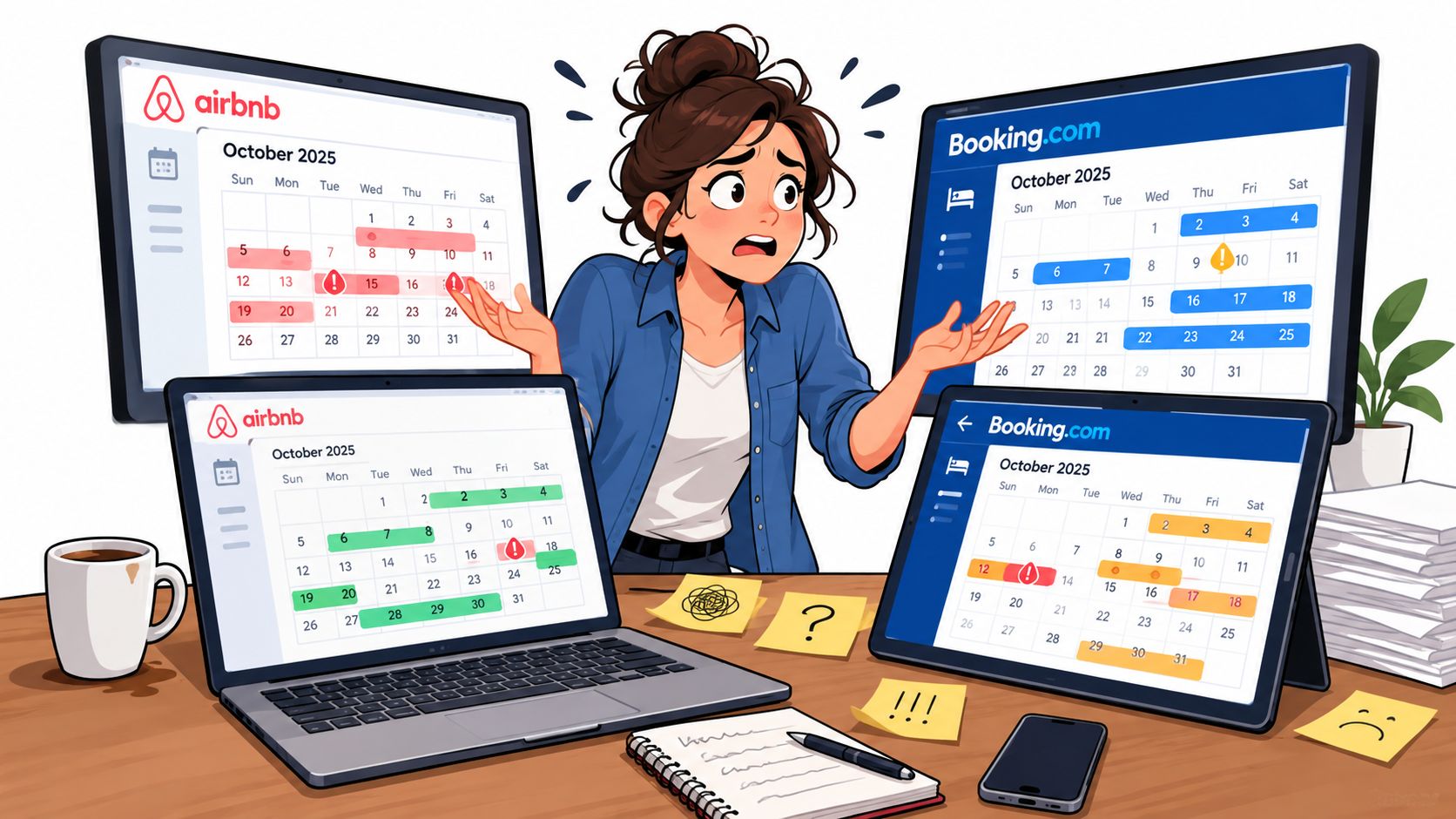
A manager receives a booking for a two-bedroom property on Airbnb. The reservation changes availability, affects the property's pricing logic, creates a guest record, and may trigger cleaning and owner-reporting workflows. If the same dates remain open on Booking.com or the direct site, a second guest can book inventory that no longer exists.
That failure isn't caused by a missing calendar view. It happens because multiple systems disagree about the current state of one unit.
A listing is therefore more than photos, amenities, and a description. It contains availability, rates, restrictions, reservation status, registration information, and channel-specific rules. A change to one field can require updates across several external systems, each with different APIs, schemas, rate limits, and confirmation behavior.
Manual updates fail because people work sequentially while bookings arrive concurrently. An operator may close dates on one extranet, switch to another, and discover that a reservation or price change arrived during the handoff. Calendar links reduce some duplication, but they don't provide the complete reservation lifecycle or reliably distribute pricing and stay restrictions.
Operational rule: Treat every booking as a state transition, not as a line on a calendar.
A centralized channel manager helps by giving teams one place to define inventory and distribute changes. That can reduce repetitive work, but the software only works as well as its synchronization model and exception handling. Practical guidance on efficiency in vacation rental management is useful here because process design still matters after automation is installed.
The category has become substantial. The global hotel channel management software market was estimated at approximately USD 1.62 billion in 2024 and is projected to reach USD 4.79 billion by 2033, with a projected compound annual growth rate of 12.8% from 2025 through 2033, according to market estimates for hotel channel manager software. The exact market boundary varies, but the operational signal is clear: distribution infrastructure is becoming a core data layer, not a minor back-office convenience.
How Channel Management Software Actually Works
A production channel manager is a bidirectional event-processing system between internal property software and external booking channels. Outbound messages distribute availability, rates, restrictions, and inventory. Inbound events bring back reservations, modifications, cancellations, no-shows, and early checkouts.
A basic calendar connection behaves differently. It usually exchanges availability on a fixed schedule and may not understand rate plans, minimum-stay rules, payment state, or reservation modifications. Full API integrations can synchronize rates, availability, restrictions, content, and reservation lifecycle events, while iCal-style links generally exchange only availability and may refresh on a 15 to 60 minute schedule, as explained in channel API integration guidance.
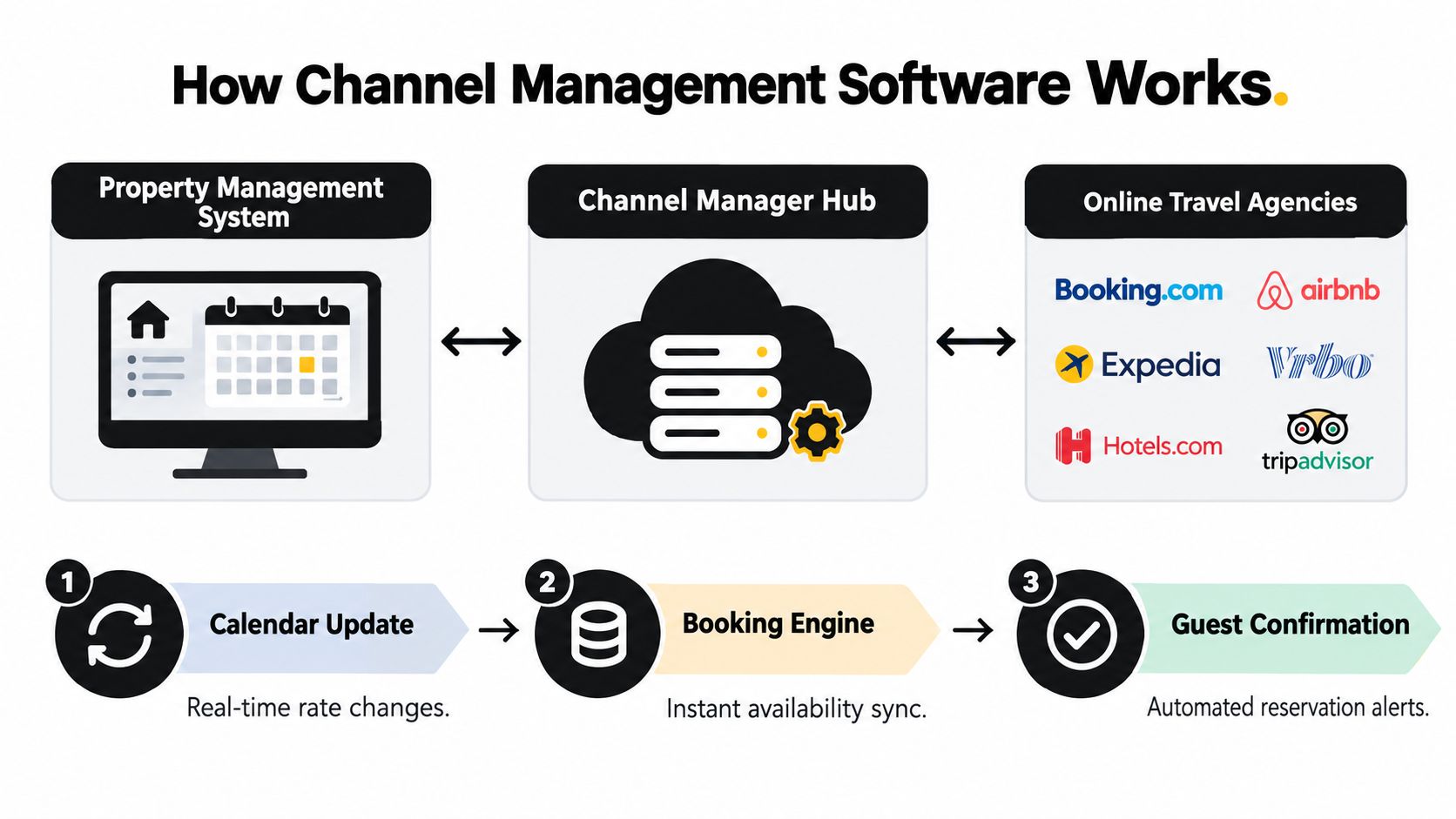
The event path matters
A booking event should enter a durable queue, receive an idempotency key, and remain safely replayable if a timeout occurs. The channel manager then updates internal inventory, sends the relevant changes to connected channels, and records acknowledgements that show whether each recipient accepted the update.
A successful HTTP request isn't enough. The receiving channel may reject a field, accept a partial payload, or process the request later. Production monitoring should distinguish submitted, accepted, applied, failed, and unknown states.
For high-demand periods, an actionable service objective is to complete the booking-to-inventory-update round trip in under 30 seconds, because longer propagation windows increase exposure to conflicting sales, according to engineering guidance on channel synchronization.
Reconciliation closes the gaps
Webhooks can be delayed or missed. Queues can stall. Mappings can point a reservation at the wrong room type. A reconciliation worker periodically compares PMS, channel-manager, and OTA states, then raises a discrepancy when the records don't converge.
A reliable implementation should:
- Replay safely: Process duplicate events without creating duplicate reservations.
- Record provenance: Show which system supplied each rate, date, guest field, or restriction.
- Track lag: Expose delivery delay, failed updates, and unconfirmed changes.
- Validate mappings: Test room, listing, and rate-plan mappings before live activation.
- Respect partner limits: Use exponential backoff and honor
Retry-Afterresponses.
For developers building adjacent property applications, the RealtyAPI integrations documentation provides a useful reference point for thinking about API-based connectivity. The principle remains the same: model capabilities per channel instead of assuming every endpoint supports the same fields or workflows.
The Real-World Architecture of a Unified Data Layer
A channel manager becomes more valuable when it stops acting like a forwarding script and starts operating as a normalized data layer. The external platforms should not dictate your internal schema. Your system should preserve the source payload, map it into a canonical model, and retain the relationship between the original field and the normalized value.
That architecture usually has several distinct stages.
Start with a canonical listing model
Define internal objects for listings, units, availability, rates, restrictions, reservations, guests, policies, and compliance identifiers. Keep source-specific identifiers alongside your own stable identifiers. This prevents a provider's naming convention from becoming the identity of your property.
A canonical model should also represent uncertainty. If an external channel sends a value your system can't map confidently, mark it for review instead of converting it without a record. Coercion that happens without a trace creates the kind of data drift that becomes visible only after a guest receives the wrong price or a manager discovers a missing reservation.
Separate ingestion from distribution
Inbound connectors should fetch or receive source data, validate it, and write an immutable event record. A normalization service can then create the current internal state. A separate distribution layer transforms that state into each channel's schema.
This separation gives operators a useful audit trail:
- Raw event: What did the source send?
- Normalized record: How did the platform interpret it?
- Outbound payload: What did the system transmit?
- Partner response: Did the destination accept it?
- Current state: Does the destination now match the internal record?
Developers building booking engines, market monitors, or pricing applications can use a unified API rather than maintaining a point-to-point connector for every source. RealtyAPI's introduction to its data layer describes the broader pattern of retrieving property and rental data through a developer-facing interface.
Make capabilities explicit
Don't assume every channel supports the same inventory controls. Store capability metadata for each connection, including supported rate fields, restrictions, reservation events, content attributes, registration identifiers, and update semantics.
This matters when a product combines direct integrations with third-party data services. A normalized record can be consistent internally while still requiring different outbound behavior. The architecture should preserve that difference instead of pretending that a universal payload exists.
Building or Buying, Architectural Choices for Platform Creators
Platform creators usually choose among three paths. They can build every connector, use a unified data provider, or combine both approaches. The right decision depends less on ideology than on where the product creates value.
A custom integration gives maximum control over payloads, business rules, and timing. It also makes the product responsible for authentication changes, schema drift, partner certification, rate limits, retries, sandbox testing, mapping tools, support escalation, and historical recovery. Those responsibilities don't disappear after launch.
A unified API reduces connector maintenance and can shorten the path to a working product. The trade-off is dependency. You inherit the provider's coverage, normalization decisions, outage behavior, and commercial terms. A hybrid design often works well: use an aggregation layer for broad discovery and market data, while maintaining direct integrations for workflows where your product needs deep control.
Channel Management Architectures
| Architecture | Control Level | Maintenance Overhead | Time to Market |
|---|---|---|---|
| Direct point-to-point integrations | Highest | Highest | Slowest |
| Unified aggregation API | Moderate | Lower | Fastest |
| Hybrid direct and aggregated model | High where it matters | Moderate | Balanced |
The table hides an important question: who owns the normalized data? A provider may expose convenient access without giving your team a complete export, replay history, or field-level provenance. Before committing, ask how you would migrate if the vendor changed its API, pricing, or channel coverage.
For teams evaluating outside engineering support, Faberwork LLC's latest thinking offers useful context on working with a technology partner around data infrastructure. The same discipline applies whether the partner supplies implementation capacity or a connectivity layer. Define ownership, operating boundaries, and exit conditions before production traffic arrives.
Pricing should be evaluated against engineering scope, not just request volume. Review RealtyAPI pricing alongside the expected data flows, support model, and integration responsibilities. A lower subscription can become expensive if your team must build monitoring, retries, mapping interfaces, and recovery tooling around it.
Moving Beyond Connectivity, The Underserved Selection Criteria
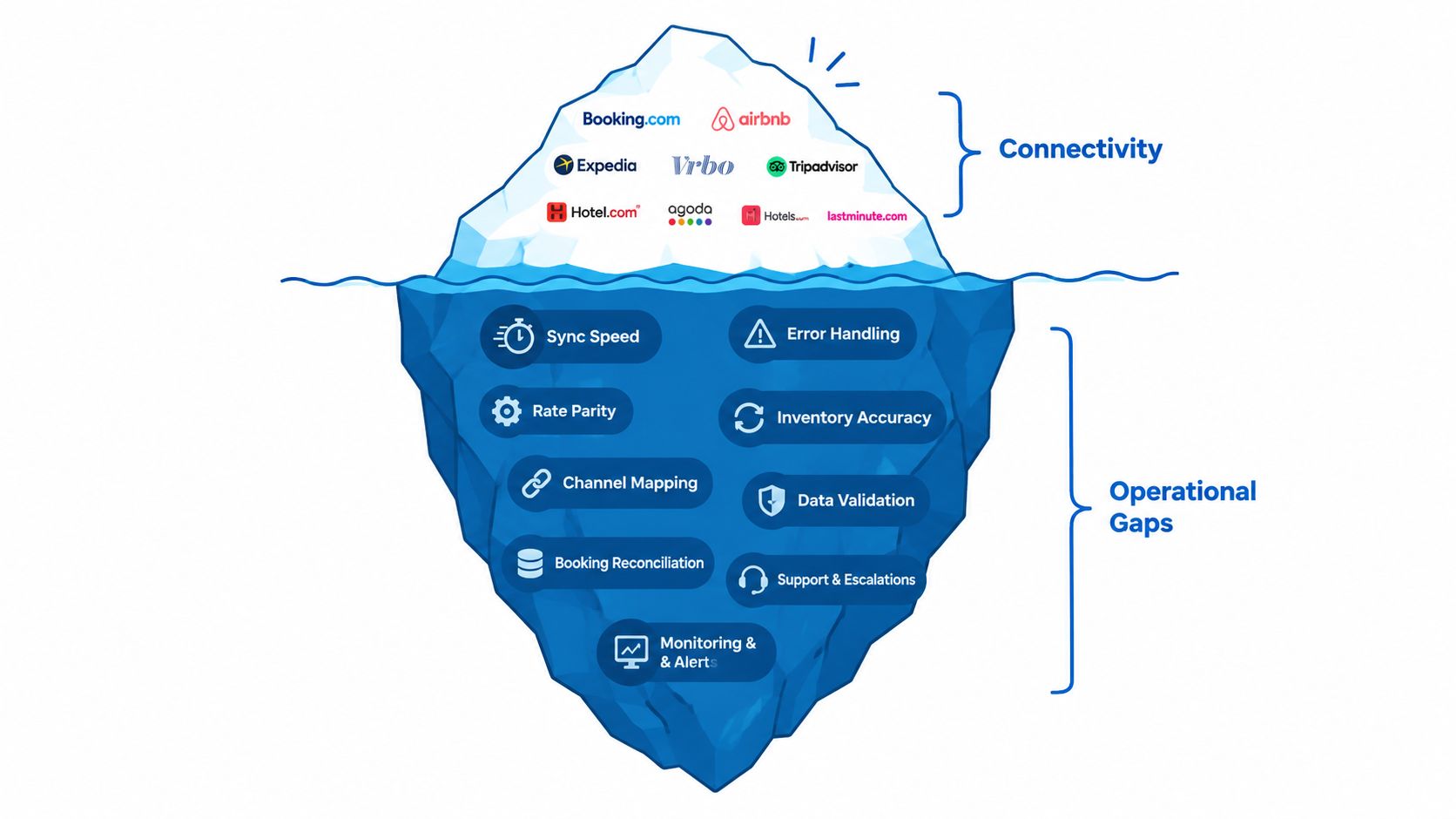
A long integration list can conceal a fragile operating model. A platform may connect to many OTAs yet leave managers unable to export historical listings, inspect failed deliveries, replay webhooks, or determine which system last changed a rate.
Connectivity is only the visible layer.
Ask who owns the record
Your team should be able to export normalized listings, reservations, mappings, event history, and operational metadata in a usable format. An export that contains only the current listing description isn't enough. Migration requires historical context, source identifiers, cancellation records, and the decisions that produced the current state.
Field-level provenance is equally important. If a displayed nightly price came from a pricing engine, a manual override, or an OTA conversion, the interface should make that origin visible. Without provenance, operators can't distinguish a bad upstream value from a failed transformation.
Test recovery, not only the happy path
During vendor evaluation, ask the provider to demonstrate:
- Failed delivery handling: Can an operator see the failed payload and the partner response?
- Replay behavior: Can the system retry one event without resending unrelated updates?
- Partial failure handling: What happens when one channel accepts an update and another rejects it?
- Stale-state alerts: Does the system identify data that hasn't been confirmed within its service objective?
- Migration support: Can the complete dataset be exported without custom intervention?
Practical rule: A channel manager is resilient only when an operator can explain what happened, correct it, and prove that the correction reached the destination.
More integrations can increase dependency rather than resilience. A system with many connectors but weak logs, opaque mappings, and no export guarantee can make an outage harder to diagnose than a smaller system with transparent controls. Select for recovery-time behavior and observability before counting logos.
Handling Regional Compliance and Operational Exceptions
Automation doesn't remove operational complexity. It moves complexity into policy evaluation, reconciliation, tax reporting, payout matching, and exception queues.
That shift is already visible in operator pain points. Recent industry reporting identified technology as the biggest operational problem for 44% of short-term-rental operators, while accounting-related technology complaints rose from 5% in 2021 to 21% in 2025, according to short-term-rental management software reporting. The lesson isn't that automation failed. It is that automated distribution creates new requirements for financial and regulatory controls.
EU platforms need a structured compliance model. Under Regulation (EU) 2024/1028, where a country requires registration, hosts must provide a registration number to the platform and the platform must display it clearly on the listing. Platforms must also let hosts declare that an accommodation is registered and collect the number when required, as described by Your Europe guidance on short-term accommodation.
Compliance belongs in the data model
A registration number shouldn't live in a free-text note. Store it as structured listing data with its jurisdiction, status, effective dates, source, and verification history. The distribution layer should know whether a destination requires the field, whether the value is valid, and whether publishing must be blocked when it is missing.
Regulation (EU) 2024/1028 applies from 20 May 2026 and requires platforms to share short-term-rental data with public authorities through automated processes, according to the European Parliament legislative timeline. That makes effective-date handling and jurisdiction-specific logic concrete engineering requirements, not future policy notes.
Currency support illustrates a related problem. A platform must distinguish display currency, booking currency, payout currency, and accounting currency rather than treating them as one string. A resource such as the RealtyAPI Airbnb currencies endpoint can support currency-aware workflows, but teams still need explicit rules for conversion, rounding, refunds, and reconciliation.
Exceptions should produce actionable states. A missing license, unsupported occupancy rule, rejected tax field, or channel-specific cancellation condition should identify the cause and next action. For example, Airbnb's home-host cancellation policy distinguishes timing thresholds and applies fees of 10%, 25%, or 50% depending on when the host cancels, with a $50 minimum fee, as set out in Airbnb's cancellation policy. A channel manager must therefore retain cancellation timing, check-in status, reservation value, and unused-night value instead of storing a generic cancellation flag.
Conclusion, The Strategic Role of Channel Management Software
Channel management software has moved beyond publishing listings. Its strategic role is maintaining a trustworthy operating state across systems that were never designed as one database.
A production platform needs a canonical data model, bidirectional event handling, idempotent processing, channel capability metadata, reconciliation workers, audit trails, structured compliance fields, and exportable history. Operators need failure details: which value failed, where it failed, whether a retry is safe, and what state the destination currently holds.
Market estimates differ by scope. One values hotel channel management software at approximately USD 1.62 billion in 2024, while another places the broader hospitality channel-management market at USD 2.48 billion, as shown by the hotel channel manager market analysis. Cloud deployment represented approximately 68.8% of the market, compared with 31.2% for on-premises systems in one 2024 estimate, according to industry adoption reporting.
A reconciliation queue shows the operational difference. If a reservation reduces availability on one channel but not another, the system should compare event IDs, timestamps, inventory versions, and destination responses. It should mark the mismatch, prevent unsafe replay, retry only idempotent operations, and expose the remaining discrepancy to an operator. A final audit record should show the correction and its downstream result.
Property managers should test whether they can identify stale listings, correct mappings, replay reservation events, verify results, and export data if the vendor relationship ends. Platform builders should decide which distribution rules remain proprietary and which belong in a shared data layer.
Reliable systems make exceptions visible, bounded, auditable, and safe to resolve. That turns separate OTA connections into infrastructure that operators can trust.
RealtyAPI.io provides a unified developer API for property and rental data, including availability, pricing, listing details, reviews, and related market signals, with REST, GraphQL, and webhook access. Visit RealtyAPI.io to review an integration path for a marketplace, booking workflow, or channel-management product.