Best Secretary of State API Providers (2026 Pricing)
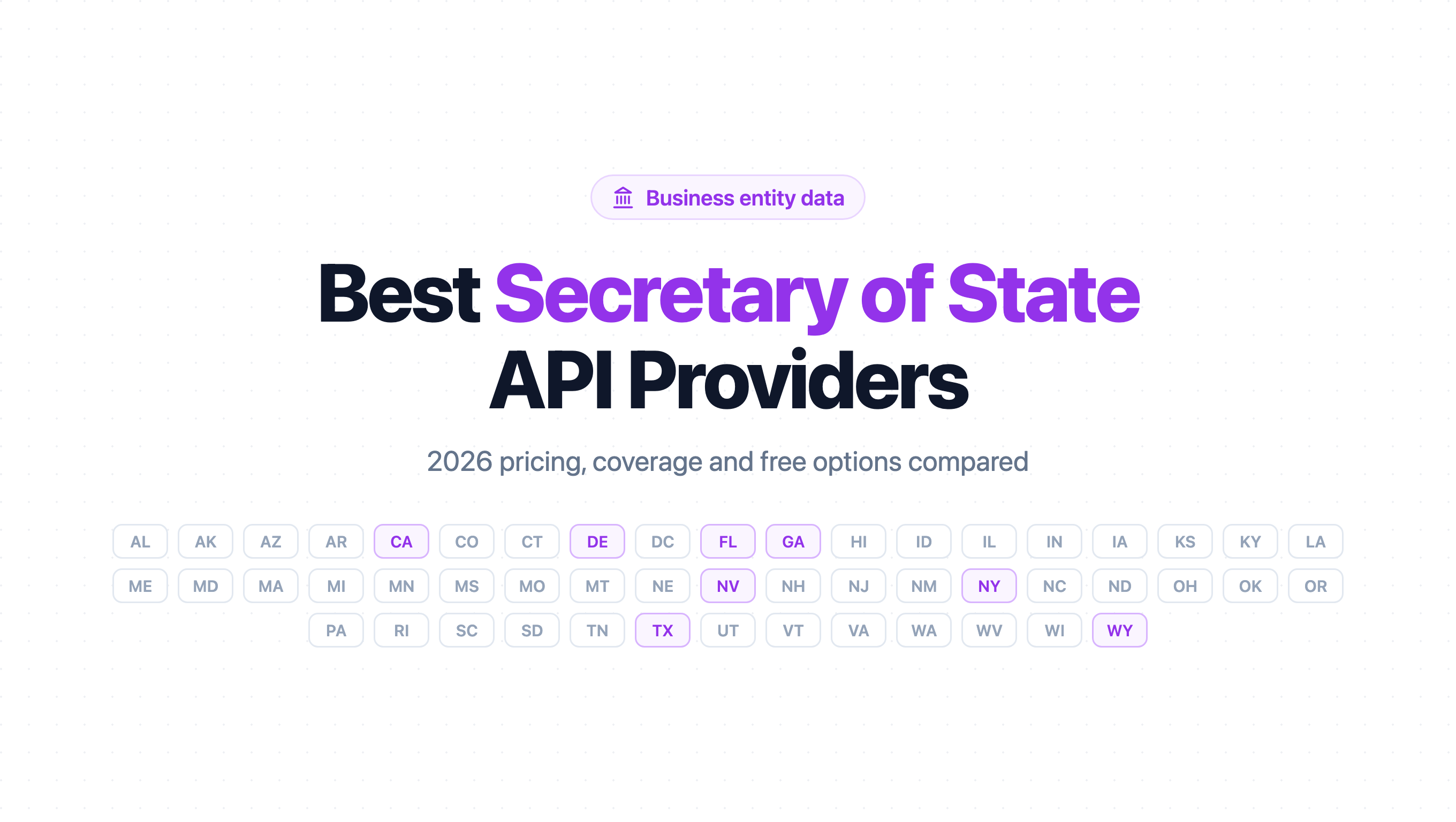
There are 51 state-level business registries in the United States (50 states plus DC), and no two of them agree on anything. Different search pages, different field names, different status words ("Forfeited Existence" is a real one), and a handful that block anything that isn't a human with a mouse. If you need business entity data from more than one state, sooner or later you go looking for a Secretary of State API.
This guide compares the best Secretary of State API providers in 2026 with their real, published prices, plus the free options most articles skip: state websites, official open-data downloads, and the one state that sells its own API. We also cover the use case we care about most at RealtyAPI: figuring out who is actually behind the LLC that owns a property.
Short version:
- Best for developers and AI agents: SOSfinder. All 50 states plus DC through one endpoint, 50 free lookups a month, published per-lookup pricing, and a hosted MCP server.
- Best for lenders who need live proof: Cobalt Intelligence, which returns a timestamped screenshot with each live lookup.
- Best full KYB platform: Middesk (sales-led) or Baselayer (self-serve pricing).
- Best for global or bulk research: OpenCorporates.
- Best free option: state open-data portals, if your states publish one.
Pricing below was read from each vendor's own site in October 2026. Prices move, so treat every number as "at the time of writing" and check the vendor's page before you sign anything.
What is a Secretary of State API?
Every US state keeps a public registry of the businesses formed or registered there, usually run by the Secretary of State (a few states use a different office, like a Division of Corporations). A Secretary of State API lets your code search those registries and get the results back as structured JSON instead of a web page.
A typical record tells you six things:
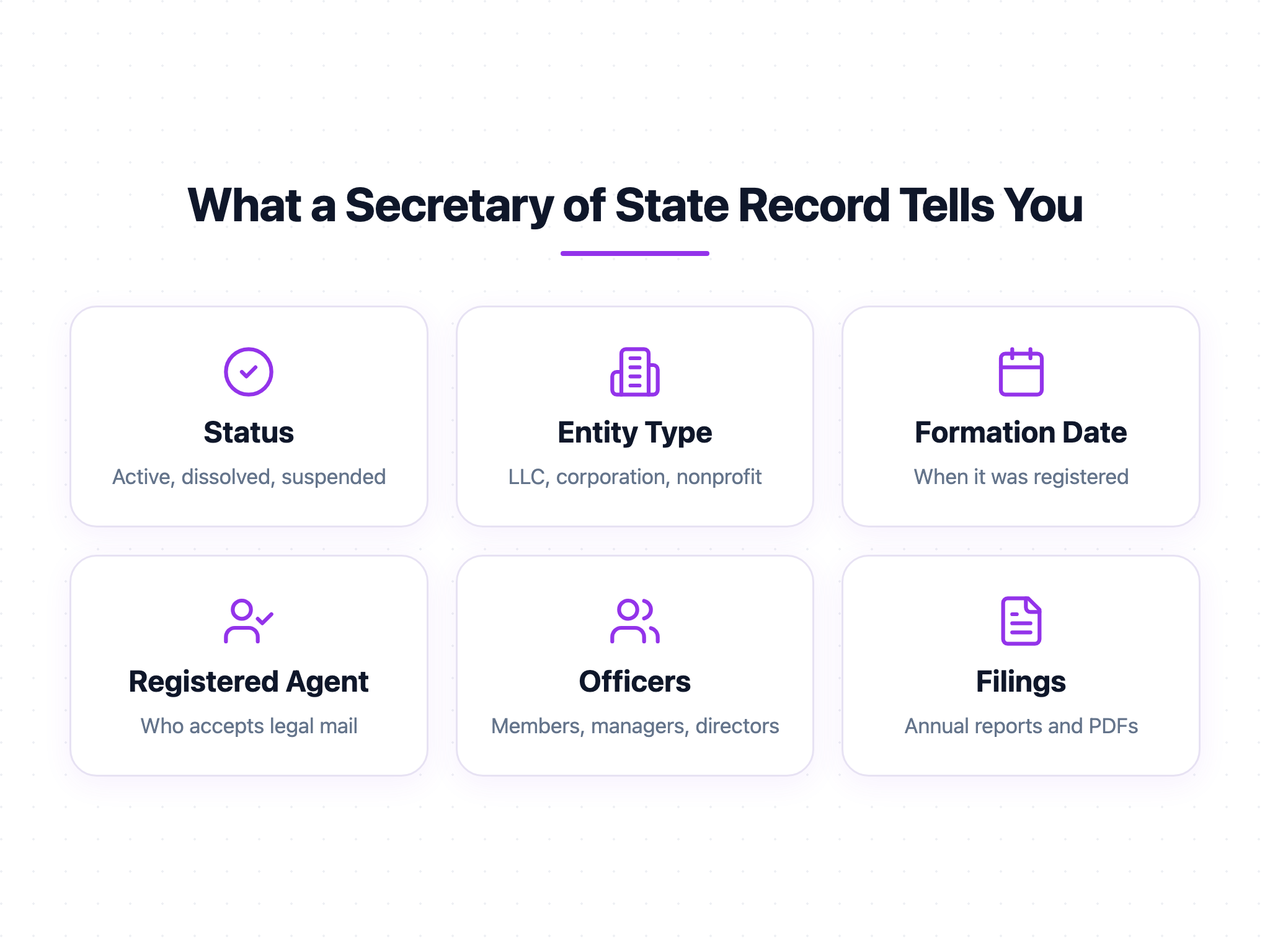
- Status: active, inactive, dissolved, suspended, or one of the many state-specific variations.
- Entity type: LLC, corporation, limited partnership, nonprofit.
- Formation date: when the entity was registered, which is a quick signal for "brand new company, be careful."
- Registered agent: the person or company that accepts legal papers on the entity's behalf.
- Officers: members, managers, directors. Only some states publish these, which matters more than any vendor's marketing.
- Filings: annual reports, amendments, and sometimes downloadable PDFs.
The single most important thing to understand before you compare providers: no API can return data a state doesn't publish. If a state doesn't list LLC members, every vendor's "officers" field for that state will be empty or come from somewhere other than the state. Coverage claims like "all 50 states" are about reaching each registry, not about getting every field from every registry.
Three ways to get Secretary of State data
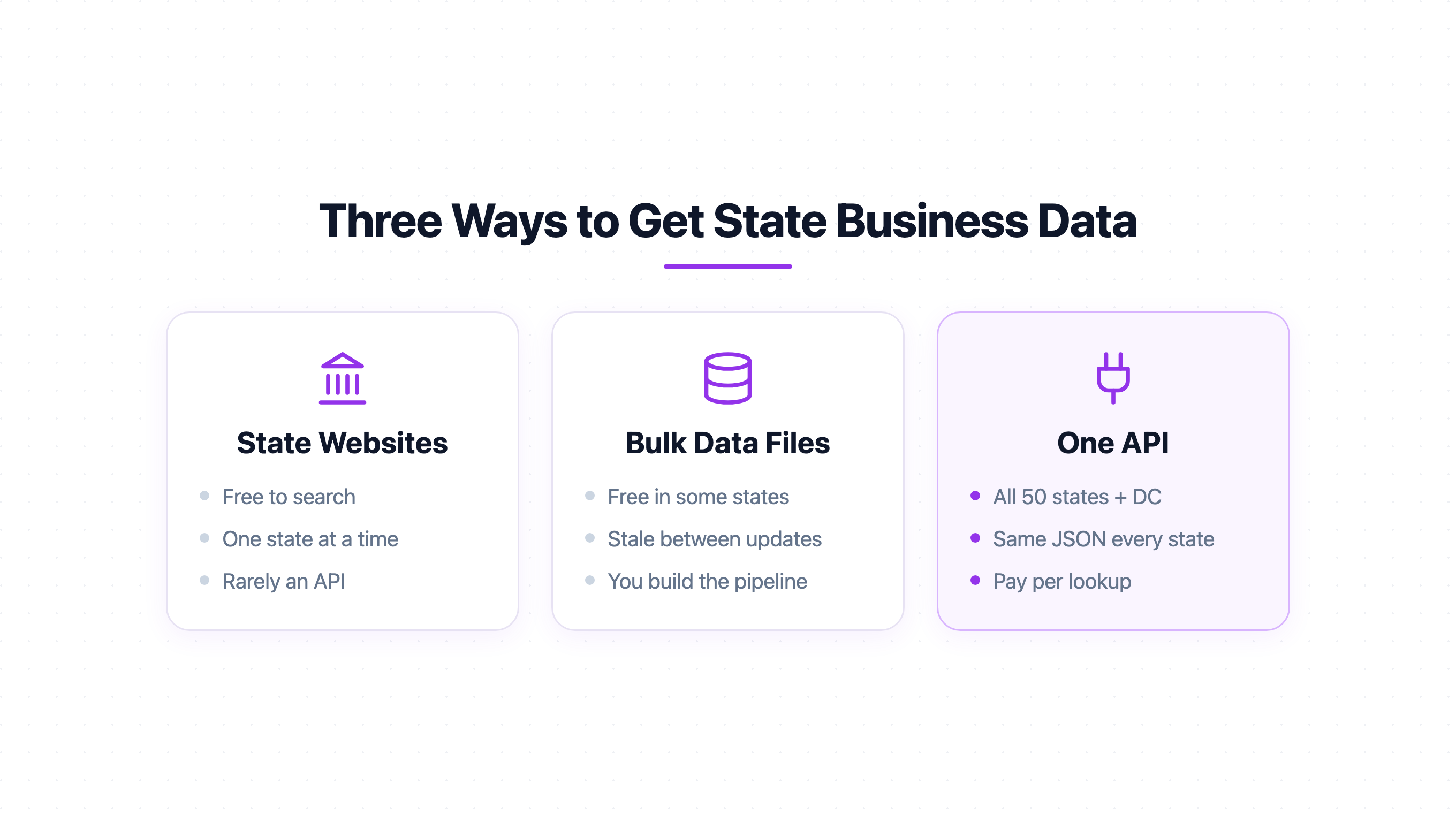
1. State websites (free, manual)
Every state has a free business search page. The National Association of Secretaries of State keeps a directory of every state's business registration and name search pages, which is the best starting point if you only need a few lookups. It does not scale: you search one state at a time, by hand, and each site has its own layout and quirks.
2. Bulk data and official state APIs (free or cheap, some states only)
A few states publish their registries as open data you can download or query:
- Colorado: Business Entities in Colorado, covering entities back to 1864, updated daily.
- Connecticut: the Business Registry master table, updated daily.
- Oregon: Active Businesses, including registered agents, updated weekly.
- New York: Active Corporations, posted monthly, active entities only.
- Iowa: runs an official API, but it is paid: subscriptions are listed at $2,400 a year for monthly updates or $10,400 a year for weekly updates.
Open data is great for analysis, market research, or building your own index for one state. It is not great for "is this company active right now?" because a monthly file is up to a month stale, and you own the pipeline that loads, cleans, and refreshes it. Most states don't publish bulk files at all.
3. A Secretary of State API provider (paid, all states)
This is what the rest of this guide compares. You send a business name (or ID) and a state; the provider handles the 51 registries and gives you one consistent response. The differences between providers come down to five questions:
- Live or stored? Does each lookup query the state, or a database the vendor refreshes on a schedule?
- Which fields, in which states? Officers and documents vary a lot.
- What does it cost at your volume? And is that price published or behind a sales call?
- How do you integrate? REST, bulk upload, webhooks, MCP for AI agents.
- What happens when a state is slow or down? Some state sites are slow on a good day.
Secretary of State API providers compared
| Provider | Best for | Entry price (published) | Free option | Data freshness | Watch out for |
|---|---|---|---|---|---|
| SOSfinder | Developers, proptech, AI agents | $49/mo for 1,000 lookups, or $0.09 per lookup pay-as-you-go | 50 lookups/month | Live, then cached (cached repeats are free) | Failed requests still use a credit; officers only where states publish them |
| Cobalt Intelligence | Lenders needing live proof | Not published (credit-based, billed monthly) | Trial lookups | Live, with screenshots | Slow states can take 30+ seconds; officers in 28 states |
| Middesk | Banks and fintech KYB | Contact sales | Sandbox | Not stated | Sales-gated; SOS is one part of a larger KYB platform |
| Baselayer | Self-serve KYB for lenders | $150/mo (500 credits) | Sandbox (no credits used) | "Daily to weekly" per its docs | Credits per search not published |
| Enigma | Business data enrichment | $20/mo (2,100 credits) | Free tier (search, summaries) | Weekly registration updates (per its docs) | Limited coverage in some states; no document retrieval |
| OpenCorporates | Global and bulk research | £2,250/yr (500 calls/month) | Free for public-benefit projects | Varies by state, daily to annual | Annual pricing; share-alike license on open use |
| Filed.dev | Cheap name and status checks | $49/mo (1,000 credits) | 14-day trial | Not stated | Officer data in 6 states; 60 requests/minute |
| Bizapedia | High-volume enrichment | $999/yr (180,000 calls) | 7-day refund if under 1,000 calls | Not stated (database) | Annual up front; not a live registry query |
| State open data | Free bulk analysis | Free | Free | Daily to monthly, by state | A few states only; you build and run the pipeline |
The best Secretary of State API providers, one by one
1. SOSfinder: best for developers and AI agents
Full disclosure: SOSfinder is a sister product of RealtyAPI. We've tried to hold it to the same standard as everyone else on this list, including its limitations.
SOSfinder is built for the "I just want one endpoint" crowd. It searches all 50 states plus DC through a single REST call, where the state is just a parameter, and normalizes every registry into one fixed schema of 60+ fields. A field a state doesn't publish comes back null instead of disappearing, so your parsing code stays the same for Wyoming and California.
A lookup looks like this (from the entity search docs):
curl 'https://api.sosfinder.com/search?state=FL&business_name=Acme%20LLC' \
  -H "x-api-key: $SOS_API_KEY"
And a trimmed version of the response from the same docs page:
{
  "state": "FL",
  "success": true,
  "count": 3,
  "bestMatch": {
    "name": "ACME LLC",
    "entityId": "L19000123456",
    "status": "Active",
    "entityType": "Florida Limited Liability Company",
    "formationDate": "04/08/2019",
    "registeredAgentName": "Jane Doe",
    "officers": [{ "name": "Jane Doe", "title": "President" }],
    "documents": [{ "title": "01/15/2026 -- ANNUAL REPORT", "url": "https://search.sunbiz.org/..." }],
    "sosUrl": "https://search.sunbiz.org/..."
  },
  "results": ["...best match first, then similar filings..."]
}
Strengths:
- Live, then cached. A new query hits the state registry; repeats within the cache window come back from cache and aren't billed. Every result carries a cached flag and a timestamp, so you always know how fresh it is.
- Search by name or by the state's own ID (document number in Florida, file number in Delaware, and so on). An ID lookup returns exactly one record.
- Documents that actually download. Some registries only serve filing PDFs to a browser that passed their bot check; SOSfinder routes those through its own document endpoint so the links work for your users.
- More than search: business monitoring (get alerted when a tracked company's status, agent, or address changes), bulk CSV search, a free business name checker, and UCC and officer lookup in beta on the Pro plan.
- A hosted MCP server, so Claude, Cursor, and other AI agents can search registries as a native tool. More on that below.
Pricing (published): Free gives 50 lookups a month with no credit card. Starter is $49/month for 1,000 lookups, Pro is $99/month for 2,500, and Scale is $449/month for 15,000, with overage from $0.09 down to $0.06 per lookup. There are also one-time credit packs at $0.09 per lookup that never expire. See the pricing page for current numbers.
Limitations: it is US-only. Officers and documents depend on what each state publishes, like every provider. A request that fails after your key is validated (a typo'd parameter, say) still uses a credit, so validate inputs before you send them. UCC search is still in beta.
Best for: developers who want predictable pricing without a sales call, proptech and real estate tools, vendor and customer checks, and anyone wiring entity lookups into an AI agent.
2. Cobalt Intelligence: best for live proof in lending
Cobalt pulls live Secretary of State data on each lookup and returns a timestamped screenshot of the state's page as evidence, which is exactly what merchant cash advance and small business lenders want in an underwriting file. It covers all 50 states plus DC, with a business monitoring product, bulk CSV upload, and a long list of extras (UCC, TIN verification, court cases, OFAC, contractor licenses).
Watch out for: field coverage varies a lot by state. Cobalt's own docs list officers in 28 states and organization documents in 18. Because lookups are live, slow states can take longer than 30 seconds, so the API hands back a retry ID or uses a callback. There is no public price table: pricing is credit-based (most lookups cost 1 credit, a multi-state verification costs 3), billed monthly in arrears, and credits don't roll over.
Best for: lenders and underwriters who need evidence, not just data.
3. Middesk: best full KYB platform (sales-led)
Middesk is a know-your-business platform where Secretary of State search is one step of a larger verification. Create a business and Middesk searches all 50 states plus DC automatically, alongside TIN checks, watchlists, UCC and tax lien searches, and monitoring webhooks. It also runs an MCP server.
Watch out for: pricing is not published (the docs say to contact sales), and you are buying a compliance platform rather than a lookup API. If you only need entity status and agent data, it's more than you need.
Best for: banks, fintechs, and payroll companies that need full KYB with an audit trail.
4. Baselayer: best self-serve KYB pricing
Baselayer covers all 50 states plus DC and Puerto Rico, with officers, liens, litigation, sanctions, batch search, an MCP integration, and a sandbox that doesn't consume credits. Unlike most KYB vendors, it publishes prices: Start-up from $150/month (500 credits) and Growth from $750/month (3,000 credits), with no contract on either.
Watch out for: how many credits one search costs isn't published, and its docs describe Secretary of State data as "refreshed daily to weekly" while another page says "live," so ask which you get. Monitoring is Enterprise-only.
Best for: small lenders and fintechs that want KYB without an enterprise contract.
5. Enigma: best for enrichment at scale
Enigma sells a stored business graph built from many sources, with state registrations from all 50 states, DC, and Puerto Rico. It has a free tier for search and summaries, Pro at $20/month (2,100 credits), and Max at $200/month (25,000 credits, including MCP access). Its rate card prices registration details at $0.10 each and a KYB verification at $2.50 per match.
Watch out for: it is a database, not a live registry query. Its older (v1) documentation says registration data is updated weekly and lists limited coverage in a few states, including Delaware and Nevada, two of the most popular formation states. It doesn't retrieve filing documents.
Best for: sales, marketing, and risk teams enriching large lists of businesses.
6. OpenCorporates: best for global and bulk research
OpenCorporates is the largest open database of companies worldwide, with an API and bulk delivery. Its US coverage includes all 50 states plus DC, and it is honest about freshness: its coverage page lists an expected update cadence per state, from daily in some states to semi-annually or annually in others.
Pricing: annual plans in pounds: Essentials at £2,250/year (500 calls a month), Starter at £6,600/year (2,500 a month), and Basic at £12,000/year (5,000 a month). Access is free for qualifying open-data and public-benefit projects.
Watch out for: stored data means "active" might be weeks or months old in some states, and the open data license requires share-alike attribution.
Best for: journalists, researchers, and anyone who needs companies outside the US too.
7. Filed.dev: best budget option for basic checks
Filed.dev offers a developer-friendly REST API covering all 50 states plus DC, along with SEC, lobbying, and federal contract data. Developer is $49/month for 1,000 credits with a 14-day trial; Business is $199/month for 10,000; Scale is $499/month for 50,000.
Watch out for: officer data is limited to six states (Florida, New York, Oregon, Pennsylvania, Texas, and Washington), a cross-state query costs 5 credits, and the rate limit is 60 requests per minute.
8. Bizapedia: best for cheap annual volume
Bizapedia is a well-known business directory with a paid API and an MCP server over a database of more than 123 million US and Canadian entities. The Pro API is $999 a year for 180,000 calls, which is cheap per call if you use the volume.
Watch out for: it is a database rather than a live state lookup, its freshness isn't stated, and you pay a year up front (with a 7-day refund if you've made 1,000 calls or fewer).
Also worth knowing
- Dun & Bradstreet and LexisNexis include Secretary of State registration data inside larger enterprise products. Pricing is sales-only, and you're buying far more than entity lookups.
- Signzy searches all 50 Secretary of State registries plus DC as part of its business verification suite; pricing is demo-gated.
- Marketplace scrapers (Apify actors and similar) are cheap per result, but typically cover a subset of states and break whenever a state redesigns its site or adds a CAPTCHA. Fine for a one-off project, risky for production.
What 2,000 lookups a month actually costs
"Pay per lookup" means nothing until you put a volume on it. Here is what roughly 2,000 basic entity lookups a month would cost on each published price list, as of October 2026. It assumes one basic lookup equals one credit or call unless the vendor publishes otherwise.
| Provider | Plan that fits | Monthly cost | Notes |
|---|---|---|---|
| SOSfinder | Pro (2,500 lookups) | $99 | Cached repeats are free, so real usage is often lower |
| Bizapedia | Pro API (180,000 calls/year) | About $83 equivalent | $999 paid up front for the year; stored data |
| Filed.dev | Business (10,000 credits) | $199 | The $49 Developer plan only includes 1,000 credits |
| Enigma | Max (25,000 credits) | $200 | At $0.10 per registration record |
| OpenCorporates | Starter (2,500 calls/month) | About £550 equivalent | £6,600 billed annually |
| Baselayer | Growth (3,000 credits) | $750+ | If one search uses one credit, which isn't published |
| Cobalt, Middesk, Signzy | Custom | Ask sales | No public price list |
The cheapest line isn't automatically the best. A stored database at $83 is the wrong tool if you need to know a company's status today, and a live API is overkill if you're enriching a marketing list once a quarter. Decide whether you need live or stored first, then compare prices inside that group.
Real estate: who really owns that property?
Here's the use case that brought us to this topic. A lot of investment property is held by LLCs, so when you pull an owner name from a deed or a property record, it's often something like "Maple Holdings 4 LLC." That name is a dead end for outreach, due diligence, or a closing until you look the company up.
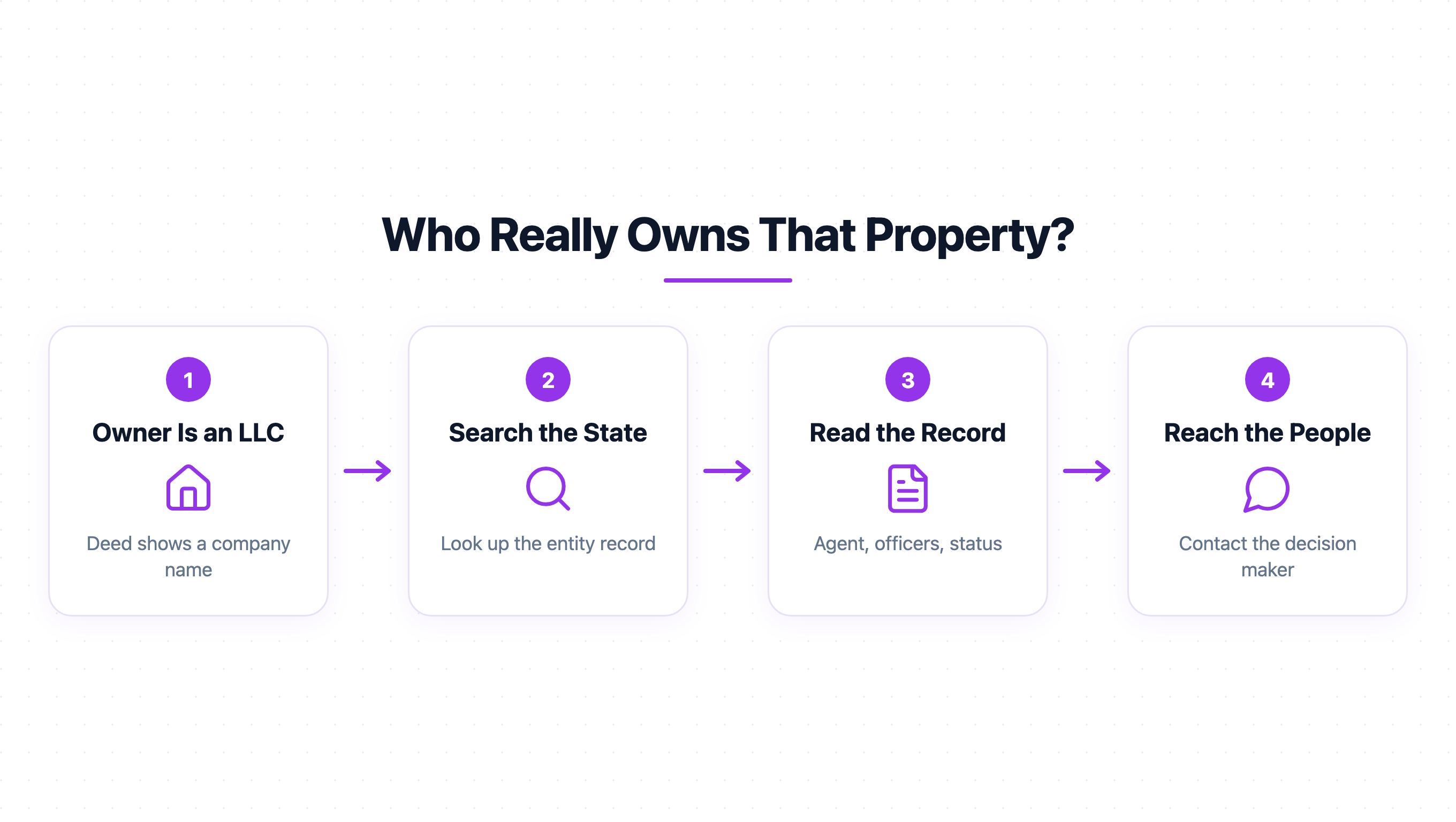
- Get the owner name from the deed, the county assessor, or your property data source.
- Search the Secretary of State registry in the state where the LLC was formed. That's often not the state where the property is. Delaware and Wyoming LLCs regularly own property far from home.
- Read the record: status (a dissolved LLC can't sign a deed), formation date, registered agent, and, where the state publishes them, managers or members. Filings like annual reports often list a principal address or an authorized person.
- Reach the decision maker through the officer or principal address, or hand the names to a skip tracing step.
Real estate investors, wholesalers, and agents do this by hand every day. PropertyRadar lists Secretary of State searches as one of the main ways to find LLC owners, and LegalZoom points out the catch: filings often don't name the owners at all. That's why the state matters as much as the provider. A Florida record usually gives you names to work with; a Delaware record mostly gives you a registered agent.
Title and escrow teams use the same lookups the other way around: confirming that a seller LLC is active and that the person signing is actually authorized to sign for it. An API turns both workflows from a 10-tab research session into one request per property.
Secretary of State data for AI agents (MCP)
This is the newest and least-covered part of the market. The Model Context Protocol (MCP) lets AI assistants like Claude and Cursor call external tools directly, so instead of writing integration code you can ask, "Is Acme Logistics LLC still active in Texas, and who's its registered agent?"
Several providers now offer MCP: SOSfinder, Middesk, Baselayer, Enigma (on its Max plan), and Bizapedia. SOSfinder's is a hosted server you add with one command (from its MCP docs):
claude mcp add sosfinder https://api.sosfinder.com/mcp \
  --transport http \
  --header "Authorization: Bearer $SOS_API_KEY"
Searches through MCP are metered exactly like REST calls. Listing supported states, managing monitors, and reading the change feed are free, which makes "watch these 20 entities and tell me when anything changes" a cheap thing to hand to an agent.
How to choose a Secretary of State API
- Need to know a company's status right now? Choose a live provider (SOSfinder, Cobalt). Stored databases can be weeks behind.
- Need proof for compliance files? Cobalt's screenshots, or a full KYB platform like Middesk or Baselayer.
- Need officers or members? Check field coverage per state, not the "50 states" headline. Ask every vendor which states return officers.
- Want to avoid sales calls? SOSfinder, Baselayer, Enigma, Filed.dev, and Bizapedia all publish prices.
- Building with AI agents? Pick a provider with an MCP server so the agent can search and monitor without glue code.
- Only need one state, for analysis? Check whether that state publishes open data before paying anyone.
Frequently asked questions
Is there a free Secretary of State API?
Mostly no, with partial exceptions. Every state's search website is free to use by hand. A few states publish free open-data files (Colorado, Connecticut, Oregon, and New York among them), and Iowa sells an official API. For an API across all states, the closest thing to free is a provider's free tier, such as SOSfinder's 50 lookups a month.
How often are Secretary of State records updated?
The state registry itself changes whenever a filing is processed. What you see depends on your provider: a live API reflects the registry at the moment of the lookup, while stored databases refresh on their own schedule, anywhere from daily to annually depending on the vendor and the state.
Can I find the owner of an LLC through the Secretary of State?
Sometimes. Many states list managers, members, or an authorized person on the formation filing or annual report, but some list only the registered agent. If the state doesn't publish owners, no Secretary of State API can return them; you'll need other sources such as property records or skip tracing.
Does Delaware show LLC owners?
No. Delaware's free entity search shows basic details like the entity name, file number, formation date, and registered agent, but not members or managers. That privacy is a big part of why so many companies form there.
What's the difference between a Secretary of State API and a KYB API?
A Secretary of State API returns registry records: status, agent, officers, filings. A KYB (know your business) API uses those records as one input and adds identity checks, TIN matching, sanctions screening, and risk scoring. If you only need the registry data, a Secretary of State API is simpler and cheaper.
Key takeaways
- "All 50 states" is about reach, not fields. Ask which states return officers and documents before you compare prices.
- Decide live vs stored first. Status checks need live data; enrichment and research can use a cheaper database.
- Published pricing is a feature. At 2,000 lookups a month, published plans range from about $83 to $750+, and several vendors won't tell you at all.
- Check free state data before paying. Colorado, Connecticut, Oregon, and New York publish their registries as open data.
- MCP is the new integration path. If agents are part of your roadmap, pick a provider that already speaks MCP.
If you want to try a Secretary of State API today, SOSfinder gives you 50 free lookups a month with no credit card, which is enough to test it against the states you care about before choosing anything. And if you're on the real estate side, pair it with RealtyAPI's property data to go from a listing to the people behind the LLC that owns it.