Best Real Estate Listing APIs in 2026, Compared

Search for the best real estate listing API and look at who wrote the results. ATTOM's roundup ranks ATTOM first. HouseCanary's ranks HouseCanary. The scraping vendors rank scraping. And in the 28-item listicles, half the pricing column says "contact sales," which tells you exactly nothing when you are trying to scope a build on a Tuesday afternoon.
This is the comparison we wanted to read: the best real estate listing APIs in 2026, sorted by what they actually are, with real prices where prices exist and an honest note where they do not. Yes, RealtyAPI is on the list. We build it, and we will also tell you where it is the wrong choice, because a customer who churns in two weeks helps nobody.
The criteria: what data you get, how fresh it is, what it costs at small and medium scale, how long setup takes, and where each option quietly falls over.
The three kinds of listing API (pick your model first)
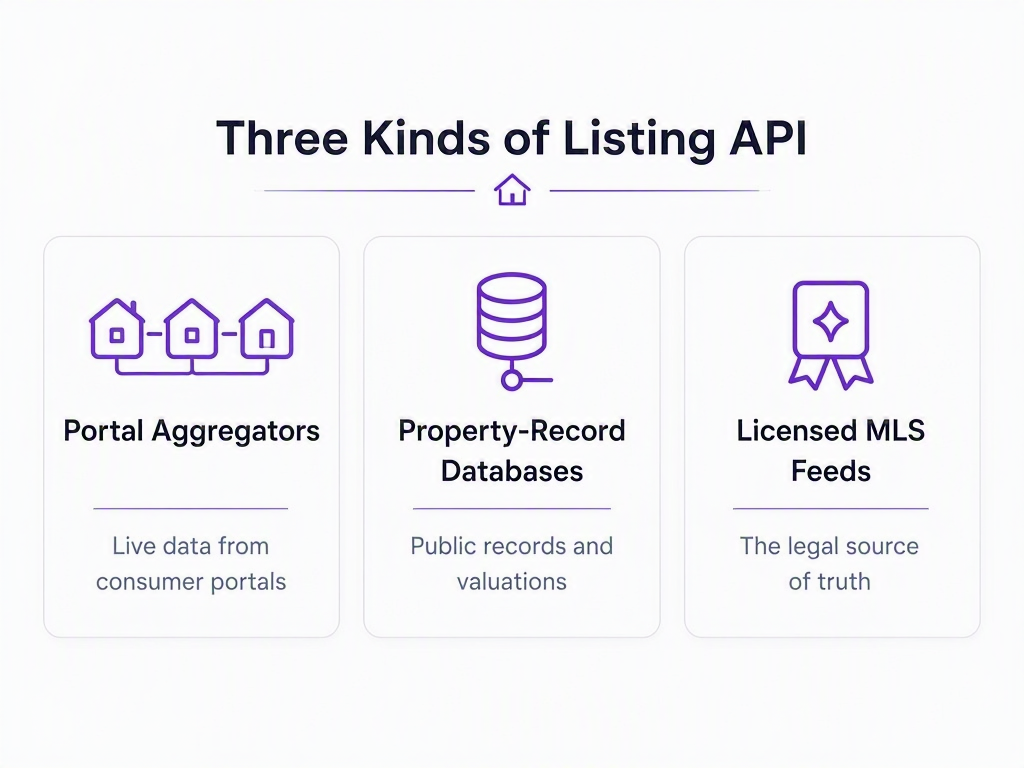
Most roundups lump everything with "real estate" and "API" in the name into one ranked list, which is how you end up comparing an AVM vendor against a scraping proxy as if they were substitutes. They are not. For listings specifically, there are three access models, and the right provider follows from the model, not the other way around.
- Portal aggregators. One API in front of the consumer portals: Zillow, Redfin, Realtor.com, Rightmove, Zoopla, and so on. You get what a buyer sees on the site, fetched when you ask. RealtyAPI is this.
- Property-record databases. The provider maintains its own copy of US property data assembled from public records, county filings, and listing feeds, then serves it back with valuations and owner details attached. RentCast and ATTOM are this.
- Licensed MLS feeds. The legal source of truth, straight from the MLSs, with the display rights brokerage websites need. Bridge Interactive and SimplyRETS are this.
Here is the first thing worth internalizing: there is no general-purpose public Zillow API anymore. Zillow wound down open developer access years ago, and official Zillow Group data now flows through Bridge Interactive, behind an approval process built for MLS participants and their vendors. Everything else calling itself a Zillow API is an aggregator or a scraper in a nicer shirt. That single fact explains most of the confusion in this market, so the sections below say plainly which model each provider belongs to.
Can't I just use the Zillow API?
If you mean "sign up on zillow.com and get a key": no, that program is gone. If you qualify for Bridge (you are an MLS member, an IDX vendor, or a technology partner of one), you can get official feeds, and you should. If you do not qualify, your options are an aggregator like RealtyAPI that fetches portal data live, or building a scraper yourself. We wrote a whole guide to getting Zillow data in 2026 if that is your main question.
Best real estate listing APIs at a glance
Every number below was checked against the provider's public pricing page in August 2026. Where a provider does not publish pricing, the table says so instead of pretending.
| Provider | Model | Free tier | Entry pricing | Setup to first call | Biggest limitation |
|---|---|---|---|---|---|
| RealtyAPI | Portal aggregator (27 platforms) | 250 requests/mo | $20/mo for 20,000 requests; pay-as-you-go credits from $0.003 | Minutes | Not a licensed MLS feed, so no IDX display rights |
| RentCast | Property-record database | 50 requests/mo | $74/mo for 1,000 requests | Minutes | US only; records update on a daily pipeline, not live |
| ATTOM | Property-record database (enterprise) | None public | Quote-based; public references put entry near $95/mo, production deployments far higher | Days to weeks (sales process) | Cost and procurement; heavy for listings alone |
| Zillow via Bridge | Licensed MLS / Zillow feeds | Bridge charges no service fee | $0 from Bridge; individual MLSs may charge their own fees | Days to weeks (approval) | Requires MLS membership or a vendor agreement |
| SimplyRETS | MLS feed middleware | Demo feed for development | From $49/mo plus a $99 one-time fee per MLS connection | Hours once your MLS approves the feed | You bring your own MLS membership; one feed covers one MLS |
RealtyAPI: live portal data behind one key
RealtyAPI puts one API key in front of 27 listing platforms and 300+ endpoints: Zillow, Redfin, Realtor.com, and Apartments.com on the US side, and international portals like Rightmove, Zoopla, Idealista, Funda, and Property Finder. Each portal gets its own subdomain, so a Zillow search is a GET against zillow.realtyapi.io and a Redfin lookup is redfin.realtyapi.io, all with the same x-realtyapi-key header.
The part that matters for listings: requests are fetched live from the source portal at call time, not served from a stored copy. When a listing gets a price cut at 9 AM, the 9:05 API response contains the price cut. For listings, freshness beats volume. A 150-million-record archive is the wrong tool for knowing what went pending this morning.
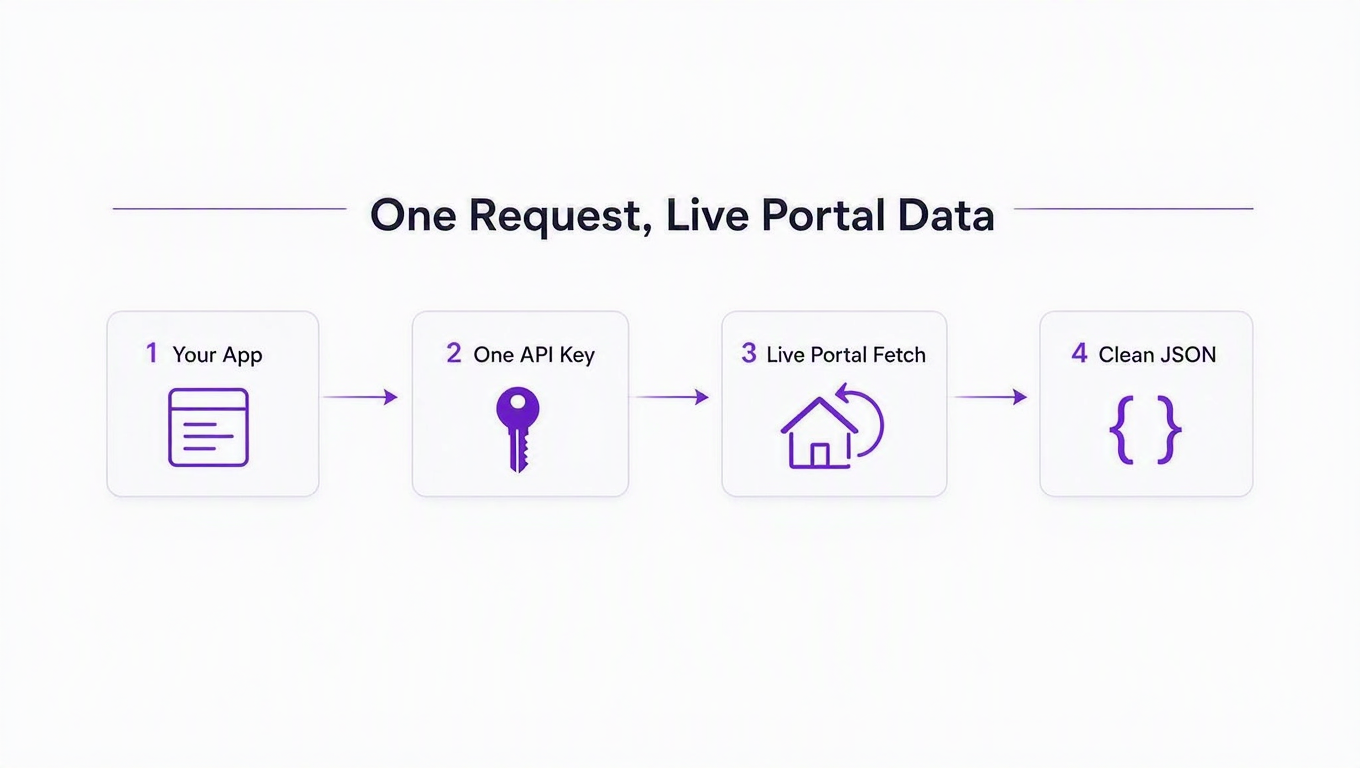
Here is a real call against the Zillow search endpoint, filtering ZIP 78006 for active listings between $400k and $420k:
import requests

resp = requests.get(
    "https://zillow.realtyapi.io/search/byaddress",
    headers={"x-realtyapi-key": "YOUR_API_KEY"},
    params={
        "location": "78006",
        "listingStatus": "For_Sale",
        "listPriceRange": "min:400000, max:420000",
    },
    timeout=30,
)
resp.raise_for_status()
data = resp.json()

print(data["resultsCount"]["totalMatchingCount"])
for result in data["searchResults"][:3]:
    home = result["property"]
    print(
        home["address"]["streetAddress"],
        home["price"]["value"],
        home.get("estimates", {}).get("zestimate"),
    )
Output when we ran it while writing this post:
19
111 Brackenridge 405000 393900
115 Village Park #115 415000 None
117 RETAMA RD 419500 414100
Each result carries the fields you would see on the listing card and then some: beds, baths, living area, year built, days on market, price history, Zestimate and rent Zestimate, photo links, and coordinates. A trimmed real response:
{
  "message": 200,
  "resultsCount": { "totalMatchingCount": 19 },
  "pagesInfo": { "totalPages": 1, "currentPage": 1, "resultsPerPage": 200 },
  "searchResults": [
    {
      "property": {
        "zpid": 2070051869,
        "address": { "streetAddress": "111 Brackenridge", "city": "Boerne", "state": "TX", "zipcode": "78006" },
        "bedrooms": 2, "bathrooms": 2, "livingArea": 1075, "yearBuilt": 1955,
        "propertyType": "singleFamily",
        "daysOnZillow": 67,
        "price": { "value": 405000, "priceChange": -10000, "pricePerSquareFoot": 377 },
        "estimates": { "zestimate": 393900, "rentZestimate": 1834 },
        "listing": { "listingStatus": "forSale", "marketingStatus": "active" }
      }
    }
  ]
}
Strengths. Coverage across portals and countries with one bill and one auth header. Live fetches, so no staleness window. And the pricing is hard to argue with: the free tier is 250 requests a month, the PRO plan is $20 for 20,000 requests (a tenth of a cent each), and pay-as-you-go credits from $0.003 per request never expire, which is the sane option for cron jobs and side projects. The platform currently reports a 99.5% success rate across roughly 40 million requests a month.
Weaknesses, honestly. This is not a licensed MLS feed. If you are building a brokerage website that displays listings to consumers, IDX rules apply and you need Bridge or SimplyRETS, not us. Responses mirror each portal's own structure, so Zillow JSON and Redfin JSON are shaped differently; cross-portal normalization is your job. And because data comes from public portal pages, anything a portal does not show, we cannot show either.
Best for: market analytics, deal-sourcing and alerting tools, investor dashboards, AI agents that need to answer "what is for sale in this ZIP right now," and any product that needs international portals without signing five contracts. For a broader view of building on property data, see our real estate API guide.
RentCast: the tidy US records database
RentCast is what a records database looks like when it is built for developers instead of procurement departments. One clean, consistent schema over 150+ million US property records: property details, owner information, tax history, value and rent estimates, active sale and rental listings, and market statistics by ZIP. The docs are good and you can be making calls ten minutes after signing up.
Strengths. The unified schema is the draw. Every property looks the same regardless of source, which makes it pleasant for valuation tools and rent analytics. The AVM endpoints (value and rent estimates with comparables) are the standout feature, and there is nothing equivalent in a pure portal aggregator.
Weaknesses. US only. Listings ride an ingestion pipeline (RentCast says it updates around 500,000 records daily), so it is a snapshot refreshed on their schedule rather than a live fetch. And per-request economics are steep at entry: the free Developer tier is 50 requests a month, then $74/mo buys 1,000 requests, which works out to about 7 cents each versus a tenth of a cent on RealtyAPI's entry plan. For enrichment-style workloads (one lookup per property, cached forever) that is fine; for search-heavy workloads it adds up fast.
Pricing. Developer free (50/mo), Foundation $74/mo (1,000), Growth $199/mo (5,000), Scale $449/mo (25,000), with overage rates from $0.20 down to $0.015 per request.
Best for: rent estimators, valuation features, owner lookups, and investor tools that need one consistent US dataset more than they need this-morning freshness.
ATTOM: enterprise records, enterprise procurement
ATTOM is the incumbent's incumbent: 158+ million US properties with deeds, mortgages, foreclosures, tax assessments, school data, neighborhood boundaries, and AVMs, licensed with the kind of paperwork that makes a compliance team relax. If you are a lender, an insurer, or a funded proptech with a legal review step, ATTOM is probably already on your shortlist.
Strengths. Depth of historical and title-adjacent data nobody else on this list matches, national consistency, and clear licensing. When the question is "who owned this parcel in 2009 and what did they pay," this is the right shelf.
Weaknesses. You will not find a price on the website, and that is a signal worth reading. In property data, a missing pricing page is itself the price: if you have to talk to sales, you are the enterprise tier. Public references put entry access near $95 a month, but production deployments are widely reported to land far higher, and the sales cycle is measured in meetings, not minutes. For a listings-first product, you are buying a warehouse to get a mailbox.
Pricing. Quote-based. Budget a sales call to find out. Ask me how I know.
Best for: enterprises that need records, title history, and risk data under a negotiated license, where listings are one ingredient rather than the product.
Zillow data, officially: Bridge Interactive
Bridge Interactive is Zillow Group's data platform and the only official road to Zillow-affiliated data. It serves normalized MLS feeds through a modern REST API, and Bridge itself charges no service fee. The catch is qualification: you need to be an MLS participant, an IDX vendor, or a technology company with an agreement from a participating MLS, and every application goes through a review that takes days to weeks. Individual MLSs may add their own fees on top.
Do I need an MLS membership to show listings in my app?
If your app is a consumer-facing brokerage or agent site displaying active listings, effectively yes: IDX display rules exist for exactly that case, and a licensed feed is the compliant way to do it. If you are building analytics, internal tooling, lead research, or anything that consumes listing data without republishing it as an MLS display, you have more freedom, which is the space aggregators and records databases serve. (For where the legal lines sit on portal data specifically, our web scraping legality post walks through the case law.)
Strengths. It is the source of truth, it is free from Bridge's side, and the data comes with the display rights that make brokerage websites legal.
Weaknesses. The qualification wall. If you are not in the MLS ecosystem, no amount of API design helps you; your application simply will not be approved. Coverage is also per-MLS, so a national product means many agreements, not one.
Best for: brokerages, agent site vendors, and MLS-affiliated technology companies that qualify and can wait out the approval cycle.
SimplyRETS: your MLS feed, minus the RETS pain
SimplyRETS sits between your MLS credentials and your application. You bring your own MLS membership, your board approves a feed, and SimplyRETS turns whatever ancient transport your MLS speaks into one clean REST API, starting at $49 a month plus a one-time $99 fee for each MLS connection. There is a demo feed with test listings, so you can build the whole integration before your MLS paperwork clears, which is a thoughtful touch.
Strengths. Fastest sane route to a compliant IDX website. The RESO Web API standard is doing the Lord's work normalizing MLS data, and SimplyRETS rides it well.
Weaknesses. Scope. One feed is one MLS, so it inherits the fragmentation of the MLS system itself, and it does nothing for markets outside your membership. No MLS membership, no feed.
Best for: agents, brokerages, and the developers building their websites.
This video is a solid plain-English walkthrough of how RESO Web API access works when you connect a site to MLS listings:
What about scraping the portals yourself?
You can. Plenty of teams start there, and for a one-off research dataset it is a fine weekend. As a production data source it works right up until it does not, usually at 2 AM, usually the week after you stopped maintaining the selectors. Portals rotate their markup, tighten anti-bot systems, and serve captchas with enthusiasm, so the real cost is not the first script, it is the maintenance treadmill afterward. We compared the two approaches properly in web scraping vs API; the short version is that scraping is a hobby you adopt, not a dependency you install.
How to choose in five minutes
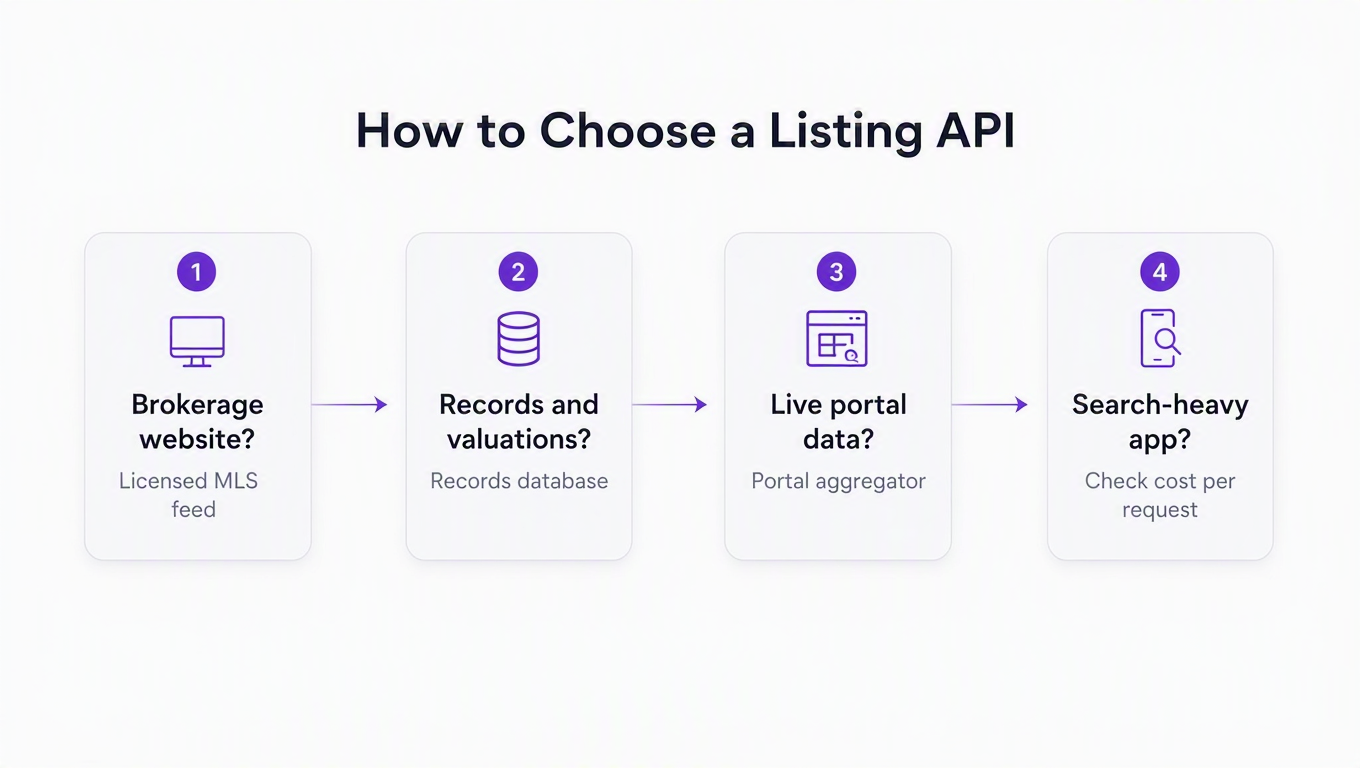
- Displaying listings on a consumer brokerage or agent site? You need a licensed feed. Bridge if you qualify and can wait; SimplyRETS if you want the fast lane and have MLS membership.
- Need US records, owner data, or valuations more than live listings? Records database. RentCast at indie and startup scale, ATTOM when procurement and legal are in the room.
- Need what buyers see right now, across portals or countries? Portal aggregator. That is RealtyAPI, and the free tier will tell you within an hour whether the data fits your product.
- Sanity-check the per-request math before committing. Entry tiers vary by almost two orders of magnitude ($0.001 to $0.074 per request among the published prices here), and a search-heavy product feels that difference immediately.
Key takeaways
- Decide the access model before the vendor. Aggregator, records database, or licensed feed determines legality, freshness, and cost more than any feature list does.
- There is no public Zillow API, and there has not been one for years. Official data means Bridge and MLS qualification; everything else is an aggregator or a scraper.
- Match freshness to the job. Live portal fetches for "what is on the market this morning"; daily-updated records for enrichment and valuations. Buying one when you need the other is the most common (and most expensive) mistake on this list.
- Read pricing pages like a health check. Published prices with a free tier mean you can validate before you commit. "Contact sales" means the validation happens after the contract.
- Compliance is a feature. If IDX display rules apply to you, only the licensed-feed column of the table above keeps you compliant, whatever the other columns cost.
The Zillow search earlier in this post cost exactly one credit, and the free tier includes 250 a month. That is enough to run this comparison against your own market before you pay anyone anything. Grab a key, open the docs, and point a search at your own ZIP code; if the data fits, the $20 plan will not slow you down, and if it does not, you found out for free.