Availability vs Reliability for APIs That Stay Fast
A listings search endpoint can show 99.9% uptime while users still report failed searches, stale availability, and pages that spin until they give up. The status check returns 200, the gateway is reachable, and the dashboard stays green. Yet a renter searching by destination, a broker checking coordinates, or an analyst requesting fresh market signals experiences the product as unreliable.
That gap is the practical difference between availability and reliability. Availability asks whether an API can be reached and fulfill a request at a given moment. Reliability asks whether it keeps fulfilling the right request, correctly and consistently, over time. Those questions lead to different monitoring, SLA, retry, redundancy, and capacity decisions. The RealtyAPI.io developer platform is one example of the kind of API workload where both properties matter, because a fast search response is useful only when the listing data is available and fit for the user's decision.
Introduction Why PropTech Teams Confuse Availability and Reliability
Consider a property marketplace during a busy search window. The API gateway is healthy, the application process is accepting connections, and the health endpoint responds. The listing index, however, is lagging behind the source data. Some searches return quickly with incomplete results, while others time out after a dependency becomes saturated. From an uptime perspective, the service is operating. From the customer's perspective, the search experience has failed in several different ways.
A second failure pattern is even harder to spot. The API returns successful responses, but a webhook is delayed, a price has not refreshed, or an availability check reflects an earlier state. No obvious outage appears in the status page. Users still make poor decisions, retry requests themselves, or assume the marketplace can't be trusted.
The operational question isn't only “Was the API up?” It's “Could the user complete the intended real estate workflow correctly and within an acceptable time?”
Treating the terms as synonyms creates bad engineering bets. A team may spend heavily on failover while ignoring recurring data errors. Another team may reduce individual outage duration with retries but leave the same dependency failure happening repeatedly. Both teams can improve a headline metric while leaving the user's pain unchanged.
This distinction affects three conversations. Monitoring must capture request success, latency, freshness, and correctness, not only host reachability. SLAs and SLOs must describe the service customers consume, including the relevant search or retrieval operation. Architecture must match the failure pattern, because redundancy, retries, caching, and capacity planning solve different problems.
The right choice also depends on the workload. Live listing search and market signals punish frequent short interruptions. A batch analytics process may tolerate a delayed run if it preserves complete and correct results. Lease processing and payment workflows introduce another priority, correctness over time, where an immediate but incorrect response is worse than a controlled delay.
What Availability and Reliability Actually Mean for APIs
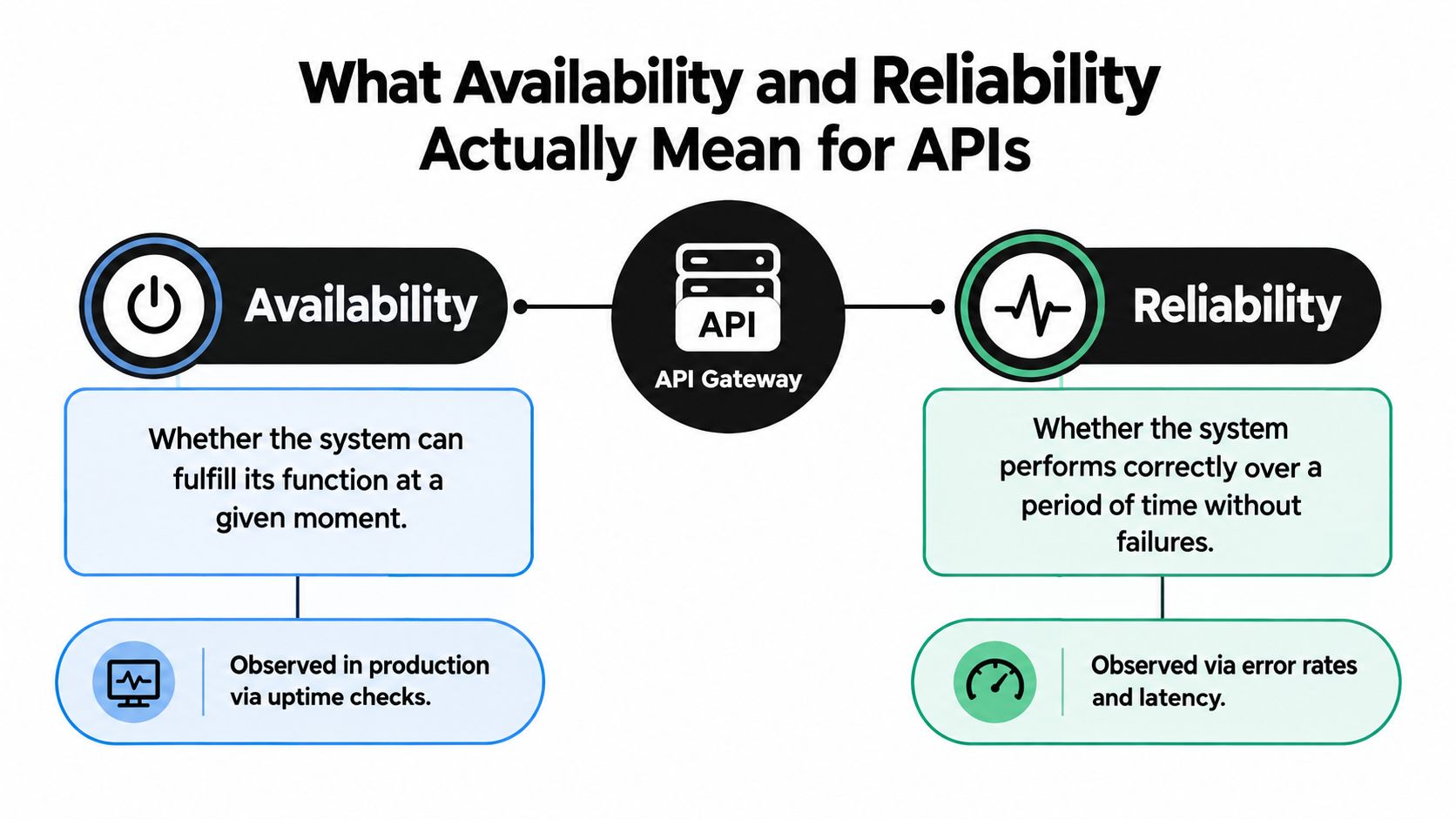
A listing search can return an HTTP success while showing stale inventory, incomplete results, or the wrong properties. The endpoint was available at that moment. The user's workflow was not necessarily reliable.
Availability measures whether a workload can be used at a given point in time. For a web API, that usually means a request reaches the service and receives an acceptable response. AWS defines availability as the percentage of time a workload is available for use. Request-based measurement can compare successful requests with total requests (AWS Well-Architected reliability guidance).
Reliability covers whether the system continues performing its intended function correctly over time and under expected conditions. It includes access, repeated faults, response speed, data freshness, processing completeness, and result correctness.
Availability answers whether the service is accessible now. Reliability answers whether it keeps doing the right thing consistently.
For PropTech APIs, the distinction changes what teams monitor and what they fix:
- Search by destination: Availability means the endpoint responds. Reliability means the results remain usable, query behavior stays correct, and responses arrive within the product's tolerance.
- Search by coordinates or place ID: Availability means the lookup completes. Reliability requires stable geospatial behavior and consistent handling of valid inputs.
- Search by URL: Availability means the API accepts and processes the URL. Reliability requires predictable extraction, correct normalization, and an understandable failure result.
- Listing details and availability: Availability means the record can be retrieved. Reliability also requires information that is current enough and internally consistent for the user's decision.
- Webhooks: Availability may show a healthy receiving endpoint while deliveries arrive late or more than once. Reliability requires observable delivery status and idempotent processing.
These properties lead to different operational choices. Redundancy and failover reduce the time a failure blocks requests. Validation, cache controls, dependency isolation, and safer retry policies reduce recurring or incorrect outcomes. A standby region can accept traffic after a primary failure, yet stale caches or an unsafe retry path can still return unreliable listings. Shorter outages do not automatically mean fewer failures or better data.
Define the intended function before choosing a target. A health check can confirm that infrastructure responds, while a synthetic transaction submits a listing search and checks the response's shape, freshness, and usability. Without that distinction, monitoring confirms that the front door is open but says little about whether customers can complete the search.
How to Measure Availability and Reliability With Nines and Error Budgets
A listing search can fail in two different ways. The API may reject requests for several minutes, or it may respond with slow, incomplete, or stale results for much longer. Nines measure the first problem more directly. Reliability measurement must also capture whether the response remains correct and useful.
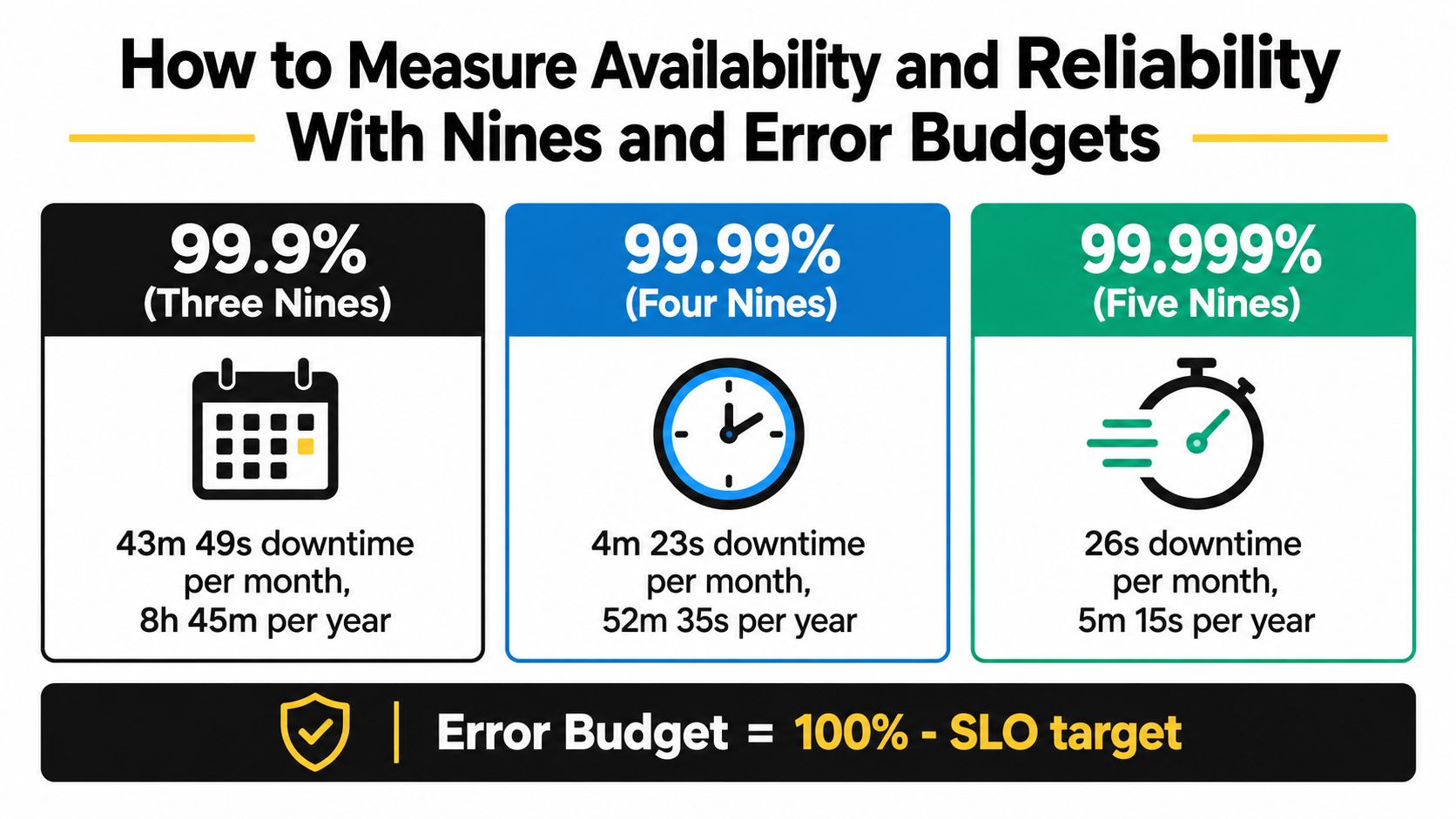
Teams express availability in nines, a compact uptime target that translates into permitted unavailability. Google's SRE guidance connects these targets with service-level objectives and error budgets (Google SRE guidance on embracing risk).
The practical budgets are:
- 99.9% availability: about 43.8 minutes per month, or nearly 8.76 hours per year.
- 99.99% availability: about 4.38 minutes per month, or about 52.6 minutes per year.
- 99.999% availability: about 26.3 seconds per month.
An extra nine removes much of the time available for deployment, recovery, and investigation. Google's material describes each additional nine as roughly an order-of-magnitude improvement toward complete availability, making the final step expensive and difficult (ACM article on SRE).
Measure the user-facing unit
Uptime checks show whether infrastructure responds. For an API, request-based measurement usually provides a better service signal. Calculate successful requests divided by total requests, then define success for each workflow. A search response that arrives too late for a user's session may count as an SLO failure even if it returns an HTTP success code.
Reliability requires more fields than an uptime ratio. Track whether listing responses have the expected structure, include required fields, meet freshness requirements, and avoid duplicate side effects after retries. For read-heavy search, result correctness and latency can matter more than the health of an individual process.
Error budgets turn these measurements into operating decisions. Google defines an error budget as 1 minus the service's SLO, so a 99.9% SLO creates a 0.1% budget for unavailability (Google SRE service best practices). Over a 30-day window, Google's example converts a 99.9% target into 43.2 minutes of permitted downtime. After the budget is consumed, pause risky releases, prioritize remediation, or defer a planned change.
Gateway errors belong in the same accounting. Teams investigating upstream latency and 504 responses can use this guide to prevent gateway timeouts on AWS, then attach the result to an SLI rather than handling each timeout as a separate ticket.
A public status page communicates aggregate availability. Internal dashboards should break it down by endpoint and show success rate, latency, error class, retry volume, and data-quality signals. RealtyAPI.io publishes operational information through its service status page, giving teams context when they evaluate an external data dependency.
Detailed Comparison of Availability and Reliability in Practice
The cleanest way to separate the two concepts is to ask what each metric can reveal and what it leaves hidden. Availability is a useful service-access measure. Reliability is a behavior-over-time measure that helps explain why customers may lose confidence even when availability remains high.
Availability vs Reliability at a Glance
| Criteria | Availability | Reliability |
|---|---|---|
| Definition | Whether the service is accessible and can fulfill its function at a point in time | Whether the service performs its intended function correctly and consistently over time |
| Typical unit | Uptime percentage or successful requests divided by total requests | Failure-free behavior, correctness, latency, freshness, durability, and recurring incident patterns |
| Strong signal | Outage duration and access failure | Repeated faults, incorrect results, degraded performance, and operational consistency |
| What it can hide | Failure frequency, event duration, slow responses, stale data, and partial failures | It requires explicit definitions of what “correct” means for each workflow |
| PropTech example | A search endpoint responds to requests | Search returns the expected listings, with acceptable latency and dependable data behavior |
| Main design response | Redundancy, failover, load balancing, and graceful degradation | Testing, idempotency, validation, observability, capacity planning, and root-cause removal |
| Business impact | Measures how long users may be unable to access a feature | Explains whether users can trust and complete the feature over time |
Availability alone gives no indication of how often failures occur or how long individual downtime events last, a distinction outlined in Fujitsu's availability FAQ (Fujitsu availability FAQ). Two services can report the same aggregate availability while creating very different experiences. One may suffer a single interruption. Another may fail repeatedly in short bursts during searches, causing clients to retry, abandon, and report a broken product.
Failure duration changes the remedy. A long regional interruption points toward redundancy, failover automation, dependency isolation, and recovery drills. Frequent short failures point toward a different investigation: connection pools, rate limits, deploy regressions, cache behavior, malformed upstream records, or a recurring source-system fault.
Failure frequency also changes the customer conversation. A brokerage's morning search may tolerate a planned degraded mode better than repeated unexplained errors. A payment or lease workflow may prefer a controlled refusal over an apparently successful response that writes inconsistent state.
Status codes help engineers classify the visible part of the problem, but they don't establish reliability by themselves. Teams should pair HTTP status code documentation with request traces, dependency context, latency thresholds, and outcome validation. A 200 response can still carry stale or incomplete data. A 429 can indicate healthy protection under demand, while a repeated 5xx pattern may expose a systemic reliability issue.
Real World Trade Offs and Use Cases for PropTech Platforms
A PropTech team shouldn't optimize availability and reliability in the abstract. It should identify the failure pattern users can tolerate, then spend engineering effort on the pattern they can't.
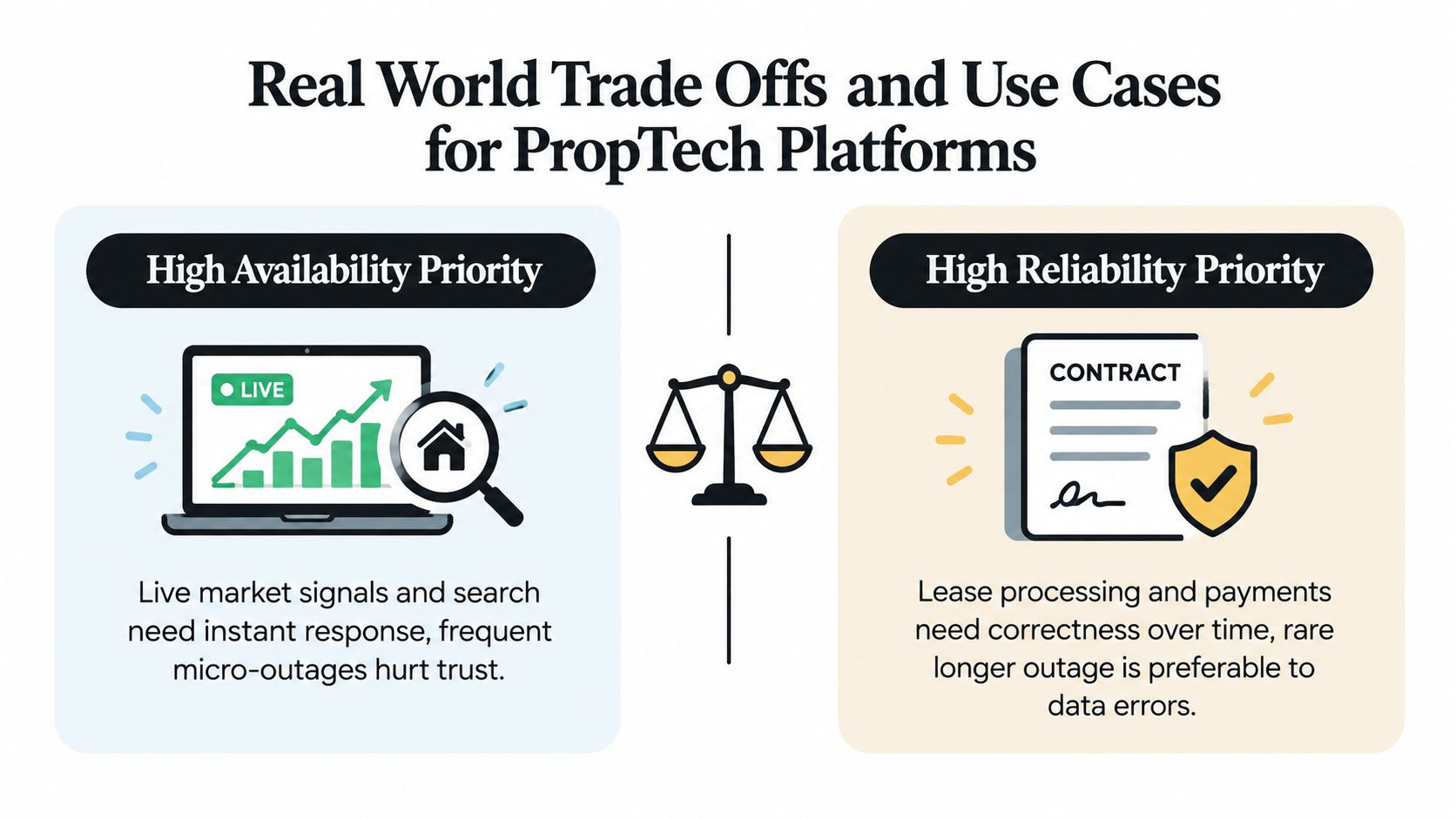
Live market signals and property search usually favor shorter failures and fast recovery. A user comparing listings expects an immediate response. Frequent micro-outages can be more damaging than a rare, clearly communicated interruption because they make the product feel unpredictable. Retries with exponential backoff, regional delivery, bounded timeouts, cached fallback results, and autoscaling can reduce the visible duration of transient dependency failures.
Lease processing, payments, and state-changing operations put more weight on correctness and consistency over time. A delayed transaction is frustrating. A duplicated charge, incorrectly applied lease state, or lost webhook is worse. These workflows need idempotency keys, durable queues, explicit reconciliation, and a safe failure response. A retry is only helpful when the operation can be repeated without creating a second side effect.
Capacity is part of reliability. NERC's 2026 reliability materials reported that conventional generator forced-outage rates rose to 9.2% in 2025, above the historical 7% to 8% range, while the bulk power system still performed reliably overall (NERC reliability reporting covered by Power Engineering). The lesson for platform teams is broader than electricity. Aggregate health can remain acceptable while the assets under peak stress become less available. Data-center demand and constrained capacity can turn a static uptime target into a planning problem involving headroom, graceful degradation, and demand shaping.
Decision matrix for the dominant pain
| Workload | User pain threshold | Prioritize | Useful design choices |
|---|---|---|---|
| Live listing search | Users notice short interruptions immediately | Shorter failures | Fast timeouts, intelligent retries, cached fallback, edge delivery |
| Market monitoring | Missing a signal can distort a decision | Fewer failures and freshness | Redundant ingestion, freshness checks, replayable events |
| Lease processing | Incorrect state creates operational and legal risk | Reliability and correctness | Idempotency, validation, durable queues, reconciliation |
| Payments | Duplicate or ambiguous outcomes are unacceptable | Correctness first, then recovery | Idempotent writes, clear transaction states, controlled retries |
| Nightly analytics | A delayed run may be acceptable if results are complete | Fewer failures | Checkpointing, replay, batch validation, dependency isolation |
Teams moving quickly with generated application code often build the happy path without the failure semantics. That makes resources about why vibe coding fails in production relevant to platform planning, especially where retries, partial failures, and data correctness need deliberate design.
Rate limits also shape the trade-off. A client that retries every failed search immediately can turn a small dependency problem into a larger saturation event. Define client behavior against the provider's rate-limit guidance, use jittered backoff, and distinguish retryable transport failures from permanent validation errors.
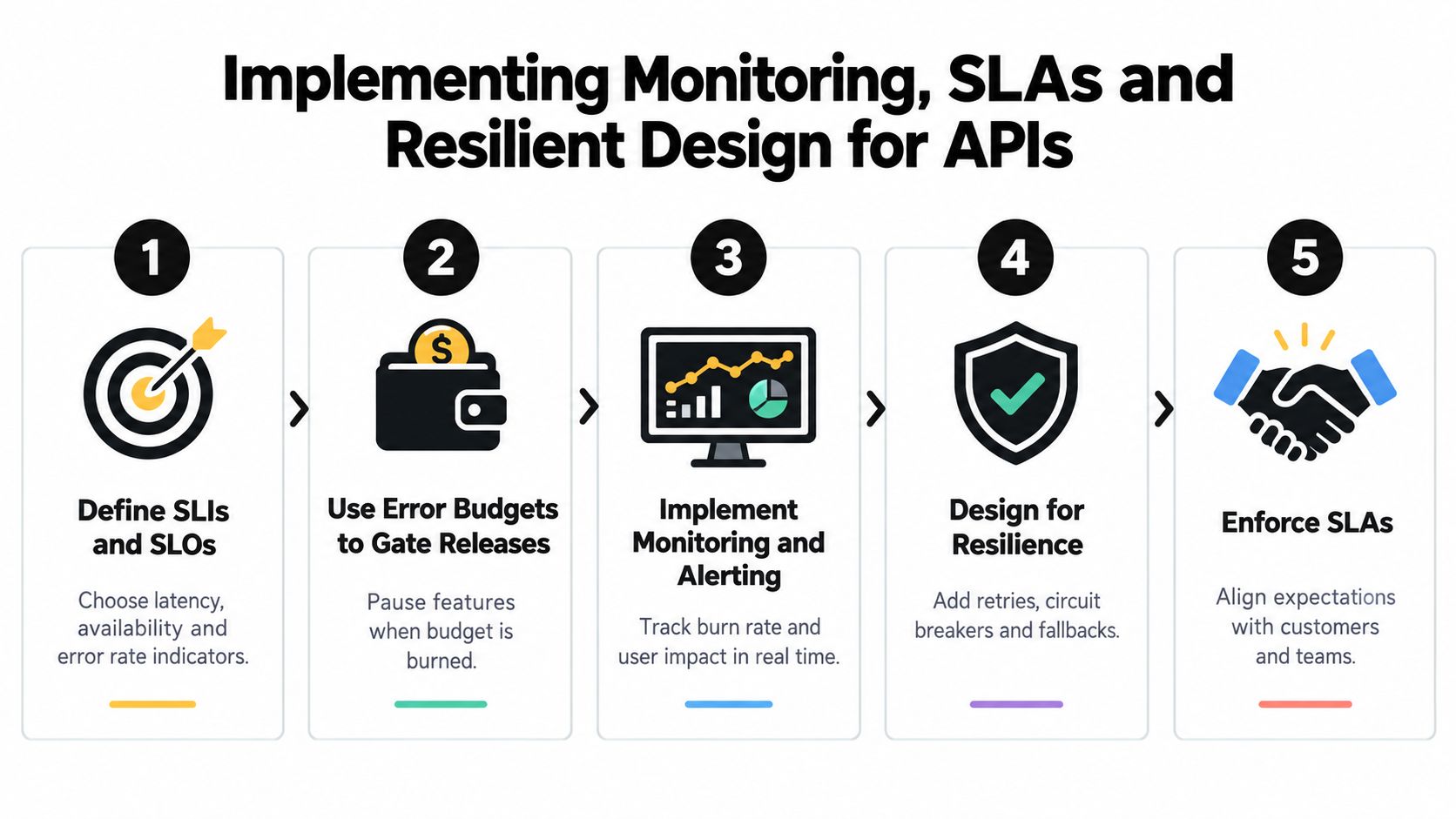
Implementing Monitoring SLAs and Resilient Design for APIs
Start with the user action, not the infrastructure component. For a search API, define an SLI around successful responses within an acceptable latency boundary. For listing data, add freshness and completeness signals. For webhooks, measure accepted, delivered, acknowledged, and reconciled events separately.
An operational checklist
- Define SLIs and SLOs. Choose indicators for availability, latency, error rate, freshness, and correctness. Keep the boundary explicit, so a fast
200response with invalid content doesn't pass unnoticed. - Use error budgets to govern releases. When the budget burns quickly, pause feature work and investigate. Don't let a green deployment pipeline override evidence that customers are experiencing failures.
- Alert on user impact and burn rate. Endpoint-level dashboards should separate search, detail retrieval, webhook delivery, and mutation traffic. Page on sustained customer impact, not every isolated retry.
- Design failure behavior deliberately. Use bounded retries with exponential backoff, circuit breakers for unhealthy dependencies, request deduplication, and fallbacks that don't misrepresent stale data as current.
- Test recovery. Inject dependency failures, exhaust connection pools in controlled environments, exercise regional failover, and replay webhook events. A documented failover that nobody has practiced is an assumption, not a capability.
- Write the SLA around the service consumed. State exclusions, measurement boundaries, response expectations, and what happens when the target is missed. Align the customer promise with the SLO engineering can observe.
REST, GraphQL, and webhook interfaces need different reliability checks. GraphQL should expose resolver-level failures rather than hiding partial results. REST clients need clear status handling and idempotent mutation behavior. Webhook consumers need durable receipt, replay support, and a way to identify duplicate delivery.
Infrastructure choices should support the product's growth and failure model. Guidance on modern digital platform strategies can help frame that broader platform conversation, but the implementation still depends on workload-specific SLIs and tested recovery paths.
A monitoring diagram is useful only when each visual step maps to an owner, alert, or runbook.
The following video provides additional context for designing dependable API operations:
Recommendations on When to Prioritize Availability or Reliability
A property search that fails during a rush can cost a user a listing. A lease or payment workflow that writes the wrong state can create a larger operational problem. Choose availability first for read-heavy experiences such as listing search, map discovery, and live market views, where users can safely retry. Keep requests bounded, fail quickly when dependencies degrade, retry only transient errors, and label fallback or stale results clearly.
Choose reliability first when the API changes durable state or supports a high-consequence decision. Payments, lease workflows, inventory commitments, and event processing require idempotency, validation, reconciliation, and explicit handling for duplicate or out-of-order events. A fast response that creates an incorrect state is a failure, not a reliability win.
Set the initial target from customer impact. AWS guidance uses different availability examples for internal tools and video delivery workloads, which shows why the target should match the consequence of an outage rather than prestige. Apply that reasoning to PropTech workloads. Do not buy or build another nine until the team can name the customer pain it removes. Google's SRE material also makes the trade-off clear: each additional nine demands a sharper improvement toward full availability, while engineering and operating costs rise.
Use this decision sequence:
- Identify the workflow users cannot complete.
- Separate access failure, slow response, stale data, and incorrect state.
- Set an availability SLO and reliability indicators for silent failure.
- Assign an error-budget owner and release policy.
- Test recovery before promising it to customers.
- Review recurring incidents, not aggregate uptime alone.
Availability gets users into the product. Reliability determines whether they trust the listings, prices, and transactions they encounter.
RealtyAPI.io provides a real estate data layer with REST, GraphQL, and webhooks, plus global delivery, auto-scaling, and retry-oriented infrastructure for listing and market-data workloads. Review the platform and visit RealtyAPI.io to assess its API capabilities against your availability targets, reliability checks, and recovery design.