7 API Documentation Examples to Study in 2026

Great API documentation is an integration experience, not merely a reference page. The strongest API documentation examples make the first successful request obvious, then keep developers productive when authentication, pagination, webhooks, validation, or production failures complicate the path. That matters because a controlled REST documentation study found that examples improved task success, reduced mistakes, shortened completion time, and increased developer satisfaction, especially when examples showed request structure, required headers, data formats, and payloads at the point of use (controlled study of REST API documentation).
This list examines seven documentation models through the developer problems they solve. The comparison focuses on first-success speed, endpoint clarity, authentication, pagination, error handling, complete request and response samples, webhook guidance, interactive tooling, and code coverage. It also translates the strongest patterns into a reusable RealtyAPI blueprint for REST, GraphQL, webhooks, real estate search, market signals, and multi-language integrations. For broader planning guidance, see this API documentation guide.
1. RealtyAPI.io
RealtyAPI.io is the strongest model here when the developer problem is fragmented real estate data. Instead of forcing a team to integrate separate providers for listings, rentals, and market signals, the platform presents a unified data layer built around publicly available sources across major real estate and travel platforms. That makes the documentation challenge less about explaining one endpoint and more about showing how developers can move from a property search to a production workflow.
The useful pattern is breadth with an obvious first action. A developer should be able to authenticate, search by destination, coordinates, place ID, or URL, inspect a complete property response, and then choose REST, GraphQL, or webhooks without reconstructing the platform's model from scattered pages. RealtyAPI's introduction documentation should sit near that first-success path, with authentication, request parameters, response schemas, pagination behavior, and common failure cases linked directly from each endpoint.
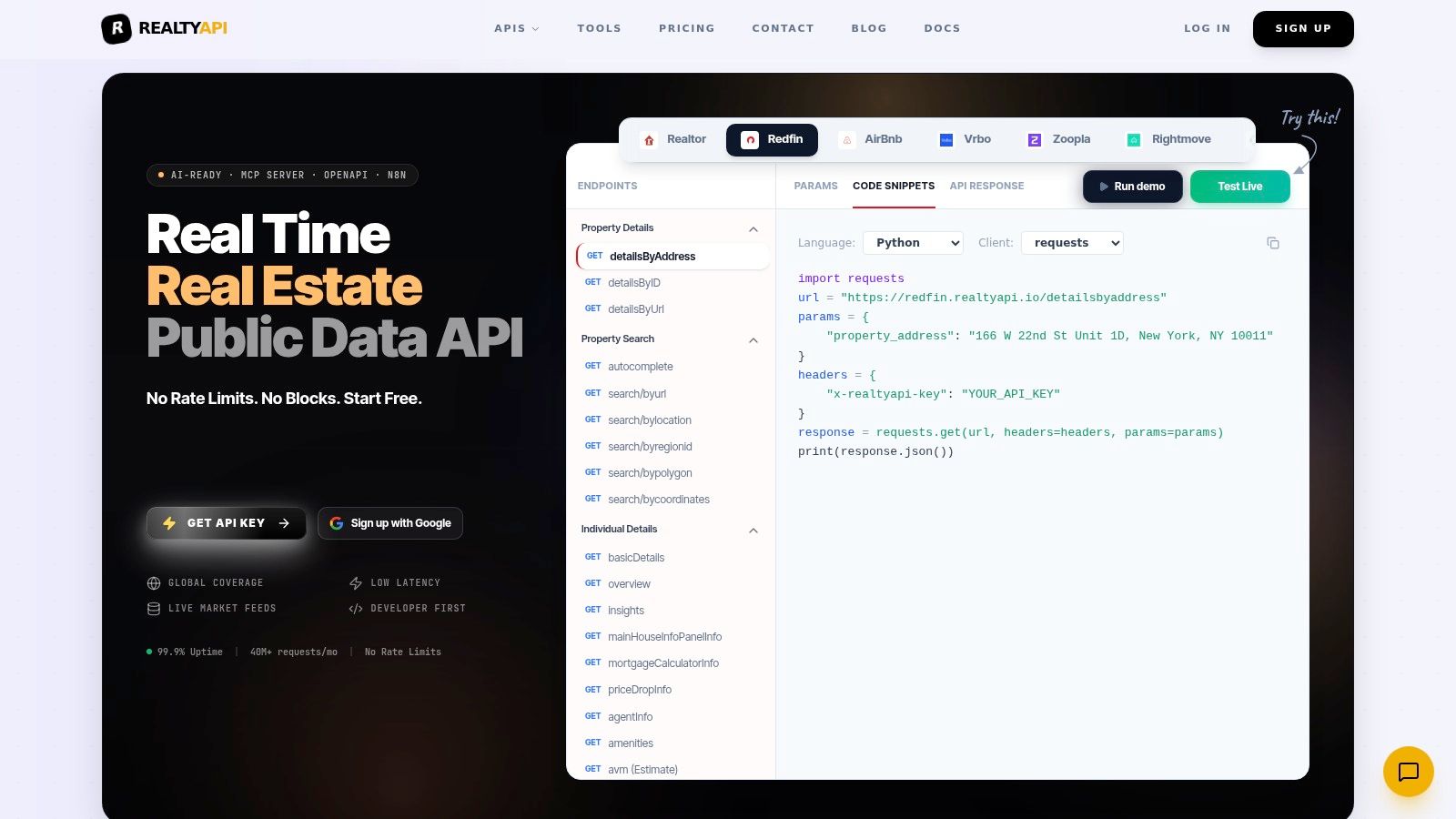
What RealtyAPI gets right
RealtyAPI combines several patterns that usually appear separately:
- Multiple integration surfaces: REST, GraphQL, and webhooks let developers choose request-response, flexible querying, or event-driven workflows.
- Executable examples: Copy-ready snippets in Python, JavaScript, Go, PHP, and other languages reduce translation work.
- Interactive validation: An in-browser playground lets developers test an endpoint, inspect a real response, and generate code from the same request.
- Operational context: OpenAPI specifications, usage analytics, team access, and dashboard support help teams move beyond experimentation.
- Production-oriented infrastructure: Global edge delivery, automatic scaling, retries with exponential backoff, and IP rotation address reliability concerns that surface after the first prototype.
The platform also presents a transparent commercial model. The Free tier includes 250 requests per month for testing, Pro is $49 per month for 20,000 requests, Ultra is $99 per month for 85,000 requests, and Mega is $399 per month for 500,000 requests, with documented overage rates. Pay-as-you-go credits start at $0.005 per request and don't expire. These figures come from the RealtyAPI plan notes supplied for this comparison.
Practical rule: Every RealtyAPI endpoint should show the smallest valid request, a realistic property response, the fields developers usually map, and at least one failure response beside the copy button.
The trade-off is equally important to document. Complex endpoints can count as more than one request, so usage pages should explain request accounting before a team designs high-volume collection jobs. Public-source coverage also won't replace proprietary MLS or behind-login datasets. Clear limitations make the examples more trustworthy, not less useful.
2. Stripe
Stripe documents the work that happens after an API call succeeds. Payment integrations involve idempotency, test environments, webhook delivery, retries, error types, and state changes that may occur after the original request. Those operational details determine whether an integration survives production conditions.
The Stripe documentation keeps these details close to the reference material. Developers can move from explanations to requests, responses, and language-specific code without relearning the page layout for each resource. Copy-ready cURL and official SDK examples support implementation, while separate guidance addresses test keys, test cards, test clocks, webhooks, and troubleshooting.
Document the full state transition
Stripe's strongest pattern is lifecycle coverage. A parameter reference alone cannot prepare developers for duplicate requests, asynchronous events, or failures that can be retried. A useful page shows the initial request, the resulting state, the events that follow, and the action the application should take.
For RealtyAPI, that model can connect a property search to pagination and then to monitoring through a webhook. Each example should identify the returned fields, possible state changes, and next request. A practical blueprint includes:
- Authentication: Show where the API key belongs and explain server-side use versus client-side exposure.
- Request construction: Include required query parameters, filters, coordinates, and URL encoding.
- Response mapping: Identify stable identifiers, listing attributes, availability, pricing, and source metadata.
- Failure recovery: Document authentication failures, invalid filters, unavailable records, transient upstream errors, and usage-related responses.
- Webhook handling: Show signature validation, event parsing, acknowledgement, retries, and deduplication.
The RealtyAPI OpenAPI integration documentation can provide the source-of-truth layer for this approach. Generated references and hand-written guides must agree. If a generated example omits a header or a guide describes a field absent from the schema, developers lose confidence quickly. The same contract should support REST references, GraphQL explanations where applicable, and multi-language snippets without hiding important request or response details.
Stripe's trade-off is discoverability. Its breadth can overwhelm newcomers, and the navigation takes practice. RealtyAPI can retain consistent page anatomy while reducing that initial load: put the shortest working path first, then place pagination, webhooks, errors, and advanced workflows in focused guides. An equally important trade-off to document is operational cost. Examples should show which calls consume usage and which workflows may require additional requests, so teams can design collection jobs with realistic expectations.
3. Twilio
Twilio's documentation solves the first-success problem particularly well. Communications products are easy to describe abstractly but much more useful when a developer can send a message, receive a callback, or make a call with a complete runnable example.
The Twilio documentation organizes quickstarts around product-specific outcomes. A developer working on SMS doesn't need to begin with the entire communications platform. They need prerequisites, credentials, a complete request, a response or callback, and the next step after the first successful delivery.
Build around a working outcome
Twilio's language-selectable quickstarts show why snippets need more than syntax. Each example should identify the runtime assumptions, required credentials, installation step, and expected result. Open-source SDKs and sample applications reinforce the documentation because developers can inspect a working implementation instead of copying an isolated line.
That structure maps neatly to RealtyAPI use cases:
- Search properties: Provide a complete request using a destination or coordinate input.
- Render results: Show how to select listing identifiers, titles, locations, prices, amenities, and media.
- Continue through pages: Demonstrate the exact pagination fields and the next request.
- Monitor changes: Show webhook registration, event payloads, and receiver behavior.
- Handle failure: Explain which errors require correcting the request and which justify a retry.
Twilio also documents practical webhook work, including local testing patterns and request validation. RealtyAPI's examples should do the same for property and market events. A webhook page that shows only an event JSON object isn't enough. Developers need the receiver route, authentication or signature checks, response status, retry behavior, and a safe way to replay an event during development.
The trade-off is that Twilio's product breadth can send users across pricing pages, product references, and destination-specific messaging rules. RealtyAPI can reduce that friction by placing endpoint-level usage notes beside examples and linking directly to request accounting where complex operations use more than one request.
The RealtyAPI API playground is the right complement to Twilio's quickstart model. A runnable example gives developers a known baseline. An interactive playground lets them change a location, filter, or pagination value and immediately see how the response changes.
4. Slack
Slack's documentation addresses a problem ordinary REST references often leave unresolved: developers must design payloads whose output people can see and use. Block Kit messages require layout choices, visual checks, and confirmation that interactive elements behave as intended. The Slack API documentation connects the Block Kit Builder with detailed block and element references, shortening the cycle from payload edit to rendered result. Its Web API method catalog then documents authentication, request structure, responses, and method-specific behavior.
That visual workflow translates directly to real estate products. A RealtyAPI response may become a listing card, map marker, comparison table, availability calendar, or analytics view. Documentation should annotate the response rather than merely display JSON, showing which fields drive each interface decision.
- Listing cards: Identify fields for title, price, image, location, and property type.
- Map results: Explain coordinates, place identifiers, and display precision.
- Availability views: Show date inputs, occupancy fields, and empty-result behavior.
- Comparison screens: Demonstrate stable identifiers and normalized attributes.
- Monitoring interfaces: Connect webhook events to changed listing or market fields.
Slack's support for HTTP and Socket Mode also separates transport from payload definition. RealtyAPI documentation should apply the same boundary. REST requests, GraphQL queries, and webhook delivery need distinct examples, while shared schemas and event fields remain linked. A developer should be able to move from an endpoint to its authentication method, response shape, or related event without losing the workflow.
The trade-off is navigation. Slack's historical and current material can be divided between api.slack.com and docs.slack.dev, so readers may lose context between pages. RealtyAPI can keep each workflow coherent by placing those connections beside the relevant request and response examples.
Usage constraints belong beside the operation that creates traffic. Link collection endpoints and monitoring guides to the RealtyAPI rate limits documentation, then show how pagination, polling, batching, and webhook adoption affect request volume. That placement lets developers choose an implementation with its operational cost visible, rather than discovering limits after an integration is already built.
5. Plaid
Plaid solves the trust problem in security-sensitive integrations by making safe testing part of the primary workflow. Its documentation places sandbox access, environment separation, token handling, and webhook behavior alongside setup instructions. Developers can test the integration before sending production traffic and see how the API responds under controlled conditions.
The Plaid documentation combines a guided Quickstart, product-specific references, a Postman collection, and a Sandbox with programmable tokens and mock user data. The strength is the connection between explanation and execution. A team can inspect a request, run it with test data, and compare the response with the documented flow.
For RealtyAPI, the same approach should support property-data workflows. Separate test credentials from production credentials, state which responses are representative, and identify fields that can change as listings and market signals change. An empty search result should have an interpretable outcome: an invalid filter, no matching inventory, or a temporary upstream condition.
A useful example path can be organized around five checks:
- Environment guidance: Show where credentials belong and which requests are safe from browser, server, or worker contexts.
- Deterministic inputs: Use stable destinations, coordinates, or identifiers so examples produce results developers can reproduce.
- Expected responses: Display realistic property objects while clarifying that live market data can change.
- Webhook testing: Document how to trigger, inspect, acknowledge, and replay events.
- Production transition: List the settings, limits, logging practices, and monitoring steps that change before launch.
Secret handling deserves the same treatment. Code samples should read credentials from environment variables, never hard-code them, and identify which token belongs in each request. This matters for RealtyAPI integrations that combine server-side searches, scheduled analytics, and event consumers. The documentation should also connect REST, GraphQL, and webhook examples to shared authentication and error guidance, so developers can test the full workflow rather than one isolated call.
Plaid also shows a trade-off in separating technical documentation from pricing and commercial terms. Separate billing material keeps reference pages focused, but evaluators still need a clear route from technical trial to cost estimation. RealtyAPI can provide that route by explaining request counting for complex endpoints beside examples that involve collection volume, pagination, polling, or webhook delivery.
6. Algolia
Algolia addresses the full search workflow, from indexing records to presenting results in a usable interface. Its documentation connects indexing, querying, API-key security, SDK selection, and frontend implementation, so developers can understand how each part supports a working search experience.
The Algolia documentation combines quickstarts with language-specific guides. Developers can create an initial index, choose a library for web, mobile, or backend work, and continue toward an InstantSearch interface. Its security material also distinguishes API keys by their intended use, which prevents a common implementation mistake: placing a sensitive credential in client-side code.
Follow one property-search workflow
RealtyAPI documentation can apply the same end-to-end logic. Start with a concrete developer task, then show the decisions that connect input to product behavior:
- Select the input: Search by destination, coordinates, place ID, or URL.
- Send the request: Show the endpoint, authentication, filters, sorting, and pagination parameters.
- Use the response: Mark fields needed for cards, maps, filters, analytics, and saved searches.
- Render safely: Include a small frontend example while keeping private credentials on the server.
- Operate the integration: Document usage analytics, retries, errors, and webhook monitoring.
A connected example is more useful than isolated snippets. A marketplace developer needs to see how a property response becomes a search result. An investment analyst may need historical or market signals instead. A short-term rental platform may require availability, reviews, host information, and event handling. Separate workflows should reflect those jobs rather than forcing every reader through the same endpoint sequence.
Algolia also exposes a navigation trade-off. Search, Recommend, and Insights may live in separate documentation areas even when one product workflow uses all three. RealtyAPI should keep REST, GraphQL, and webhooks clearly separated, then connect them through shared use-case guides. That structure preserves transport-specific detail without hiding the complete workflow.
Code coverage needs the same consistency. RealtyAPI examples should provide copy-ready Python, JavaScript, Go, and PHP, with cURL as a neutral reference. Each language should send the same request and show the same response, allowing developers to compare syntax without comparing different behaviors.
7. Mapbox
Mapbox solves the tweak-and-see problem. Geospatial APIs are difficult to evaluate through prose because coordinates, styles, tiles, routes, and rendering produce visual outcomes. The Mapbox documentation combines interactive playgrounds, live request and response views, map previews, tutorials, and copy-ready GL JS examples.
That feedback loop lets developers change an input, inspect the payload, and see the result before building a separate application. Its product boundaries also reduce confusion. Tiling, rendering, styles, navigation, and client-side libraries use different concepts, so the documentation keeps them distinguishable.
Make real estate data inspectable
For RealtyAPI, the strongest adaptation is a visual test bench connected to actual data examples. A developer should be able to:
- Change location inputs: Compare a destination, coordinate pair, or place ID and see how each affects the search.
- Inspect result maps: Plot returned coordinates and identify the fields needed for markers.
- Adjust filters: Modify property type, price-related criteria, dates, or occupancy inputs, then inspect the resulting payload.
- Follow pagination: Show the current page, continuation data, and the request needed to retrieve more results.
- Connect webhooks: Display an event payload beside the property or market record it updates.
The playground must expose the raw HTTP request. Pair the request, response, headers, parameters, and generated code in one view so developers can see what a production client will send. A visual preview without that detail creates a polished demo, not usable documentation.
Usage rules need the same clarity. Different Mapbox features can use different meters, which makes costs difficult to estimate. RealtyAPI should explain how simple and complex endpoints count toward usage and show realistic volume scenarios qualitatively. The playground should also label whether it uses live data, cached examples, or controlled fixtures. That distinction affects testing for availability, prices, and market signals that change over time.
The documentation example benchmark reports that enriched Java SE examples illustrated 3.35 times as many API types and Android examples illustrated 5.76 times as many API types. Developers also completed 23.81% more programming tasks and finished 9.43% faster than with raw documentation (API documentation examples benchmark). The practical takeaway is clear: RealtyAPI's blueprint should make REST, GraphQL, webhooks, authentication, pagination, errors, requests, responses, and multi-language snippets executable and verifiable, not merely readable.
API Documentation Comparison, 7 Platforms
| Product | Implementation Complexity 🔄 | Resource Requirements ⚡ | Expected Outcomes 📊 | Ideal Use Cases | Key Advantages ⭐ | Tips 💡 |
|---|---|---|---|---|---|---|
| RealtyAPI.io | Moderate→High, REST/GraphQL/webhooks, some complex multi-request endpoints | Medium, tiered plans or pay-as-you-go; scales to high traffic | Real-time global listings, sub‑second avg latency, high availability | PropTech, marketplaces, analytics, rental platforms | ⭐ Unified 27+ source coverage; production-ready infra; developer tooling | 💡 Size plan for query complexity; monitor request counts |
| Stripe | High, stateful payments, webhooks, idempotency patterns | Medium, server SDKs, test environments, operational monitoring | Reliable payment flows, clear error handling and retry guidance | Payments, subscriptions, billing orchestration | ⭐ Comprehensive docs, multi-language samples, test tooling | 💡 Use test keys/clocks; study error taxonomy before prod |
| Twilio | Low→Moderate, concise refs and language quickstarts, webhook patterns | Low, SDKs, local testing tools (ngrok); per-message/call costs | Fast time‑to‑first‑success for comms workflows | SMS, voice, verification, notification systems | ⭐ Runnable quickstarts, open-source SDKs and samples | 💡 Cross-check pricing by destination/channel |
| Slack | Moderate, UI-rich Block Kit plus event delivery and auth | Medium, dev tools and workspace limits for testing | Interactive messages/apps with visual prototyping | Chat apps, interactive bots, rich message layouts | ⭐ Block Kit Builder + clear separation of UI vs API | 💡 Docs split across domains; watch free workspace limits |
| Plaid | Moderate, security-focused flows, env separation, robust Sandbox | Medium, Sandbox tokens, test data; regulatory considerations | Safer fintech integrations with realistic Sandbox testing | Banking integrations, secure data flows, fintech apps | ⭐ Programmable Sandbox and clear environment handling | 💡 Use Sandbox for realism; review product-specific pricing |
| Algolia | Low→Moderate, SDKs and opinionated quickstarts for search UIs | Low→Medium, indexing costs and plan choices; many SDKs | Rapid search setup from indexing to UI with clear key guidance | Site search, InstantSearch UIs, recommendations | ⭐ Broad SDK coverage and end‑to‑end examples | 💡 Map features across Search/Recommend/Insights sections |
| Mapbox | Moderate, geospatial APIs, GL JS samples, interactive playgrounds | Medium, multiple meters (tiles, MAUs); preview tooling | Tweakable, visual map experiences with live request previews | Mapping, routing, map rendering and visualization | ⭐ API playgrounds with live previews and GL JS gallery | 💡 Cost modeling is multi-meter, plan per product usage |
Turn These Patterns Into Documentation Developers Trust
The seven models point to a consistent blueprint. Start with a runnable quickstart, not a conceptual essay. The first path should take a developer from an API key to a meaningful property response, using a complete request, required headers, realistic parameters, and an annotated response.
Then separate the documentation by developer task. A REST reference should make endpoint lookup fast. A GraphQL guide should explain schema discovery, queries, variables, fragments, pagination, and error responses. A webhook guide should cover event registration, delivery, validation, acknowledgement, retries, replay, and deduplication. These workflows share data models, but they don't share the same debugging process.
Authentication belongs near every example that requires it. Show the credential location, explain server-side handling, and include the response developers receive when authentication fails. Pagination needs equal treatment. A collection example should identify the page size, continuation mechanism, empty-result behavior, and the exact next request, rather than sending developers to a distant generic page.
Errors should be as concrete as success cases. Include realistic validation, authorization, not-found, transient, and usage-related responses where they apply. Explain recovery in plain language. Developers need to know whether to correct a parameter, refresh credentials, wait and retry, follow a continuation link, or contact support.
A practical RealtyAPI review
Before publishing or revising the docs, verify that:
- The quickstart runs: A new developer can copy the request after adding credentials and understand the expected response.
- Endpoint templates are complete: Each page includes method, URL, authentication, headers, parameters, request body, response body, status codes, and edge cases.
- Transport models are distinct: REST, GraphQL, and webhooks have separate examples and troubleshooting paths.
- Pagination is visible: Collection responses show how to request the next page and how to stop safely.
- Code samples agree: Python, JavaScript, Go, and PHP snippets perform the same operation as the cURL example.
- Examples stay current: OpenAPI schemas, generated snippets, contract tests, changelogs, and deprecation notices are updated together.
- Interactive content remains accessible: Playground users can inspect the underlying request and response, not only a visual result.
- Production trade-offs are explicit: Public-source coverage, complex request counting, live-data variability, retries, and usage monitoring are documented where decisions happen.
Teams can also improve adoption by adding demo embeds to their site, especially for interactive search, map, and webhook workflows. The aim isn't to make every page busy. It's to remove the questions that otherwise force developers to inspect network traffic, guess at payloads, or open support tickets.
A 2017 Cisco case study found that 55% of surveyed developers used code examples and 34% experimented with an API in a live environment, reinforcing the role of executable examples in API learning workflows (Cisco case study on automated example-driven REST API documentation). More recently, a REST API usability study reported that 14 of 16 interviewees actively used internal or public guidelines and identified inadequate API documentation as the most severe obstacle when learning a new API (REST API usability study). For RealtyAPI, the implication is direct. Documentation should help developers succeed before they need help, then give them enough operational detail to keep that integration reliable.
RealtyAPI.io provides a unified, developer-first layer for publicly available real estate listings, pricing trends, and live market signals through REST, GraphQL, and webhooks. Use its runnable examples, playground, OpenAPI resources, and multi-language snippets to turn the documentation patterns in this guide into a working property search or monitoring integration, then visit RealtyAPI.io to get started.