Accessibility Benefits in Real Estate: A 2026 Guide
Up to four times more people can benefit from accessible real estate features than originally intended, and accessible listings can improve AI processing efficiency by up to 99%. Accessibility is therefore not just an accommodation or compliance task, but a commercial and technical performance lever.
A property search platform may be designed for a narrow user profile: someone who can scan dense pages quickly, interpret ambiguous amenity labels, operate complex filters, and use a mouse without difficulty. Yet the same platform can serve a much broader audience when it presents information clearly, supports different ways of moving through the interface, and exposes relevant accessibility attributes.
That shift changes the business calculation. Accessibility benefits aren't limited to helping a small group complete a search. They can expand the audience a listing reaches, improve the quality of property data, reduce friction during discovery, and make content easier for both people and automated systems to understand.
Why Accessibility Benefits Are Transforming Real Estate

Accessibility is a performance strategy for property platforms. Step-free access, clear room descriptions, readable contrast, and structured amenity data can help a person with a disability assess a property while also serving older users, parents with strollers, travelers carrying luggage, and buyers comparing homes under time pressure.
Inclusive design can reach up to four times the intended audience, according to the Centre for Inclusive Design report on the economic impact of inclusive design. That figure does not mean every accessible listing will generate four times as many enquiries. It shows that defining a product around a narrow user profile can conceal substantial addressable demand.
A property platform also affects the cost of decision-making. Consider a buyer searching for an apartment. If the listing says only “accessible,” the buyer must contact the agent to confirm whether it has a lift, step-free entry, sufficient doorway width, or an adapted bathroom. If the platform stores and displays those attributes separately, the buyer can filter the inventory before making contact. The result is a closer match between stated requirements and presented properties, with fewer avoidable enquiries for agents.
The overlooked multiplier
Structured accessibility information can also support venue maps, building directories, and property discovery interfaces. Teams creating these experiences can apply guidance from venue navigation for Mappedin to connect physical access details with digital directions.
The commercial effect extends beyond property search. The Centre for Inclusive Design report estimates that improved accessibility across education, financial services, and retail could generate 228,000 additional tertiary qualifications, improve financial capacity for more than 830,000 people, and increase Australian retail revenue by about A$4 billion annually. These figures describe Australia and broader sectors, so they do not predict a real estate result. They do show how access improvements can increase participation and economic activity at scale.
Real estate platforms gain value when accessibility becomes shared infrastructure. Detailed attributes help people assess homes, give search engines and recommendation systems clearer signals, and provide AI agents with cleaner inputs. Implementation therefore connects an inclusion objective to measurable product outcomes: broader reach, better matching, fewer clarification requests, and information that machines can process more reliably.
Understanding What Accessibility Attributes Mean for Listings
Accessibility attributes are specific, searchable facts about how a person can use or enter a property, not a generic badge attached to a listing. Mobility attributes might include step-free entry, lift access, doorway width, accessible parking, or bathroom adaptations. Visual and auditory attributes can include high-contrast interfaces, audio descriptions, captions, visual alarms, or clearly presented signage. Cognitive attributes may involve simpler instructions, predictable page structure, plain-language descriptions, and reduced information overload.
The data model matters because a single label hides important distinctions. “Wheelchair accessible” doesn't tell a user whether every room is reachable, whether the entrance is level, or whether the bathroom supports their needs. A structured schema can preserve each relevant field and show whether the information is confirmed, unavailable, or supplied by a listing owner.
From database field to decision support
A platform should expose attributes at three layers:
- Storage: Keep normalized values in the property record, rather than burying them in free-text descriptions.
- Discovery: Allow users to filter, sort, and compare properties using the attributes that affect their search.
- Presentation: Explain each attribute in plain language, with enough context for a user to decide whether to enquire.
An API response can distinguish between “step-free entrance,” “entrance includes ramp,” and “entrance accessibility unknown.” That distinction protects users from false certainty and gives operators a clear data-quality target. Developers building accommodation search can also examine accessibility filtering for rental data as a practical example of exposing these fields programmatically.
Why structure improves machine interpretation
Structured accessibility data helps machines identify relationships that are difficult to infer from prose. A crawler or recommendation engine can distinguish an accessible entrance from an accessible bathroom when the data uses consistent field names and values. A human user benefits from the same clarity because the interface can present relevant facts without forcing them to interpret marketing language.
A useful taxonomy should be specific enough to support filtering but simple enough for agents and listing teams to maintain. It should also preserve uncertainty. If an attribute hasn't been verified, the system should say so instead of converting an incomplete record into a confident claim.
The result is better listing intelligence. Accessibility stops being a hidden note in a back-office database and becomes a meaningful part of search relevance, comparison, and enquiry qualification.
Expanding Market Reach Through Inclusive Design
Inclusive design creates commercial value when it improves the path from property discovery to qualified enquiry. For a real estate platform, the relevant question is not how many visitors identify as disabled. It is how effectively accessibility information helps people decide whether a listing fits their circumstances, then take the next step.
The Centre for Inclusive Design finding cited earlier points to a broader audience for products designed around excluded users. This section focuses on the commercial mechanism behind that reach: clearer requirements, more useful filters, and less wasted effort for both prospects and agents.
Turn accessibility data into funnel signals
Accessibility attributes can influence several stages of the funnel. A visitor who can filter for step-free entry, lift access, or suitable amenities may review fewer irrelevant listings. That reduces search friction and gives the platform a stronger basis for presenting relevant properties. An agent then receives an enquiry with clearer intent and better information about the user's requirements.
The value should be measured rather than assumed. Useful comparisons include:
- Filter usage for accessibility-related attributes.
- Listing views after an accessibility filter is applied.
- Enquiry rates from filtered and unfiltered sessions.
- The proportion of enquiries that meet the property's stated characteristics.
- Time spent by agents clarifying information already requested by the prospect.
These measures connect implementation to revenue without claiming that accessibility alone causes every improvement. Results will vary with inventory, property type, geography, data completeness, and user intent.
A structured source such as apartment details and amenities data can support this measurement by keeping amenity fields available for search, comparison, and reporting. The platform can identify which attributes users request, which listings satisfy those requirements, and where missing information prevents a confident match.
Better matching reduces avoidable cost
The commercial gain is not limited to additional demand. Detailed accessibility information can reduce unproductive enquiries, repeated clarification, and unsuitable viewings. It can also reveal where listing teams need better verification or where property owners should add information before publishing.
The timing of implementation affects the cost of achieving those gains. Adding accessibility fields during schema design is generally simpler than reconstructing them after listings, filters, reporting, and search flows depend on inconsistent labels. Early structure also makes later experiments easier because teams can compare the effect of individual attributes instead of treating accessibility as one undifferentiated label.
An industry-cited 2020 study reported a 28% revenue increase among companies improving product accessibility, according to the World Economic Forum's coverage of inclusive product design. The same coverage links earlier attention to accessibility with lower retrofit costs. For real estate platforms, that supports a practical sequencing decision: capture the relevant facts before building the experiences that depend on them.
Inclusive design therefore functions as a performance multiplier. It gives mainstream users clearer decision support, helps operators spend time on better-matched prospects, and creates measurable points between data quality, filter behaviour, enquiries, and revenue.
How Developers Can Surface Accessibility Attributes Effectively
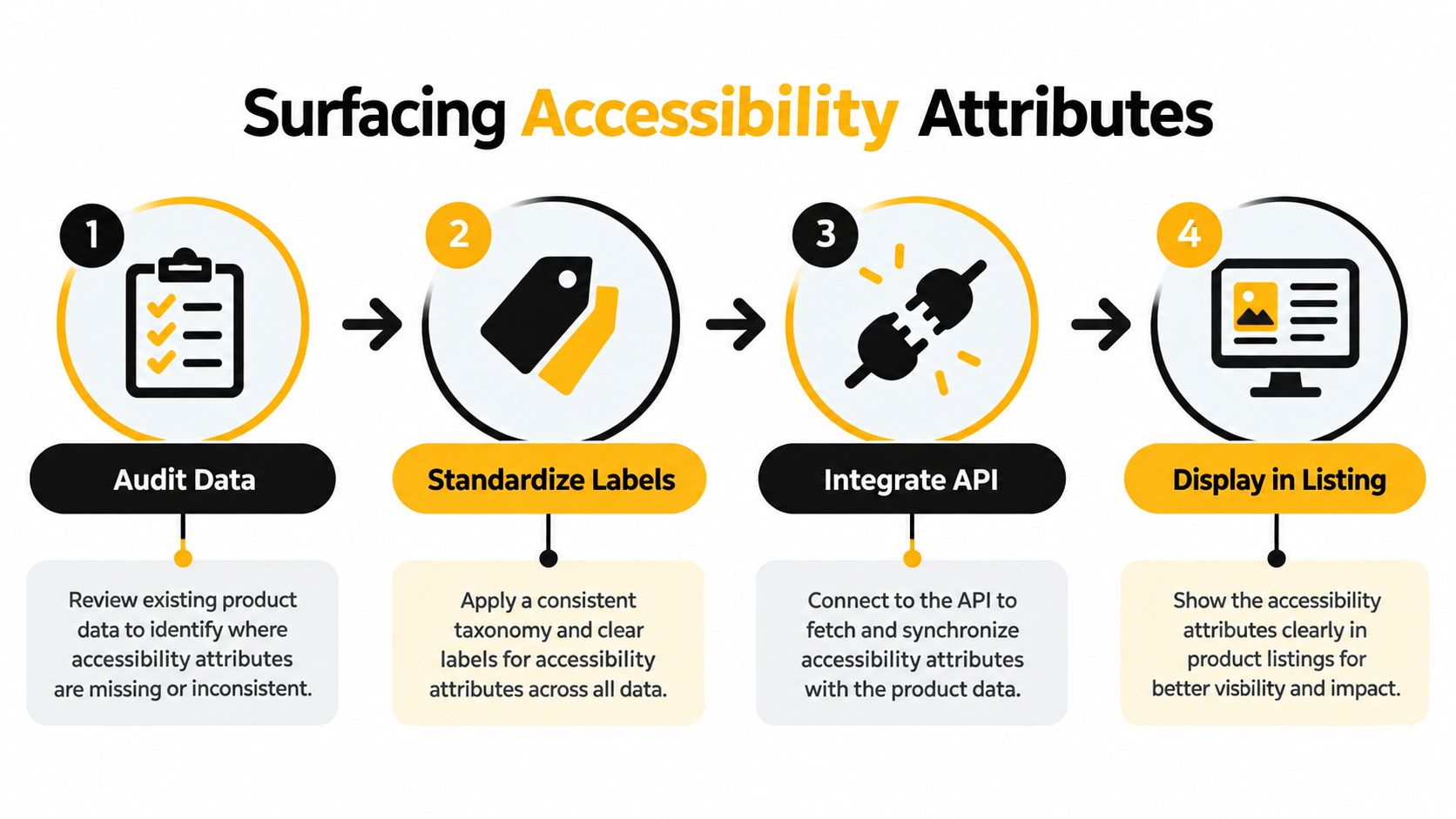
Accessibility attributes become useful business data only when developers can trace them from source record to user decision. A practical implementation follows the evidence through four stages: audit the inputs, standardize meanings, connect the schema to applications, and display verified details where people compare listings.
Start with a shared data model
Audit existing sources before changing the interface. Record which accessibility details are available, where they appear, and how providers label them. “No stairs,” “level access,” and “step-free entrance” may describe related features, but they should not become separate filter values without a defined relationship.
The taxonomy should preserve context rather than reduce every feature to a single badge. Capture Entry information such as step-free access, ramps, entrance width, and lifts. Movement can cover routes between floors, parking, and corridors. Facilities may include bathroom adaptations, kitchen access, bedroom layout, and emergency features. Digital content records text alternatives, captions, readable labels, and interaction states. Add Confidence values that distinguish verified, owner-provided, inferred, and unknown information.
That last distinction protects users and operators. Unknown does not mean inaccessible. Keeping missing and negative data separate prevents misleading filters and shows where a listing needs verification.
Make each field usable
Expose these attributes through stable API objects, consistent names, and definitions that developers can apply without interpreting free text. The RealtyAPI integrations documentation shows the kind of technical reference teams need when connecting property data with applications and services.
Display should follow the user's decision path. Search filters can narrow results, listing cards can surface confirmed features, and detail pages can provide context, provenance, and unresolved questions. This arrangement turns accessibility data into decision support instead of a decorative label.
Automated validation can identify missing labels, invalid values, and inconsistent formats. Human review still matters for descriptions and task flows, since a field may be technically present yet confusing. Teams can start with best practices before incorporating those checks into design and engineering workflows.
A reliable pipeline also records provenance, refreshes stale values, and exposes uncertainty in the interface. Developers can then measure which attributes support filtering, reduce clarification work, or improve enquiry quality. The result is a clearer connection between implementation choices and commercial performance.
This video offers another practical reference for teams turning accessibility requirements into implementation work:
The AI Advantage How Accessibility Improves Machine Readability
Accessibility can improve how efficiently machines interpret property data. Semantic headings expose hierarchy, descriptive labels identify controls, and alt text explains images. Structured fields separate a property's price, location, amenities, and access features, so an AI system can retrieve meaning without inferring it from visual placement or loosely written prose.
A 2026 POLITICO Europe-sponsored article cites research showing that accessible webpages, documents, and online transactions can reduce AI processing work by 70% to 99%, depending on the use case. The finding appears in the PLOS One research reference on cognitive accessibility and digital interaction. Real estate pages will not automatically reach the upper end of that range. The finding still establishes a useful commercial link: clearer content can reduce machine effort across AI search, automation, and agent workflows.
The practical test is whether an AI agent can answer a buyer's question without guessing. “Ground-floor access” should identify whether it applies to the building entrance, the unit, or a nearby facility. A confirmed amenity should remain distinct from a promotional suggestion. Consistent schemas, semantic markup, and explicit relationships reduce the ambiguity that produces extraction errors.
That clarity supports several operational uses:
- Recommendation: Match a user's stated requirements with specific property attributes.
- Extraction: Bring amenities and access details into comparison tools.
- Automation: Route relevant enquiries to the appropriate agent or workflow.
- Monitoring: Flag listings with incomplete or contradictory information.
Teams can examine searching Zillow by an AI prompt to see how natural-language intent can connect with real estate data. Teams shaping content for generative results can also consult understanding AI generated answers. Together, these applications create a measurable path from better data structure to faster retrieval, more relevant recommendations, and higher-quality enquiries.
The human payoff remains broad. A 2025 Forrester-based Microsoft study says more than 70% of the U.S. population stands to benefit from accessible technology, including people without disabilities, as summarized in coverage of data accessibility and its wider impact. A separate 2025 PLOS One study found that cognitive accessibility and low-vision features improved cognitive engagement for all users, while engagement declined over time when those enhancements were absent.
Design for people first, then expose the same meaning to machines through strong structure. A clear property description helps a buyer scan, an AI agent extract amenities, and a search engine assess relevance. The result is accessibility that supports reach, processing efficiency, and commercial performance rather than serving only as a compliance label.
Navigating Compliance While Building Better Experiences
Compliance establishes the floor for accessibility. Experience design determines whether people can find, understand, and act on property information. A real estate platform needs both because technical conformance can reduce legal risk, while usable content can improve discovery, comprehension, and enquiry quality.
In the United States, the Department of Justice web accessibility guidance explains that the Americans with Disabilities Act applies to state and local governments under Title II and to businesses open to the public under Title III. Those entities must make websites accessible to people with disabilities when providing full and equal enjoyment of goods and services.
For state and local governments, the DOJ final web-accessibility rule identifies Web Content Accessibility Guidelines 2.1 Level AA as the technical standard. Entities serving populations of 50,000 or more are scheduled to comply by April 26, 2027, according to the DOJ final rule.
Different jurisdictions, similar product lesson
The European Union uses a public-sector framework through the Web Accessibility Directive. The directive has been in force since December 22, 2016. It requires public-sector websites and mobile apps to become more accessible, with an accessibility statement, a user feedback mechanism, and regular monitoring supported by reporting every three years.
| Compliance-led approach | Experience-led approach |
|---|---|
| Fixes issues identified by a standard or audit | Designs around real user tasks |
| Often focuses on minimum conformance | Connects accessibility to search, comprehension, and enquiry quality |
| Treats accessibility as a release gate | Treats accessibility as a product capability |
| Can miss unclear content and poor workflows | Tests whether people can complete the journey |
A compliance baseline gives teams a defined starting point, but it does not guarantee a useful marketplace. A listing may meet technical requirements while leaving buyers unsure whether a property has a step-free bathroom or an accessible route between floors. Clearer attributes and better interaction design turn compliance work into a performance improvement, helping more users evaluate properties and giving search systems cleaner signals.
The practical choice is straightforward. Use regulations to set minimum requirements, then use user outcomes to decide where better information, interaction design, and data quality can create measurable value. That approach treats accessibility as a product capability with business impact, rather than a legal checkbox.
Building Your Accessibility Strategy for Maximum Impact
Accessibility produces measurable business value only when it is managed as a product capability with clear ownership. Assign one owner for the property taxonomy, one for listing-data quality, one for search and interface changes, and one for reporting. Record these responsibilities in the delivery plan so accessibility does not become an unassigned backlog.
Set a short initial cycle. During the first phase, the taxonomy owner should document every accessibility field, its source, permitted values, and confidence level. Separate “unknown” from “no”, because treating missing data as a negative result can hide suitable properties and weaken filter accuracy. The data-quality owner should then sample records from each feed and log the most common gaps.
A practical implementation sequence
First, establish the baseline. Choose one property category and one high-volume search journey. Document the current filters, labels, keyboard path, contrast issues, dynamic components, and enquiry steps. The product manager should approve the scope, while engineering records the fields that can be populated reliably.
Next, improve discovery. Ship the three filters most closely connected to user requests and available inventory, such as step-free access, accessible bathrooms, and lift access where those attributes exist in the data. The search owner should test filter labels with users and define what each term includes. Listing pages should show the same attributes in plain language, rather than forcing visitors to interpret icons.
Then, enrich and validate. Give listing contributors a structured form with controlled values and a way to mark an attribute as unknown. The content or operations owner should review uncertain submissions on a fixed schedule. Automated checks can identify missing fields and inconsistent values, while human review should handle descriptions that require context.
Finally, connect the data to machine workflows. The engineering owner should document API fields, maintain consistent property names across feeds, and test semantic headings, form labels, and descriptive alternatives. Search tools and AI agents should receive the same confirmed information presented to users. Track extraction errors and manual corrections rather than assuming machine readability has improved.
Measure the path from filter to enquiry
Create one dashboard owned by product analytics. Track filter use, result availability, listing views, detail-page engagement, enquiry starts, enquiry completion, and support requests. The key diagnostic is the conversion path from an accessibility filter to a qualified enquiry. A high filter-use rate with few suitable results points to inventory or taxonomy gaps. Strong result engagement with low enquiry completion points to missing details, unclear wording, or friction in the form.
Compare records with confirmed structured attributes against records without them, while separating property type, traffic source, and audience intent. Review the dashboard after each release cycle and assign an owner to every unresolved gap.
Practical rule: measure whether people can identify suitable properties, verify relevant details, and submit an enquiry with less uncertainty. Issue counts belong in quality assurance, but they are not the outcome.
A disciplined operating model turns accessibility work into a repeatable improvement process. The strongest teams can show which fields were added, who maintains them, which search behaviours changed, and whether those changes produced better-qualified enquiries.
RealtyAPI.io provides a unified real estate data layer with listing details, amenities, availability, and accessibility attributes through developer-friendly APIs. Visit RealtyAPI.io to explore the data and integrations you can use to build clearer, more inclusive property search experiences.